
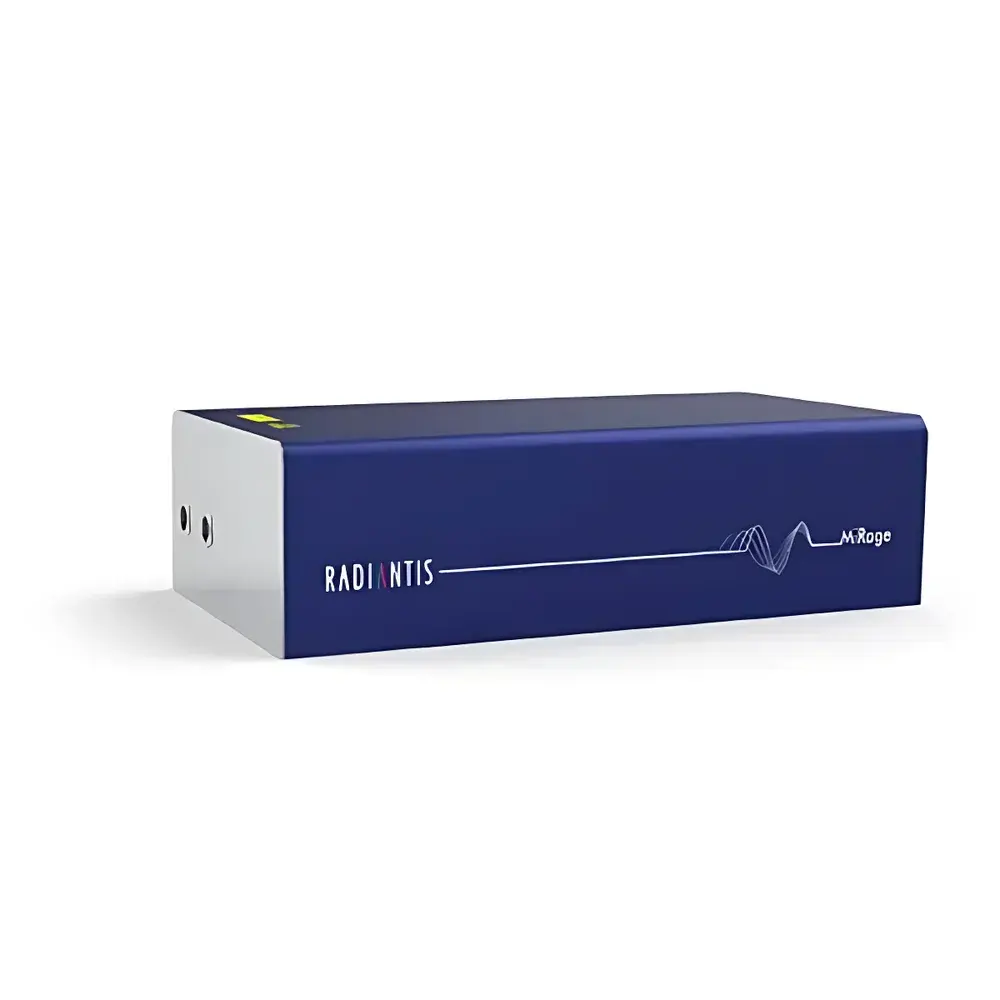
Radiantis MIRage Integrated OPO-Based Mid-Infrared Femtosecond Laser System
| Brand | Radiantis |
|---|---|
| Model | MIRage |
| Type | Optical Parametric Oscillator (OPO)-Based Tunable Mid-IR Laser System |
| Tuning Range | Signal: 1270–1290 nm |
| Idler | 6000–7000 nm |
| Output Power | Signal > 450 mW, Idler > 100 mW |
| Pulse Width | < 200 fs (both signal and idler) |
| Beam Mode | TEM₀₀ |
| Beam Diameter | 3 mm ±10% |
| Power Stability | < 5% RMS |
| Noise | < 1% RMS |
| Dimensions (W × L × H) | 652 × 320 × 150 mm |
| Output Ports | Dual synchronized outputs (signal + idler) |
Overview
The Radiantis MIRage is a fully integrated, turnkey optical parametric oscillator (OPO)-based femtosecond laser system engineered for high-stability mid-infrared (mid-IR) spectroscopy and ultrafast science applications. Unlike conventional laser sources relying on stimulated emission, the MIRage leverages non-linear optical parametric amplification in a temperature-stabilized, periodically poled crystal to generate coherent radiation across spectral regions inaccessible to standard solid-state or fiber lasers. Its core architecture enables simultaneous, synchronized output of two spectrally distinct beams—signal and idler—derived from pump photon energy division, satisfying stringent phase-matching conditions. The system delivers tunable output from 1270–1290 nm (near-IR signal band) and 6000–7000 nm (mid-IR idler band), covering critical molecular fingerprint regions essential for gas-phase spectroscopy, vibrational dynamics studies, and nonlinear optical frequency conversion. Engineered for laboratory-grade reliability, the MIRage operates within a hermetically sealed, vibration-damped enclosure with active thermal management, eliminating manual realignment and minimizing environmental sensitivity.
Key Features
- Fully automated, software-controlled wavelength tuning across both signal (1270–1290 nm) and idler (6000–7000 nm) bands—no mechanical optic replacement required.
- Dual-output architecture delivering synchronized femtosecond pulses: >450 mW signal power and >100 mW idler power, both with pulse durations <200 fs (measured at 1205 nm).
- Dynamic dispersion compensation module enabling independent pulse duration optimization across the full tuning range—critical for time-resolved pump-probe experiments.
- TEM00 spatial mode with beam pointing stability <10 µrad over 8 hours and beam diameter maintained at 3 mm ±10%, ensuring compatibility with downstream optics and interferometric setups.
- Hermetically sealed, maintenance-free chassis (652 × 320 × 150 mm) featuring three configurable output port configurations: (1) 100% signal + idler (no pump bypass), (2) partial signal/idler with 20% pump bypass, and (3) 100% pump bypass for hybrid excitation schemes.
- Integrated real-time power monitoring and feedback control, achieving <5% RMS power stability and <1% RMS intensity noise—meeting requirements for quantitative absorption and heterodyne detection.
Sample Compatibility & Compliance
The MIRage is designed for integration into ISO/IEC 17025-accredited analytical laboratories and research facilities operating under GLP or GMP frameworks. Its stable, narrow-linewidth mid-IR output supports compliance with ASTM E1421 (standard practice for FTIR microscopy), ISO 13485 (medical device testing), and USP (spectroscopic identification). The system’s low temporal jitter (<50 fs RMS) and high pulse-to-pulse reproducibility enable reliable use in time-of-flight mass spectrometry coupling, cavity-enhanced absorption spectroscopy (CEAS), and dual-comb spectroscopy platforms. All electrical interfaces conform to IEC 61000-6-3 (EMC emissions) and IEC 61000-6-2 (immunity), while laser safety complies with IEC 60825-1:2014 Class 4 specifications. Optional interlock integration supports 21 CFR Part 11-compliant audit trails when paired with validated third-party data acquisition software.
Software & Data Management
The MIRage is operated via Radiantis’ proprietary MIRage Control Suite—a Windows-based application offering GUI-driven wavelength selection, pulse width adjustment, output port routing, and real-time power logging. The suite includes a comprehensive API (C++, Python, MATLAB) supporting remote triggering, synchronization with external delay generators (e.g., SRS DG645), and timestamped metadata embedding (wavelength, power, pulse width, ambient temperature). All operational parameters are stored in HDF5-formatted logs compliant with FAIR (Findable, Accessible, Interoperable, Reusable) data principles. For regulated environments, optional validation packages provide IQ/OQ documentation, electronic signature support, and change control records aligned with Annex 11 and ALCOA+ data integrity standards.
Applications
- Ultrafast vibrational spectroscopy: Time-resolved IR pump-probe studies of protein folding, polymer relaxation, and catalytic surface reactions.
- Gas-phase trace detection: High-sensitivity photoacoustic or quartz-enhanced photoacoustic spectroscopy (QEPAS) targeting greenhouse gases (CH4, N2O), toxic industrial chemicals (TICs), and isotopic species (e.g., 13CO2).
- Nonlinear optical metrology: Difference-frequency generation (DFG) seeding, mid-IR supercontinuum generation, and electro-optic sampling in semiconductor characterization.
- Biomedical imaging: Coherent anti-Stokes Raman scattering (CARS) and stimulated Raman scattering (SRS) microscopy exploiting C–H, N–H, and O–H vibrational resonances.
- Quantum optics: Generation of entangled photon pairs via spontaneous parametric down-conversion (SPDC) in the mid-IR for quantum sensing and long-wavelength quantum communication protocols.
FAQ
What is the fundamental gain mechanism in the MIRage OPO system?
The MIRage relies on optical parametric oscillation in a non-linear crystal (e.g., MgO:PPLN), where pump photons are converted into signal and idler photons via second-order χ⁽²⁾ non-linearity—distinct from population inversion-based gain.
Does the system require periodic realignment or crystal replacement during operation?
No. The MIRage features a factory-aligned, hermetically sealed OPO cavity with active thermal stabilization—enabling continuous operation without user intervention for >12 months.
Can the signal and idler outputs be used simultaneously in independent experiments?
Yes. Both beams are spatially separated, polarization-maintained, and temporally synchronized with sub-100-fs jitter—supporting parallel detection schemes or multi-beam interferometry.
Is the MIRage compatible with vacuum-compatible beamlines or ultra-high vacuum (UHV) endstations?
The base unit is air-cooled and not UHV-rated; however, fiber-coupled or free-space output modules with CF-flanged vacuum feedthroughs are available as custom configurations.
What level of technical support and calibration services does Radiantis provide?
Radiantis offers on-site installation, annual performance verification (including spectral purity, pulse duration, and power calibration traceable to NIST standards), and extended warranty options with SLA-backed response times.






