
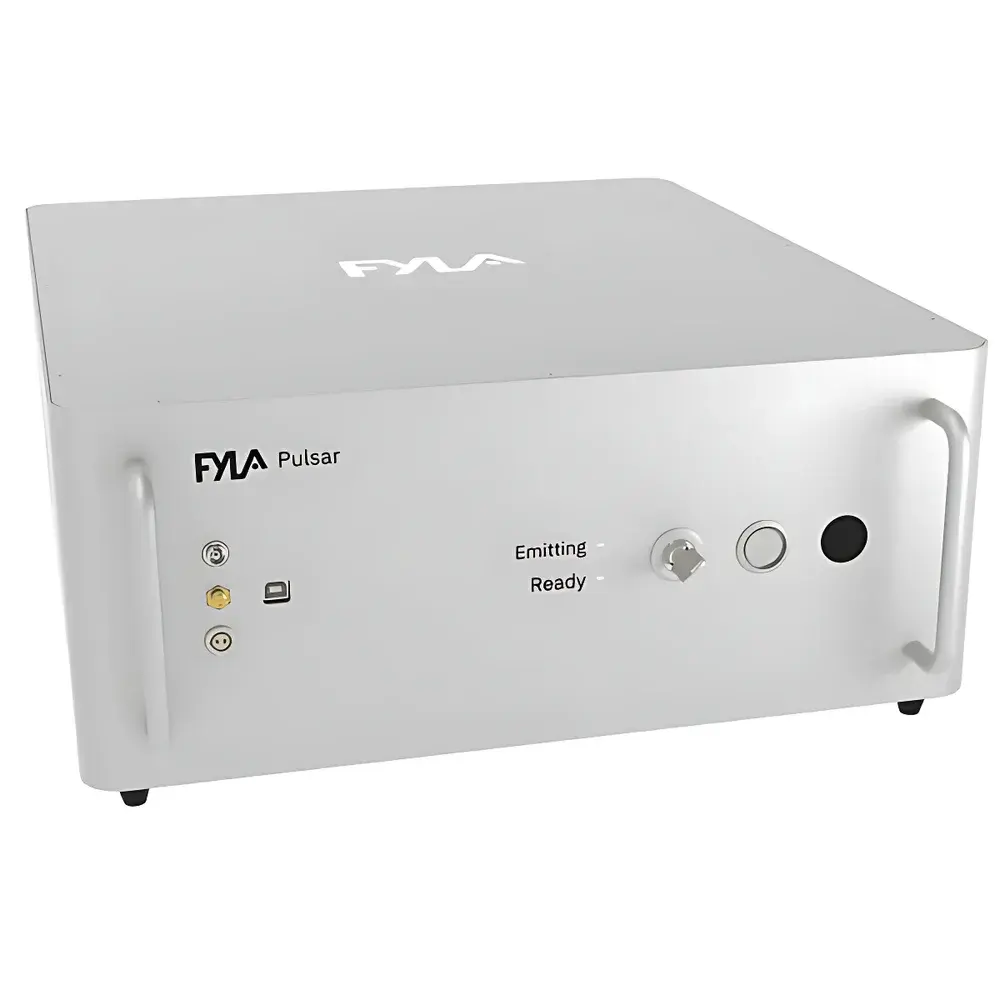
Auniontech Pulsar 1560 nm Tunable Femtosecond Fiber Laser
| Brand | Auniontech |
|---|---|
| Model | Pulsar |
| Wavelength | 1560 nm |
| Pulse Width | 120 fs (fixed base), 200–600 fs (tunable) |
| Repetition Rate | Single-shot to 10 MHz (tunable) |
| Pulse Energy | 10 nJ to 10 µJ (tunable) |
| Average Power | ≤100 mW (calculated from max energy × max rep rate) |
| Power Stability | <1% RMS (over 8 h) |
| Output | Free-space collimated beam |
| Input Power | 110–220 V AC, 50/60 Hz |
| Operating Temperature | 20–30 °C |
| Storage Temperature | 0–60 °C |
| Compliance | CE, RoHS |
Overview
The Auniontech Pulsar 1560 nm Tunable Femtosecond Fiber Laser is a fully integrated, turnkey ultrafast laser system engineered for precision control of temporal pulse characteristics in nonlinear optical experiments. Based on mode-locked erbium-doped fiber oscillator-amplifier architecture, the Pulsar generates transform-limited pulses centered at 1560 nm—a wavelength strategically positioned in the eye-safe, low-dispersion region of standard single-mode fiber and highly transmissive through biological tissue and many infrared-transparent materials. Its core functionality lies in independent, real-time adjustment of three orthogonal pulse parameters: repetition rate (from single-shot triggering to 10 MHz), pulse energy (10 nJ to 10 µJ), and pulse duration (200–600 fs, with a base configuration delivering sub-120 fs pulses). This decoupled tunability enables rigorous experimental design across pump-probe spectroscopy, multiphoton excitation, and time-resolved photonic characterization—without requiring external compressors, attenuators, or pulse pickers.
Key Features
- Three-parameter independent tuning: repetition rate, pulse energy, and pulse width—each adjustable without compromising beam pointing stability or spatial mode quality (M² < 1.1)
- Integrated pulse shaping capability via spectral phase and amplitude monitoring, supporting empirical optimization of pulse fidelity for specific nonlinear interactions
- Low timing jitter (<50 fs RMS, 10 kHz–10 MHz bandwidth) and high amplitude stability (<1% RMS over 8 hours), essential for lock-in detection and long-duration acquisition protocols
- Free-space output with collimated, polarization-maintained beam (extinction ratio >20 dB), enabling direct coupling into microscope scan heads or interferometric setups
- Industrial-grade thermal management and vibration-isolated optical bench design ensure operational robustness in shared laboratory environments
- Compliance with IEC 60825-1:2014 (Class 4 laser product) and full CE marking for electromagnetic compatibility (EMC Directive 2014/30/EU) and safety (LVD Directive 2014/35/EU)
Sample Compatibility & Compliance
The 1560 nm emission wavelength exhibits minimal linear absorption in water, lipids, and common polymer substrates—making the Pulsar particularly suitable for deep-tissue two-photon microscopy and non-destructive evaluation of optically thick samples. Its pulse energy range supports both low-fluence photoactivation (e.g., optogenetics with red-shifted opsins) and high-intensity nonlinear processes such as third-harmonic generation in crystalline materials. The system conforms to ISO 13485–aligned manufacturing practices for medical research instrumentation and meets key requirements for GLP-compliant laboratories, including hardware-enforced interlock circuits, audit-trail-capable system logging, and user-access-level configuration controls aligned with FDA 21 CFR Part 11 principles for electronic records.
Software & Data Management
The Pulsar is operated via Auniontech’s LaserControl Suite—a Windows-based application providing synchronized GUI access to all tunable parameters, real-time power monitoring, and automated calibration routines. The software supports scripting via Python API (PyLaserCtrl), enabling integration into custom acquisition pipelines (e.g., with NI LabVIEW, MATLAB, or MicroManager). All parameter changes are timestamped and logged locally with SHA-256 checksum integrity verification. Export formats include CSV (for pulse train metadata), HDF5 (for time-stamped energy/stability datasets), and XML (for instrument configuration snapshots)—facilitating traceability in regulated research environments and reproducibility reporting per FAIR data principles.
Applications
- Two-photon and three-photon fluorescence microscopy (TPM/3PM) in neuroscience and developmental biology, leveraging 1560 nm’s extended penetration depth in scattering tissue
- Transient absorption and pump-probe spectroscopy of charge carrier dynamics in perovskite photovoltaics and 2D transition metal dichalcogenides
- Time-resolved terahertz generation and electro-optic sampling in solid-state physics laboratories
- Nonlinear frequency conversion (e.g., DFG, OPA) for mid-IR spectroscopy spanning 3–12 µm
- Ultrafast laser micromachining of transparent dielectrics (fused silica, sapphire) with minimized heat-affected zones
- Calibration source for autocorrelators, FROG devices, and single-shot pulse measurement systems
FAQ
Is the Pulsar compatible with commercial multiphoton microscope platforms?
Yes—the free-space output is designed for OEM integration with scan units from Nikon, Zeiss, and Bruker; alignment fixtures and beam-height adapters are available upon request.
Can pulse duration be measured in situ without external equipment?
The system includes an integrated spectral interferometer option (Pulsar-SI) for real-time, single-shot pulse characterization; standard configuration requires external FROG or SPIDER for full temporal reconstruction.
What cooling method does the laser employ?
Passive conduction cooling supplemented by thermostatically controlled forced-air circulation; no external chiller or liquid cooling is required.
Does the laser support external TTL triggering at arbitrary repetition rates?
Yes—sync input accepts TTL-compatible signals from 0.1 Hz to 10 MHz, enabling synchronization with delay generators, camera shutters, or scanning galvanometers.
Is remote operation supported over Ethernet or USB?
Full bidirectional communication is implemented over USB 2.0 and optional Gigabit Ethernet (TCP/IP); firmware updates and diagnostic logs can be retrieved remotely under authenticated session control.





