
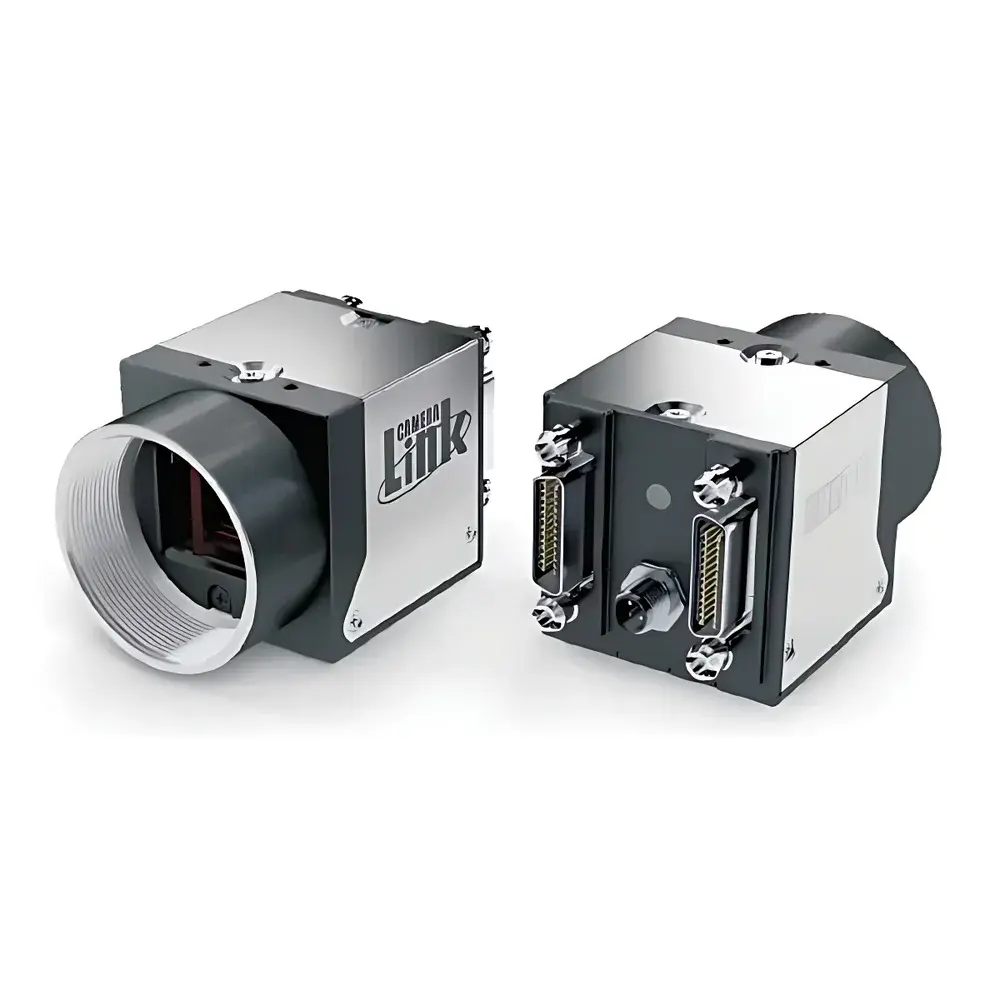
Auniontech CREVIS Polarization Camera
| Brand | Auniontech |
|---|---|
| Model | CREVIS |
| Sensor | Sony CMOS (2/3″, 2464 × 2056) |
| Interface | Camera Link Full |
| Frame Rate | 163 fps (full resolution) |
| Pixel Size | 3.45 µm × 3.45 µm |
| Output Formats | Intensity (S₀), Degree of Linear Polarization (DoLP), Angle of Polarization (AoP), and four linear polarization states (0°, 45°, 90°, 135°) |
| Pixel Format | Mono8/10, Bayer8/10, RGB8Polarization, RGB8Degree |
| ADC | 8/10-bit |
| Analog Gain | 0–24 dB (1×–15.8×), Digital Gain: 0–18 dB (1×–8×) |
| Shutter Mode | Global |
| Sync | Internal, External, or via Frame Grabber |
| Lens Mount | C-mount |
| Power | 12–24 VDC ±10% or PoCL |
| Power Consumption | 2.2 W |
| Dimensions | 29 × 29 × 29 mm |
| Weight | < 50 g |
| Operating Temperature | 0–40 °C |
| Storage Temperature | −5–45 °C (20–80% RH) |
Overview
The Auniontech CREVIS Polarization Camera is a high-performance, compact industrial imaging system engineered for quantitative polarimetric analysis in demanding real-time applications. Built around a Sony 2/3″ CMOS sensor with native 2464 × 2056 resolution and global shutter architecture, it captures synchronized, on-sensor polarization-resolved data across four linear orientation channels (0°, 45°, 90°, and 135°) at up to 163 frames per second. Unlike conventional intensity-only cameras, the CREVIS integrates a micro-patterned polarization filter array directly onto the sensor surface—enabling simultaneous acquisition of Stokes parameter S₀ (intensity), DoLP (Degree of Linear Polarization), and AoP (Angle of Polarization) without mechanical moving parts or external optics. This design eliminates motion artifacts, ensures pixel-level registration fidelity, and supports robust, repeatable measurements under dynamic conditions. Its physics-based contrast enhancement mechanism—rooted in Mueller matrix formalism—suppresses specular reflections, enhances edge definition in low-contrast scenes, and improves target visibility through scattering media such as fog, smoke, or turbid biological tissue.
Key Features
- On-chip polarization filtering with fixed 4-directional micropolarizer array (0°/45°/90°/135°), enabling single-shot full-Stokes acquisition
- Native 2464 × 2056 resolution at 163 fps via Camera Link Full interface; supports lossless streaming with precise timing control
- Embedded real-time polarization processing firmware delivering calibrated DoLP, AoP, and intensity outputs in parallel
- Power-over-Camera-Link (PoCL) compatibility for simplified cabling and reduced EMI in industrial machine vision setups
- C-mount lens interface with mechanical stability optimized for precision metrology and automated optical inspection (AOI)
- Low thermal drift design (< 50 g mass, passive cooling) suitable for embedded integration in UAVs, robotic arms, and space-constrained enclosures
- Configurable analog/digital gain (0–24 dB / 0–18 dB), programmable exposure, and defect correction algorithms compliant with industrial image quality standards
Sample Compatibility & Compliance
The CREVIS camera operates across visible wavelengths (400–700 nm) and is compatible with standard C-mount lenses featuring f/# ≥ 2.8 to maintain polarization fidelity. It meets IEC 60950-1 safety requirements and conforms to CE marking directives for electromagnetic compatibility (EMC) and low-voltage operation. While not certified for medical device use, its output data structure aligns with ASTM E2912–22 guidelines for polarization-based material characterization. The camera’s deterministic latency (< 1.2 ms from trigger to first pixel) and hardware-triggered synchronization support time-critical applications requiring traceable measurement intervals, including those governed by ISO/IEC 17025-accredited laboratories conducting GLP-compliant optical testing.
Software & Data Management
Auniontech provides a cross-platform SDK (Windows/Linux/macOS) supporting GenICam-compliant configuration and image acquisition. Raw polarization frames are delivered in standard GenTL buffers with metadata tags identifying polarization state, exposure timestamp, and sensor temperature. Post-processing tools enable batch computation of Stokes vectors, retardance maps, and surface normal estimation using established Mueller calculus pipelines. Export formats include TIFF (with embedded EXIF polarization tags), HDF5 (for multi-dimensional time-series datasets), and CSV (for statistical process control integration). Audit trail functionality—including user-access logs, parameter change history, and firmware version tracking—is available when deployed with optional logging middleware compliant with FDA 21 CFR Part 11 requirements.
Applications
- Industrial Inspection: Detection of subsurface defects, stress-induced birefringence in tempered glass, and coating uniformity verification in semiconductor wafer handling
- Autonomous Systems: All-weather perception enhancement for ADAS and UAV navigation under glare, haze, or rain-scattered illumination
- Biomedical Imaging: Label-free visualization of collagen fiber alignment in ex vivo tissue sections and corneal stromal anisotropy mapping
- Astronomy & Remote Sensing: Solar corona observation, planetary surface mineralogy classification, and atmospheric aerosol profiling
- 3D Metrology: Polarization-assisted shape-from-shading reconstruction and specular-free surface normal estimation for high-precision reverse engineering
FAQ
Does the CREVIS camera require external calibration for polarization accuracy?
No—factory calibration of polarization crosstalk and responsivity non-uniformity is performed per unit and stored in onboard EEPROM. Users may perform optional field recalibration using a NIST-traceable linear polarizer and uniform light source.
Can the camera operate in environments with strong EMI, such as near motor drives or RF transmitters?
Yes—the aluminum alloy housing provides >60 dB shielding effectiveness above 30 MHz, and the Camera Link interface includes differential signaling compliant with ANSI/TIA/EIA-644-A.
Is real-time AoP/DoLP computation performed on-device or offloaded to host PC?
All polarization calculations—including demosaicing, Stokes vector derivation, and noise-weighted AoP unwrapping—are executed in FPGA firmware with sub-frame latency.
What is the maximum cable length supported for Camera Link Full configuration?
Up to 10 meters using Category 6A shielded twisted-pair cables; longer distances require repeaters or fiber-optic Camera Link extenders.
Are software development licenses required for commercial deployment?
No—Auniontech grants royalty-free redistribution rights for OEM integrators embedding the SDK into validated end-user applications.



