
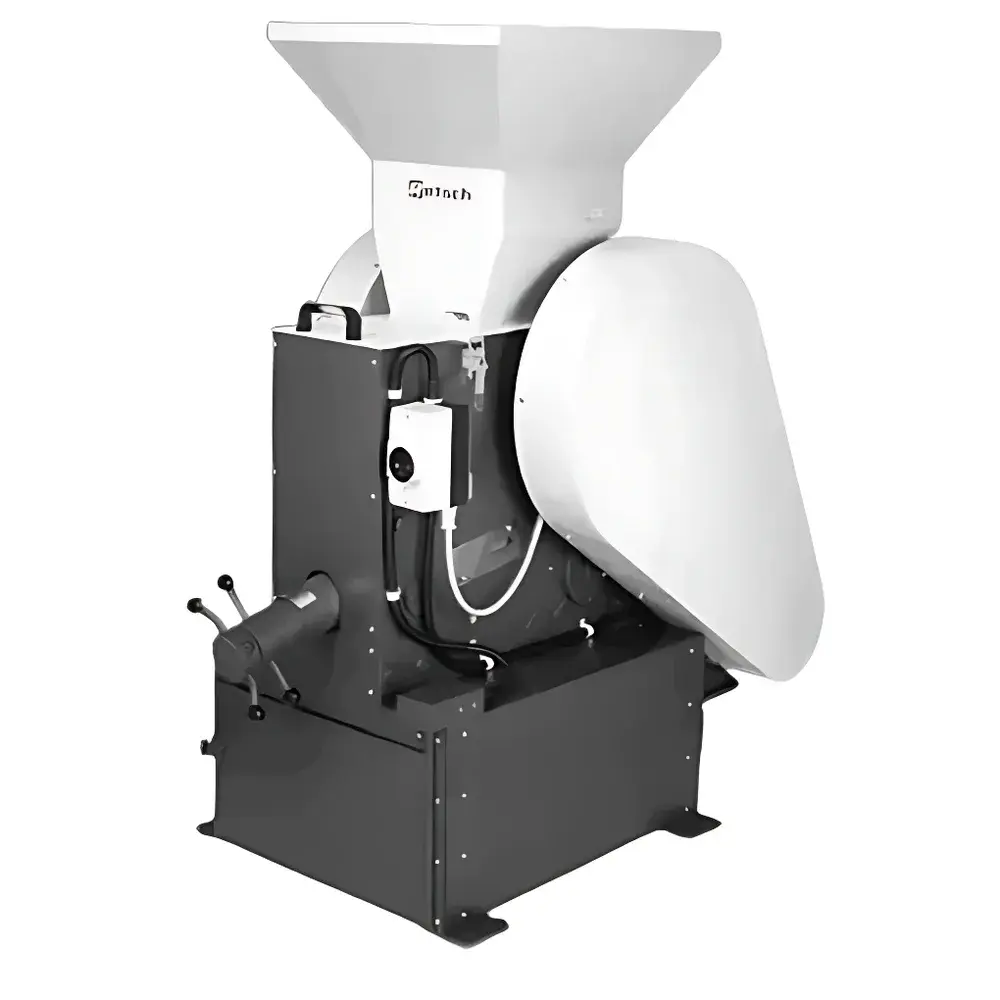
RETSCH BB 300 Jaw Crusher
| Brand | RETSCH |
|---|---|
| Origin | Germany |
| Model | BB 300 |
| Instrument Type | Jaw Crusher |
| Sample Applicability | Hard and Brittle Materials |
| Maximum Feed Size | < 130 mm |
| Final Particle Size | < 5 mm |
| Drive | Belt-driven Eccentric Shaft with Brake Motor |
| Overload Protection | Integrated Belleville Spring Washers |
| Safety Features | Interlocked Hopper with Splash Guard, Safety Switch, Automatic Motor Stop on Lid Opening |
| Chamber Accessibility | Hinged Hopper for Rapid Cleaning |
| Optional Configurations | Heavy-Metal-Free Version (Plastic-Lined Hopper + Tungsten Carbide Crushing Plates), Semiconductor-Grade Version, Continuous-Feed Production Line Variant |
Overview
The RETSCH BB 300 Jaw Crusher is an industrial-grade, benchtop primary size reduction instrument engineered for reproducible, controlled comminution of hard, brittle, and abrasive solid materials. Operating on the principle of compressive crushing—where material is fed between two opposing jaws (one fixed, one movable) and subjected to high mechanical stress—the BB 300 delivers consistent particle size reduction through regulated gap control and robust kinematic design. Its core architecture adheres to DIN EN ISO 17025-compliant mechanical integrity standards and supports GLP/GMP-aligned laboratory workflows where traceability, repeatability, and contamination control are critical. Designed and manufactured in Haan, Germany, the BB 300 integrates precision-machined components, including a hardened eccentric shaft, V-belt transmission with flywheel effect, and dynamically balanced braking motor—ensuring stable operation at nominal speeds without vibration-induced measurement drift or sample segregation.
Key Features
- Continuous jaw gap adjustment with zero-point recalibration: Enables real-time compensation for jaw plate wear while the unit is running, preserving set final particle size distribution over extended operational cycles.
- Interlocked feed hopper with splash guard and safety switch: Prevents operator access during operation; automatically de-energizes the brake motor upon lid opening per IEC 61000-6-2 and EN 60204-1 requirements.
- Hinged hopper design: Allows rapid disassembly and full access to the crushing chamber for residue-free cleaning—critical for cross-contamination-sensitive applications such as geochemical assay or semiconductor precursor processing.
- Overload protection via integrated Belleville spring washers: Absorbs transient shock loads from oversized or heterogeneous feed material, extending service life of drive components and maintaining torque stability.
- Five jaw plate material options: Manganese steel (standard), stainless steel (corrosion resistance), tungsten carbide (ultra-high wear resistance), heavy-metal-free steel (for trace metal analysis), and custom ceramic-composite variants—each certified for specific regulatory environments (e.g., USP , EPA Method 6010D).
Sample Compatibility & Compliance
The BB 300 accepts feed particles up to 130 mm in maximum dimension and reduces them to a nominal top size of < 5 mm—ideal for preparing representative subsamples prior to downstream analytical techniques (e.g., XRF, ICP-OES, XRD). It is validated for use with construction aggregates (concrete, asphalt, slag), geological specimens (granite, quartz, basalt), industrial ceramics (alumina, zirconia), energy materials (coal, coke, biomass pellets), and refractory metals (tungsten alloys, cement clinker). All configurations comply with EU Machinery Directive 2006/42/EC and carry CE marking. The heavy-metal-free version meets ASTM D5686–22 specifications for low-background mineral digestion, while the semiconductor-grade variant—featuring PTFE-lined hopper, tungsten carbide jaws, and non-metallic collection trays—is qualified for Si, GaAs, and SiC wafer scrap processing under ISO 14644-1 Class 5 cleanroom protocols.
Software & Data Management
While the BB 300 operates as a stand-alone electromechanical device without embedded firmware or digital interface, its mechanical design supports full auditability within regulated environments. All manual adjustments—including jaw gap setting, zero-point calibration, and maintenance logs—are documented in user-maintained logbooks compliant with FDA 21 CFR Part 11 Annex 11 requirements when paired with validated electronic record systems. Optional integration with LIMS via external PLC-triggered I/O signals enables batch-level metadata capture (e.g., timestamp, operator ID, feed mass, cycle count) for QC traceability in pharmaceutical raw material testing or mining QA/QC laboratories.
Applications
The BB 300 serves as a primary crusher in multi-stage sample preparation workflows across geosciences, metallurgy, building materials testing, and environmental monitoring. Typical use cases include: reducing drill core segments to < 5 mm for homogenization prior to riffle splitting; crushing sintered ceramic blanks before laser ablation target preparation; size-reducing coal lumps for proximate and ultimate analysis per ASTM D3172–21; and pre-crushing spent catalysts or battery cathode scrap for hydrometallurgical leaching studies. In production settings, the line-integrated BB 300 variant feeds continuous belt conveyors for real-time quality surveillance of clinker fineness in cement manufacturing—aligned with EN 196-1 and ISO 679 test method prerequisites.
FAQ
What is the maximum throughput capacity per batch?
The BB 300 handles up to 35 L (approx. 5–8 kg depending on material density) per batch. For continuous operation, throughput is governed by feed rate consistency and downstream conveying capacity—not by the crusher’s internal duty cycle.
Can the BB 300 be used for cryogenic or moisture-sensitive samples?
No—it is not designed for sub-ambient operation or sealed inert-atmosphere crushing. Samples must be dry and thermally stable below 80 °C.
Is routine calibration required?
Jaw gap calibration is performed manually using the zero-point adjustment procedure described in the operating manual; no external calibration standard or metrology lab certification is mandated, though internal verification against NIST-traceable gauge blocks is recommended annually.
How often do jaw plates require replacement?
Service life varies significantly by material abrasivity and daily load: manganese steel plates last ~200–400 operating hours on granite; tungsten carbide plates exceed 1,200 hours under identical conditions.
Does RETSCH provide validation documentation for GMP environments?
Yes—Installation Qualification (IQ) and Operational Qualification (OQ) templates are available upon request, supporting compliance with EU GMP Annex 15 and PIC/S TR 13 guidelines for laboratory equipment qualification.



