
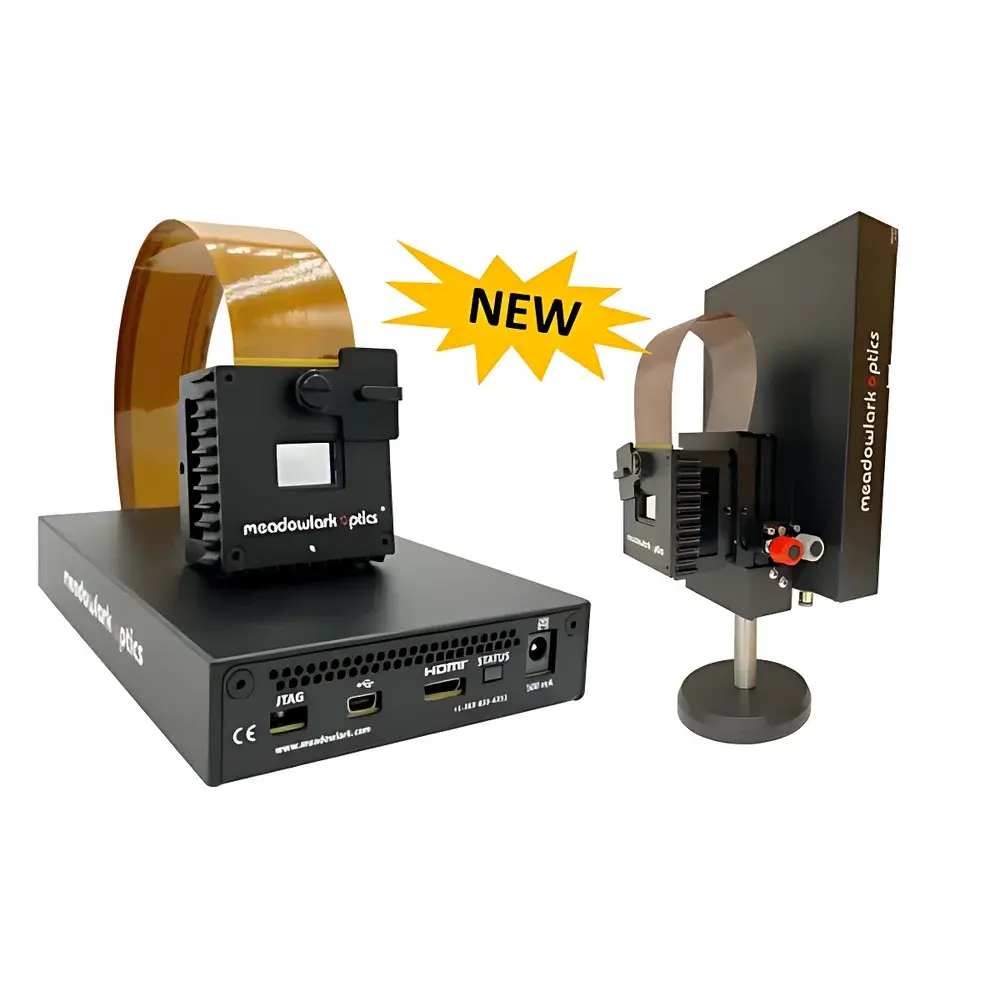
Meadowlark Optics E19x12 Series High-Stability Pure-Phase Liquid Crystal Spatial Light Modulator
| Brand | Meadowlark Optics |
|---|---|
| Model | E19x12 Series |
| Resolution | 1920 × 1200 |
| Pixel Pitch | 8.0 × 8.0 µm |
| Fill Factor | 95.6% |
| Phase Stability | ≤0.025% (RMS, over time) |
| Phase Modulation Depth | Up to 7–8π @ selected wavelength |
| Zero-Order Diffraction Efficiency | 80–91% |
| Response Time | ≤14.0 ms @ 532 nm |
| Frame Rate | 60 Hz (16.7 ms latency) |
| Gray Levels | 256 (8-bit) |
| Analog Addressing Precision | 12-bit (4096 levels) |
| Active Area | 15.36 × 9.60 mm |
| Wavelength Options | 400–700 nm, 500–1200 nm, or 850–1650 nm |
| Calibrated Wavefront Distortion (RMS) | ≤λc/12 |
Overview
The Meadowlark Optics E19x12 Series is a high-performance, pure-phase liquid crystal spatial light modulator (LC-SLM) engineered for precision wavefront control in demanding optical research and industrial applications. Operating on the principle of electrically controlled birefringence in nematic liquid crystal layers, the device enables pixel-level, analog-addressed phase modulation without significant amplitude coupling—critical for coherent beam shaping, holographic reconstruction, and adaptive optics. Its core innovation lies in an optimized backplane architecture that minimizes thermal drift and voltage-induced temporal fluctuations, achieving measured phase stability of ≤0.025% RMS over extended operation—among the highest reported for commercially available analog-addressed LC-SLMs. With a native resolution of 1920 × 1200 pixels across a 15.36 × 9.60 mm active area and a fill factor of 95.6%, the E19x12 delivers exceptional spatial sampling fidelity and high diffraction efficiency (80–91% in zero-order), making it suitable for quantitative interferometry, closed-loop wavefront correction, and multi-plane holography.
Key Features
- Pure-phase modulation architecture with negligible amplitude modulation (<0.5% intensity variation across full phase range)
- Ultra-low phase instability: ≤0.025% RMS over >1 hour under stabilized temperature and drive conditions
- Analog voltage addressing with 12-bit precision (4096 discrete voltage levels), enabling highly linear gray-to-phase response
- High optical throughput: 95.6% fill factor and anti-reflection coated optics minimize scattering and maximize usable diffraction efficiency
- Multi-wavelength compatibility via configurable alignment and calibration—supporting three standard spectral bands (400–700 nm, 500–1200 nm, 850–1650 nm)
- Calibrated wavefront accuracy: ≤λc/12 RMS (where λc is the design wavelength), verified via interferometric characterization
- Low-latency interface: Full-frame update in 16.7 ms at 60 Hz, synchronized to external triggers via TTL input
Sample Compatibility & Compliance
The E19x12 SLM is designed for integration into Class 1 and Class 3R laser systems compliant with IEC 60825-1:2014 and ANSI Z136.1-2022 standards. Its reflective configuration supports collimated or moderately focused beams (minimum spot size ≥50 µm) and accommodates both free-space and fiber-coupled inputs. The device meets RoHS Directive 2011/65/EU and REACH Regulation (EC) No. 1907/2006 requirements. While not certified for medical devices per ISO 13485, its performance repeatability and traceable calibration support GLP-compliant experimental workflows in photonics R&D labs. All factory calibration data—including pixel-wise phase maps, voltage-response curves, and thermal drift profiles—are provided in standardized HDF5 format for auditability.
Software & Data Management
Meadowlark Optics provides the proprietary SLM Control Suite v4.x—a cross-platform application (Windows/macOS/Linux) supporting real-time phase pattern generation, GPU-accelerated hologram calculation (Gerchberg-Saxton, direct binary search), and hardware-synchronized acquisition. The SDK includes C++, Python, and MATLAB APIs with full documentation and example scripts for integration with LabVIEW, Python-based imaging pipelines (e.g., MicroManager, PycroManager), and FPGA-controlled timing systems. All generated phase masks are stored with embedded metadata (wavelength, calibration timestamp, SLM serial number, user-defined experiment ID), satisfying basic FDA 21 CFR Part 11 audit-trail requirements for non-clinical research environments. Export formats include TIFF (16-bit signed), binary RAW, and industry-standard H5.
Applications
- Laser beam shaping: Generation of Bessel, Airy, or vortex beams for structured illumination microscopy and optical trapping
- Holographic optical tweezers: Simultaneous manipulation of multiple micro-particles with sub-nanometer positional stability
- Adaptive optics in astronomy: Real-time correction of atmospheric turbulence using Shack-Hartmann feedback loops
- Ultrafast pulse shaping: Spectral phase modulation in 4f compressors and coherent control experiments
- Neurophotonics: Targeted photostimulation in optogenetics via dynamic holographic projection onto neuronal populations
- Quantitative phase imaging: Integration as a programmable reference arm in digital holographic microscopy (DHM) systems
FAQ
What is the recommended operating temperature range for optimal phase stability?
The E19x12 achieves specified phase stability when operated within 20–25 °C ambient, with ±0.5 °C thermal regulation advised for long-duration interferometric applications.
Is the SLM compatible with third-party camera synchronization protocols?
Yes—TTL trigger input/output ports support GenLock, PPS, and custom frame-sync signals; detailed timing diagrams are included in the Hardware Interface Manual.
How is phase calibration performed, and how often is recalibration required?
Factory calibration uses a Mach-Zehnder interferometer with NIST-traceable HeNe reference; users may perform field verification using the included phase-retrieval utility. Recalibration is recommended annually or after mechanical shock exceeding 5 g.
Can the E19x12 be used in transmission mode?
No—it is a reflective-mode device only; transmission-mode variants are not offered in this series.
Does the system support real-time closed-loop wavefront correction?
Yes—latency from wavefront sensor input to SLM update is <25 ms when integrated with compatible Shack-Hartmann sensors and control algorithms running on a real-time OS (e.g., NI VeriStand or QNX).




