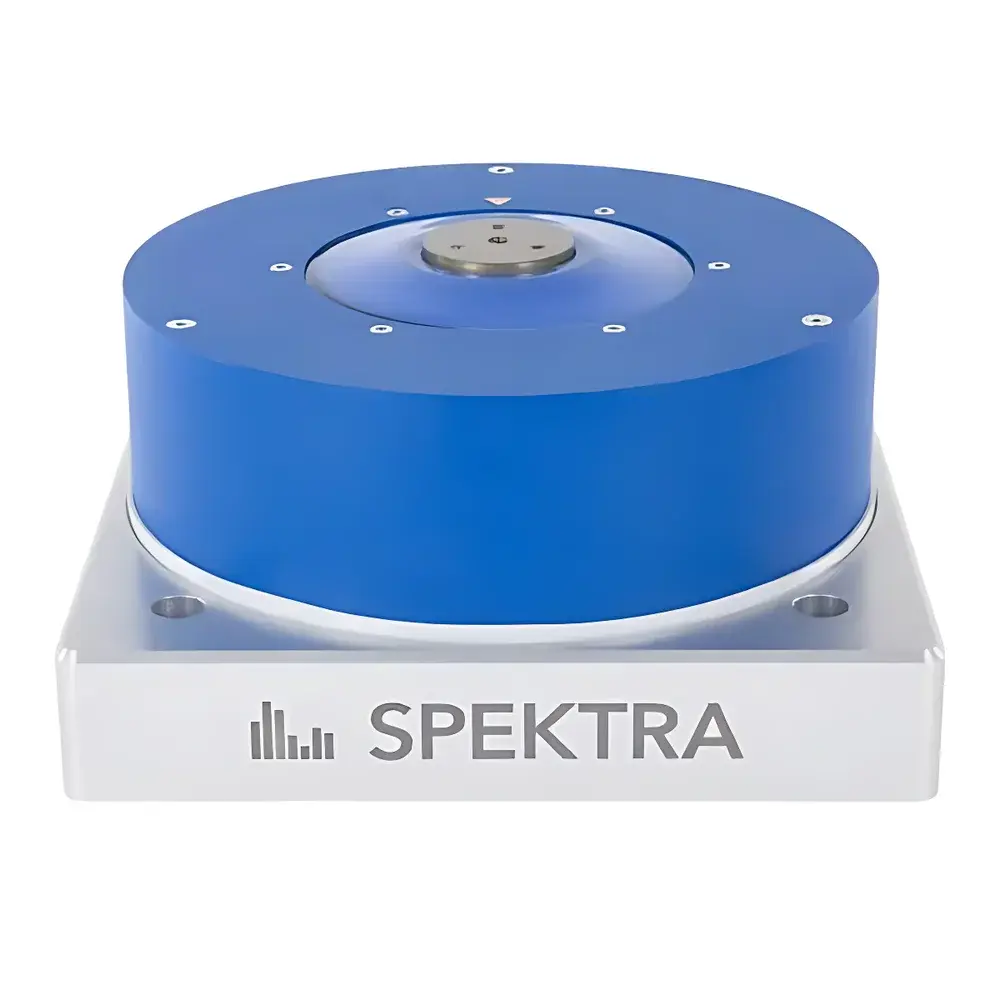
SPEKTRA SE-20/SE-09/SE-29 High-Frequency Electrodynamic Shakers
| Brand | SPEKTRA (Distributed by Auniontech) |
|---|---|
| Origin | Germany |
| Type | Electrodynamically Driven Modal Excitation Shaker System |
| Frequency Range | DC–50 kHz (SE-09/SE-29), 3 Hz–20 kHz (SE-20) |
| Max. Sinusoidal Force | 100 N (SE-09), 95 N (SE-20/SE-29) |
| Max. Acceleration | 600 m/s² (SE-20), 450 m/s² (SE-29), 400 m/s² (SE-09) |
| Max. Peak-to-Peak Displacement | 10 mm (SE-20/SE-29), 7.5 mm (SE-09) |
| Transverse Motion | < 5 % (typ.) |
| Payload Capacity | 2 kg vertical / 1 kg horizontal (SE-20/SE-29), 350 g (SE-09) |
| Operating Temperature Range | –40 °C to +120 °C (SE-20T option), –20 °C to +80 °C (SE-29), standard ambient (SE-09) |
| Compliance | ISO 16063-11, ISO 16063-21, ISO 18431-4, ANSI S2.18 |
| Reference Accelerometer | Optional integrated piezoelectric reference sensor |
Overview
The SPEKTRA SE-20, SE-09, and SE-29 high-frequency electrodynamic shakers constitute a modular family of precision excitation systems engineered for metrological-grade vibration calibration, modal analysis, and dynamic characterization of sensors and microstructures. Each model leverages electromagnetic actuation principles—based on Lorentz force generation within a controlled air gap—to deliver highly linear, low-distortion sinusoidal, random, or transient excitations across wide bandwidths. Unlike hydraulic or servo-hydraulic alternatives, these shakers operate without compressed air, oil, or active zero-position control, minimizing infrastructure dependencies and thermal drift. The SE-09 employs an ultra-low-friction air-bearing suspension to achieve near-ideal single-axis motion fidelity up to 50 kHz, making it suitable for primary calibration laboratories accredited to ISO/IEC 17025. The SE-20 and SE-29 utilize rigid spring-guided armatures with optimized magnetic circuits; the SE-20 emphasizes broad temperature resilience and high payload capacity, while the SE-29 prioritizes extended high-frequency response (>52 kHz first axial resonance) and ceramic-coated armature durability for repeated MEMS and geophone testing.
Key Features
- Electrodynamic actuation with high-force density rare-earth magnet assemblies and low-inductance voice coils
- Modular mechanical interface options including ear-mounted pivots for both vertical and horizontal mounting configurations
- Optional integrated reference-grade piezoelectric acceleration sensor for real-time closed-loop amplitude monitoring and traceable calibration
- Thermally stable aluminum housing with hard-anodized or ceramic-coated armature surfaces to minimize wear and maintain geometric repeatability over thousands of test cycles
- No external pneumatic supply or hydraulic fluid required—fully self-contained electric drive architecture
- Compliance-ready design supporting audit trails, calibration certificate linkage, and configuration logging per GLP/GMP and ISO 17025 requirements
- Standard M6 and M8 threaded mounting interfaces compatible with industry-standard stingers, impedance heads, and fixture plates
Sample Compatibility & Compliance
These shakers are validated for use with accelerometers, velocity transducers, seismic geophones, MEMS inertial sensors, piezoelectric force sensors, and miniature structural specimens (e.g., cantilevers, thin-walled shells). The SE-09’s air-bearing design ensures minimal parasitic moments during calibration of primary standards per ISO 16063-11 (vibration calibrators) and ISO 16063-21 (laser interferometric calibration). The SE-20 and SE-29 support secondary calibration and functional testing in accordance with ISO 18431-4 (mechanical vibration and shock—signal processing) and ANSI S2.18 (electroacoustic transducer calibration). All models meet CE marking requirements for EMC Directive 2014/30/EU and Low Voltage Directive 2014/35/EU. Environmental operation is certified per IEC 60068-2 series for temperature cycling, humidity, and shock exposure where applicable.
Software & Data Management
SPEKTRA shakers integrate natively with industry-standard vibration controller platforms—including m+p VibControl, Brüel & Kjær PULSE, and Siemens Testlab—via analog voltage input (±10 V) and digital TTL trigger I/O. Optional firmware enables IEEE 1451.4 TEDS-compliant transducer electronic data sheet readout from mounted reference sensors. Data acquisition synchronization supports time-stamped waveform capture at up to 256 kS/s with sub-microsecond jitter. Calibration history, shaker configuration parameters, and environmental metadata (e.g., ambient temperature, humidity) can be embedded directly into HDF5 or UFF58 file headers for long-term archival and FDA 21 CFR Part 11–compliant audit trails when used with validated software environments.
Applications
- Primary and secondary vibration sensor calibration in national metrology institutes and accredited labs
- Modal parameter identification (natural frequencies, damping ratios, mode shapes) of lightweight aerospace components and PCB assemblies
- Dynamic characterization of MEMS gyroscopes, accelerometers, and resonant pressure sensors
- Vibration stress screening (VSS) and resonant dwell testing of electronic enclosures and medical device housings
- Educational demonstrations of structural dynamics, transfer function estimation, and coherence analysis
- Material damping assessment via forced vibration decay curve fitting under controlled thermal conditions
FAQ
What standards do the SPEKTRA shakers comply with for vibration calibration?
They support full compliance with ISO 16063-11 (primary calibration using laser interferometry) and ISO 16063-21 (secondary calibration using back-to-back comparison), as well as ISO 18431-4 for signal processing validation.
Can the SE-20 operate inside environmental chambers?
Yes—the SE-20T variant is rated for continuous operation from –40 °C to +120 °C and features hermetically sealed electronics and low-outgassing materials suitable for vacuum-compatible climate chambers.
Is internal reference accelerometer integration mandatory?
No—it is optional but strongly recommended for traceable amplitude control and in-situ verification without external metrology equipment.
How is lateral motion minimized in the SE-29 design?
Through precision-ground ceramic armature guidance, symmetric magnetic circuit symmetry, and dynamically balanced moving mass—achieving transverse motion below 5% of axial displacement across the full 3 Hz–50 kHz range.
What is the maximum usable payload for modal testing on the SE-09?
The SE-09 is optimized for masses up to 350 g; exceeding this limit compromises air-bearing stability and may induce nonlinearity above 20 kHz.