Auniontech 3657 Series Vector Network Analyzer (VNA)
| Brand | Auniontech |
|---|---|
| Model | 3657A / 3657B / 3657AM / 3657BM |
| Frequency Range | 9 kHz / 100 kHz to 4.5 GHz / 9 GHz |
| Dynamic Range | up to 140 dB (10 MHz–6 GHz) |
| IF Bandwidth | 1 Hz–5 MHz |
| Output Power | +3 dBm (typ., 9 kHz–100 kHz), +13 dBm (typ., 100 kHz–9 GHz) |
| Measurement Speed | 4 µs/point |
| Form Factor | 5U benchtop or 2U rackmount |
| Display | 12.1″ capacitive multi-touch LCD (benchtop models only) |
| Interfaces | LAN, USB ×6, HDMI, DisplayPort |
| S-Parameter Analysis | Full 2-port standard |
| Time-Domain Transform | Yes |
| Fixture De-embedding & Simulation | Yes |
| Virtual Eye Diagram Generation | Yes (with jitter/noise injection, pre-emphasis & equalization modeling) |
Overview
The Auniontech 3657 Series Vector Network Analyzer (VNA) is a precision RF and microwave measurement instrument engineered for high-reproducibility S-parameter characterization across demanding production, R&D, and educational environments. Operating on the fundamental principle of coherent heterodyne detection, the 3657 Series measures complex scattering parameters (S11, S21, S12, S22) by injecting calibrated stimulus signals and analyzing reflected/transmitted responses with phase-coherent receivers. Its dual-frequency architecture supports two operational configurations: the 3657A/B variants cover 100 kHz–4.5 GHz and 100 kHz–9 GHz respectively, while the 3657AM/BM variants deliver identical RF performance in a compact 2U rack-mount form factor—optimized for automated test systems, ATE integration, and space-constrained labs. Designed to meet the traceability and repeatability requirements of ISO/IEC 17025-accredited calibration laboratories, the platform incorporates full two-port error correction per IEEE Std 1785.1, supporting SOLT, TRL, and user-defined calibration kits.
Key Features
- High dynamic range up to 140 dB (10 MHz–6 GHz), enabling accurate characterization of high-rejection filters, low-loss cables, and high-isolation couplers
- Measurement speed of 4 µs per data point—critical for high-throughput manufacturing test of RF front-end modules and antenna arrays
- Integrated time-domain reflectometry (TDR) with gating, impedance profiling, and fixture de-embedding algorithms compliant with IPC-TM-650 2.5.5.10
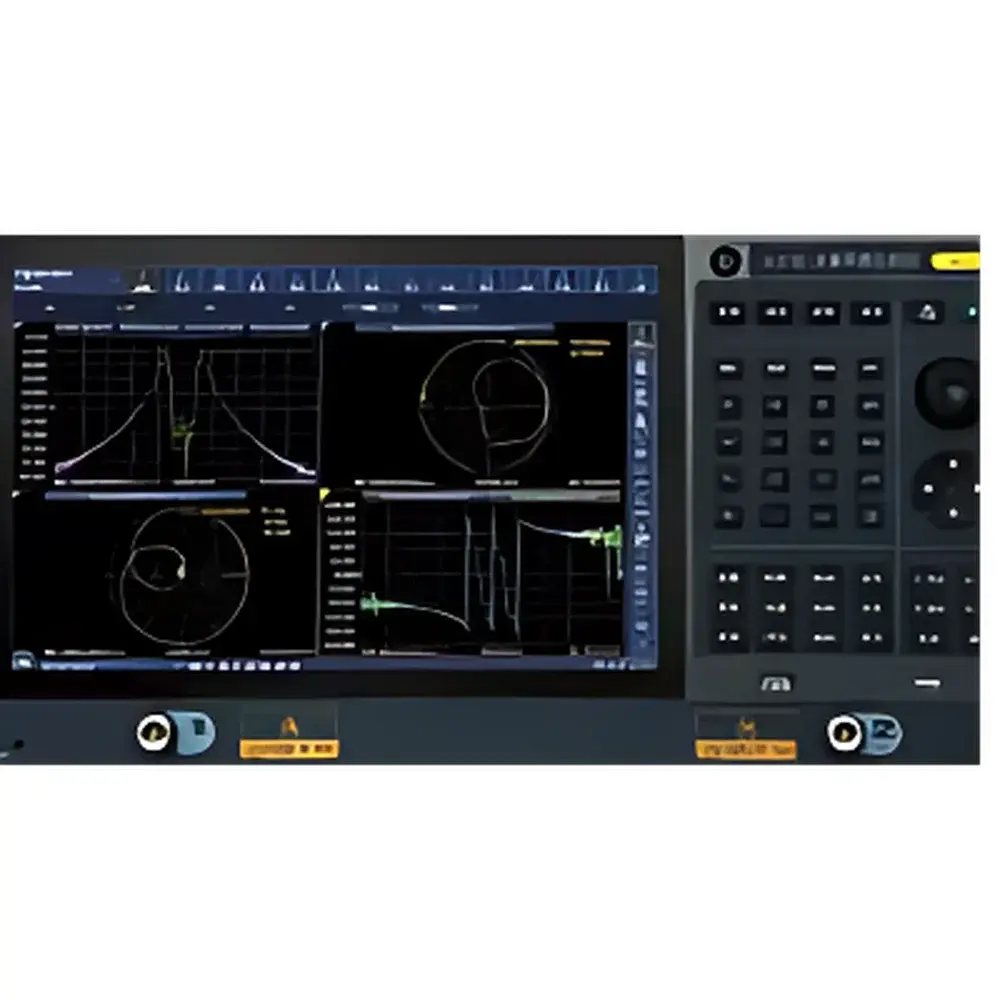
- Dual-form-factor design: 5U benchtop units include a 12.1″ multi-touch display with simultaneous multi-window visualization (Smith chart, polar plot, group delay, log/linear magnitude, VSWR); 2U rackmount variants support headless operation via LAN or USB remote control
- Optional 4-port extension enables full 16-term S-parameter acquisition in a single connection—essential for differential pair analysis, balun characterization, and multi-port passive components per IEC 62047-21
- Virtual eye diagram synthesis from S-parameters, supporting configurable jitter (random, sinusoidal, bounded uncorrelated), noise floor injection, and channel equalization modeling per IEEE 802.3bj, PCIe Gen5, and USB4 specifications
- SCPI command logging and script generation engine—facilitating rapid test sequence development and validation under GLP/GMP-aligned test documentation workflows
Sample Compatibility & Compliance
The 3657 Series supports standardized RF interfaces including 3.5 mm (male/female), N-type, and SMA connectors (adapters available). It accommodates passive and active DUTs such as bandpass/bandstop filters, low-noise amplifiers (LNAs), power amplifiers (PAs), antennas, coaxial cables, PCB transmission lines, and RF connectors. Calibration traceability aligns with national metrology institutes (NMI) via NIST-traceable standards. The instrument complies with EN 61326-1 (EMC for laboratory use), EN 61010-1 (safety), and supports audit-ready data integrity features—including electronic signatures, user access levels, and immutable test log export—meeting FDA 21 CFR Part 11 requirements when deployed in regulated quality assurance environments.
Software & Data Management
Built-in firmware provides native support for industry-standard data formats: Touchstone (.s2p, .s4p), CSV, PNG, and PDF export. The embedded analysis suite includes limit testing, ripple analysis, bandwidth computation (3 dB, 6 dB, fractional), and pass/fail mask evaluation against user-defined templates. Remote operation is enabled via VXI-11, SCPI over TCP/IP, and IVI-COM drivers. All measurement sessions automatically generate timestamped metadata logs containing instrument configuration, calibration state, environmental conditions (if external sensors are connected), and operator ID—ensuring full traceability for ISO 9001 internal audits and customer-facing test reports.
Applications
- Production line verification of 5G NR sub-6 GHz front-end modules, including duplexer insertion loss, amplifier gain flatness, and antenna return loss
- Characterization of high-speed interconnects (e.g., PCIe 5.0 channels, DDR5 DIMM stubs) using time-domain reflectometry and synthesized eye diagrams
- Design validation of balanced RF components (e.g., RF transformers, differential filters) using mixed-mode S-parameter conversion (SDD, SCC, SDS, CSS)
- Educational instruction in microwave engineering laboratories—supporting hands-on experiments in impedance matching, filter synthesis, and transmission line theory
- Field service and maintenance of CATV distribution networks, including tap loss verification, cable fault location, and node isolation testing
FAQ
What calibration methods does the 3657 Series support?
It supports full two-port vector error correction using Short-Open-Load-Thru (SOLT), Thru-Reflect-Line (TRL), and user-defined calibration kits—with support for mechanical and electronic calibration standards.
Is four-port measurement capability built-in or optional?
Four-port functionality is available as an optional hardware and license upgrade; once installed, it enables simultaneous acquisition of all 16 S-parameters without reconnection.
Can the instrument perform time-domain analysis on non-coaxial structures (e.g., PCB traces)?
Yes—via gated time-domain transformation and impedance discontinuity localization, provided appropriate launch calibration and reference plane definition are applied.
Does the VNA comply with regulatory requirements for use in medical device testing?
While not certified as a medical device itself, its measurement accuracy, data integrity controls, and audit trail features support compliance with ISO 13485 quality management systems when integrated into validated test procedures.
How is firmware updated and version history maintained?
Firmware updates are delivered via signed binary packages through the web interface or USB drive; each update preserves historical calibration coefficients and logs version transitions in the system event log.