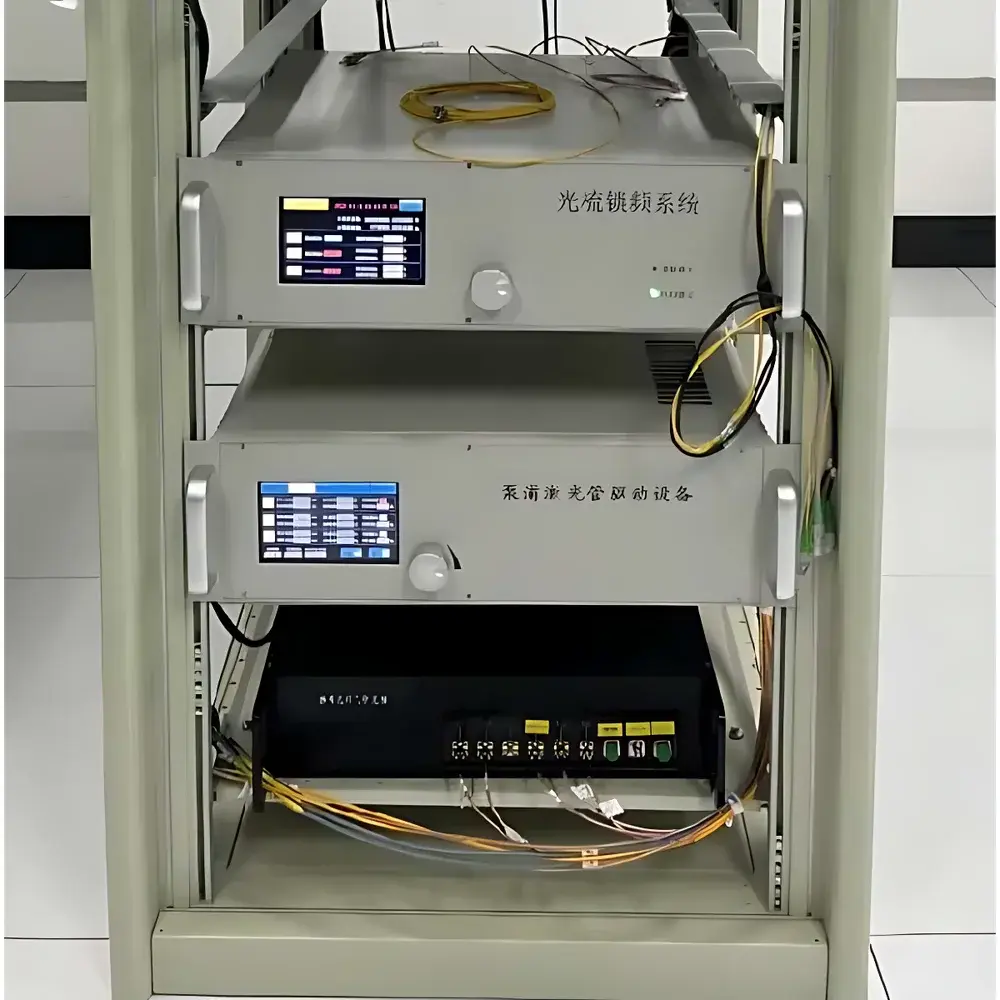
Auniontech Optical Frequency Comb System (Model: AU-OFCS)
| Brand | Auniontech |
|---|---|
| Origin | Shanghai, China |
| Manufacturer Type | Authorized Distributor |
| Product Origin | Domestic (China) |
| Model | AU-OFCS |
| Pricing | Upon Request |
Overview
The Auniontech Optical Frequency Comb System (AU-OFCS) is a turnkey, self-developed metrological-grade optical frequency comb engineered for precision optical frequency synthesis, absolute optical frequency measurement, and ultra-stable microwave generation. Based on the principle of mode-locked laser pulse trains with equidistant spectral lines in the frequency domain—governed by the relation fn = fceo + n·fr—this system enables traceable calibration across optical and microwave domains. It is designed for laboratory-based metrology, quantum optics experiments, optical atomic clock development, and high-resolution spectroscopy applications requiring SI-traceable frequency references. The system integrates a robust all-polarization-maintaining (all-PM) fiber architecture to minimize environmental sensitivity while maintaining long-term operational stability under non-vacuum, non-cryogenic conditions.
Key Features
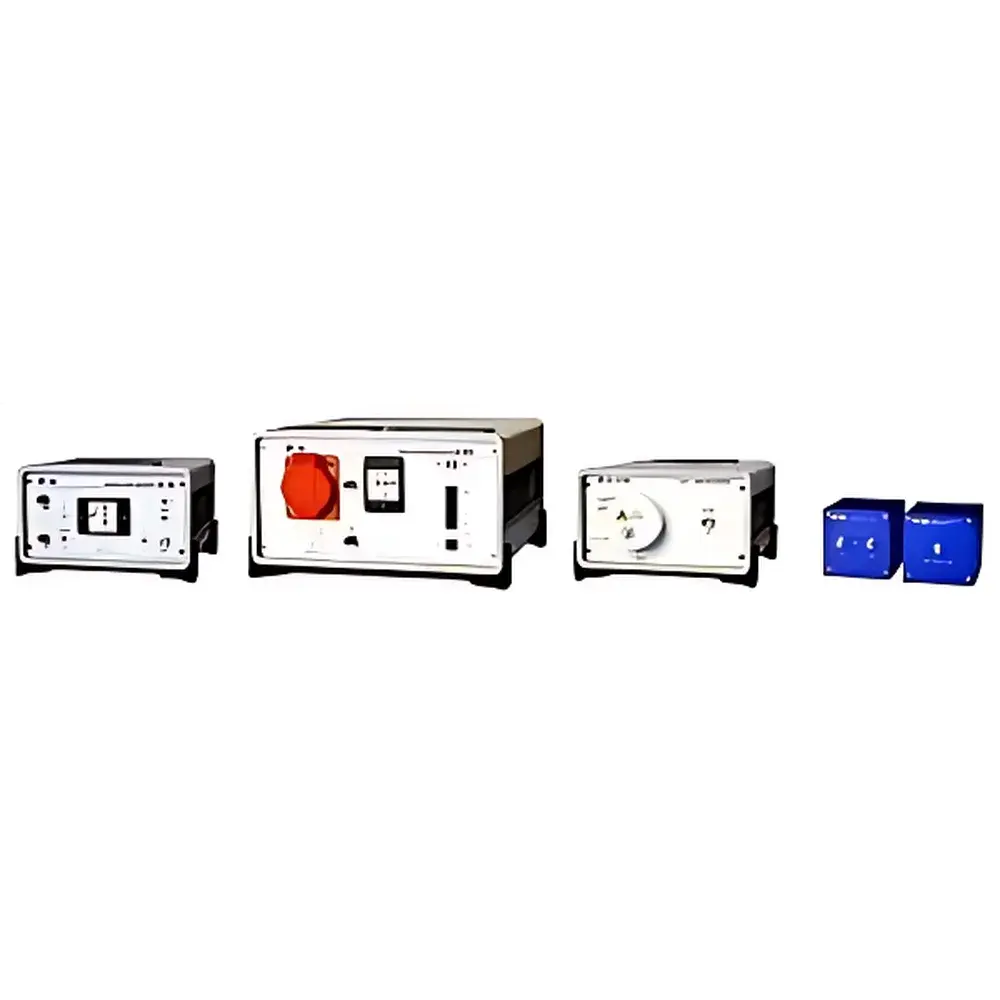
- Compact modular design: 2 × 3U electronic racks (pump drivers & locking electronics) and 1 × 2U optical rack (comb source & fceo generation)
- All-fiber, NALM-based figure-9 mode-locked oscillator centered at 1560 nm with >25 nm spectral bandwidth, 5 mW average output power, and pulse duration tunable between 70–200 fs
- Self-developed all-fiber fceo detection module delivering >35 dB signal-to-noise ratio (SNR) at 300 kHz resolution bandwidth and free-running linewidth of 250 kHz (measured at 30 kHz RBW)
- Integrated pulse amplifier stage supporting >200 mW average output power with sub-100 fs pulse width, enabling nonlinear broadening or supercontinuum generation in downstream stages
- Dual-loop active stabilization architecture: one loop locks fr to an external 10 MHz RF reference (e.g., hydrogen maser or cesium clock); the second loop stabilizes fceo using a fast PID-controlled feedback path
- Onboard frequency synthesizer converts the 10 MHz reference into precisely derived frequencies required for fr, fbeat, and fceo servo control
- Thermal stabilization subsystem maintains ±0.02 °C temperature stability over 24 h, critical for long-term phase coherence and comb line repeatability
Sample Compatibility & Compliance
The AU-OFCS is compatible with standard SMF-28 or PM1550 fiber interfaces and supports integration with commercial wavemeters, photodetectors, and heterodyne receivers. Its optical output is polarization-maintained and connectorized with FC/APC ports. While not certified to ISO/IEC 17025 for accredited calibration labs, the system meets functional requirements aligned with IEEE Std 1139 (Definitions of Physical Quantities for Fundamental Frequency and Time Metrology) and supports traceability paths compliant with BIPM CIPM MRA guidelines when referenced to primary frequency standards. It operates within Class 1 laser safety limits per IEC 60825-1:2014 when used with appropriate fiber enclosures and interlocks.
Software & Data Management
The system includes embedded firmware with real-time monitoring of key parameters—including fr, fceo, pump current, cavity temperature, and beat note SNR—accessible via Ethernet (TCP/IP) or USB-C interface. A Windows-compatible GUI provides lock status visualization, loop gain tuning, alarm logging, and timestamped parameter export in CSV format. All control actions and configuration changes are recorded with UTC timestamps to support GLP-compliant audit trails. Though not FDA 21 CFR Part 11 compliant out-of-the-box, the software architecture allows integration with third-party LIMS or ELN platforms through open API endpoints (RESTful JSON over HTTP).
Applications
- Absolute frequency calibration of narrow-linewidth lasers (e.g., ECDLs, DFBs) against SI-defined optical transitions
- Optical frequency division for generating ultra-low-phase-noise microwaves (e.g., sub-10−15 fractional instability at 1 s)
- Multi-heterodyne spectroscopy for broadband molecular fingerprinting in gas-phase analysis
- Coherent optical communications: multi-carrier generation and phase-noise characterization
- Time-domain applications including optical sampling, asynchronous optical sampling (ASOPS), and dual-comb interferometry
- Support for cold atom experiments requiring phase-coherent optical lattices or Raman sideband cooling sequences
FAQ
What reference signal is required to operate the AU-OFCS?
A stable 10 MHz sinusoidal reference with ≤1×10⁻¹² Allan deviation at 1 s is recommended; compatibility extends to GPS-disciplined oscillators, rubidium standards, or primary frequency standards.
Can the system be upgraded to support octave-spanning spectra?
Yes—via optional nonlinear photonic crystal fiber (PCF) or highly nonlinear fiber (HNLF) modules, enabling fceo detection without f-to-2f interferometry.
Is remote operation supported?
Yes—the embedded controller supports SSH, Telnet, and HTTP-based remote access for monitoring and basic lock control.
What maintenance is required during routine operation?
No consumables or periodic alignment are needed; annual verification of thermal drift and SNR performance is advised for metrological continuity.
Does the system include documentation for ISO/IEC 17025 accreditation?
Comprehensive technical manuals, calibration procedures, and uncertainty budgets are provided; full accreditation requires lab-specific validation per ISO/IEC 17025:2017 clause 7.7.
Related Products