
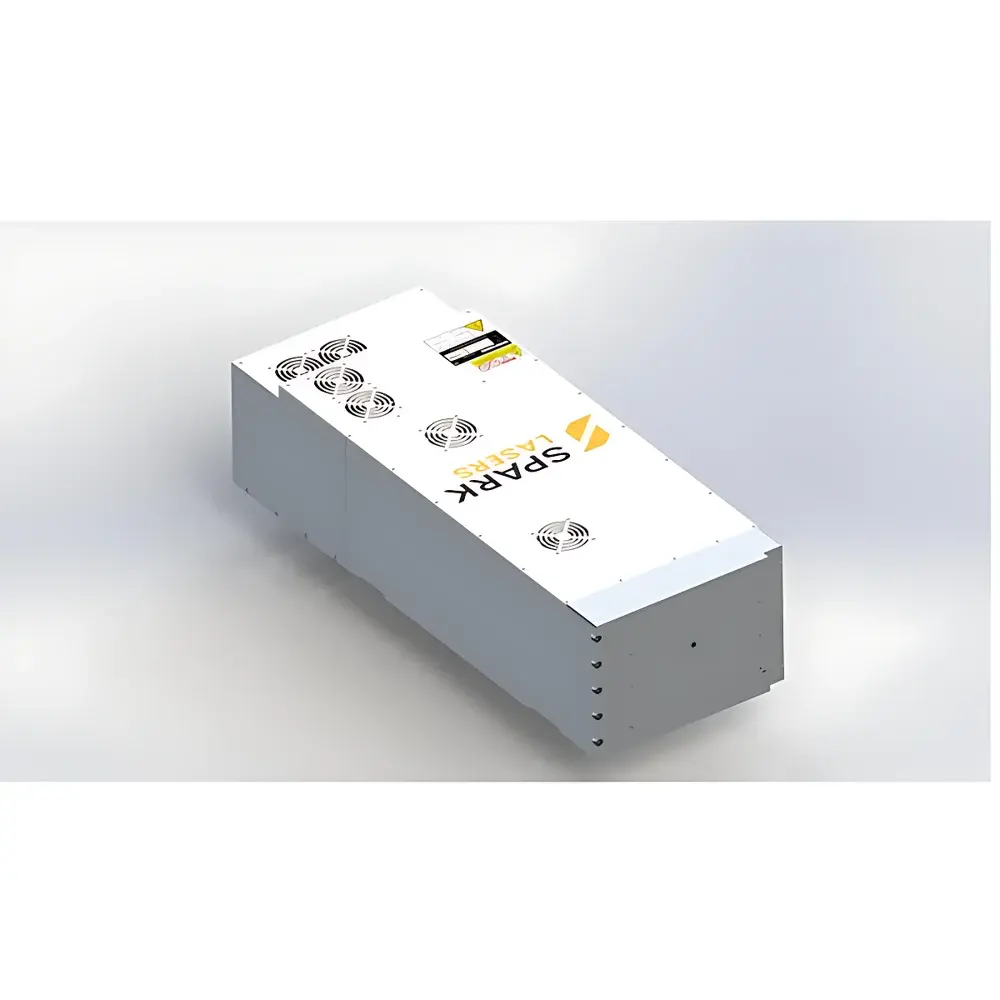
Spark Lasers ALTAIR USP High-Power Femtosecond Fiber Laser
| Brand | Spark Lasers |
|---|---|
| Origin | France |
| Model | ALTAIR USP |
| Central Wavelength | 1030 nm |
| Average Output Power | >8 W |
| Pulse Duration | <50 fs (typ. 40 fs) |
| Spectral Bandwidth | <70 nm |
| Repetition Rate | 42 MHz ±2 MHz |
| Pulse Energy | >250 nJ |
| Modulation Options | Single-shot, gated, on-demand, fine power control (<1 µs response) |
| Integrated Power Supply & Communication Interfaces | USB, RS-232, TCP/IP |
Overview
The Spark Lasers ALTAIR USP is an industrial-grade, all-fiber femtosecond laser system engineered for precision ultrafast photonics applications requiring high average power, exceptional pulse-to-pulse stability, and seamless integration into OEM or research-grade optical platforms. Operating at a central wavelength of 1030 nm, the ALTAIR USP leverages mode-locked Yb-doped fiber oscillator-amplifier architecture to generate sub-50 fs pulses with typical duration of 40 fs—enabling strong nonlinear interaction cross-sections while minimizing thermal load in sensitive samples. Its fixed-energy operation mode ensures consistent photon flux per pulse across the full repetition rate range (42 MHz ±2 MHz), making it particularly suitable for time-resolved spectroscopy, pump-probe experiments, and high-repetition-rate multiphoton imaging where temporal fidelity and shot-noise-limited performance are critical. The laser’s monolithic, air-cooled design integrates the pump diodes, amplifier stages, dispersion compensation, and controller electronics within a single compact chassis—reducing alignment sensitivity, improving long-term reliability, and eliminating external water cooling requirements common in Ti:sapphire systems.
Key Features
- Sub-50 fs pulse duration (40 fs typical) with transform-limited spectral phase profile, verified via frequency-resolved optical gating (FROG) or autocorrelation
- High average output power exceeding 8 W at 1030 nm, delivering >250 nJ pulse energy at 42 MHz repetition rate
- Narrow spectral linewidth (<70 nm FWHM) optimized for efficient nonlinear frequency conversion (e.g., SHG, THG, OPA pumping)
- Integrated electronic modulation interface supporting single-shot triggering, gated burst operation, and real-time pulse energy adjustment with <1 µs latency
- Full digital control stack compliant with industry-standard protocols: USB 2.0, RS-232 serial, and Ethernet (TCP/IP) for remote monitoring, scripting, and synchronization with external hardware (e.g., delay stages, detectors, shutters)
- Robust mechanical packaging with shock-isolated optical path, hermetically sealed fiber splices, and conformal coating for stable operation in laboratory and light-industrial environments
Sample Compatibility & Compliance
The ALTAIR USP is designed for use with standard free-space or fiber-coupled optical setups common in ultrafast laboratories. Its 1030 nm output is compatible with commercially available achromatic mirrors, broadband dielectric coatings (350–2000 nm), and nonlinear crystals such as BBO, LBO, and BiBO. The system meets IEC 60825-1:2014 Class 4 laser safety requirements and includes interlock-ready connectors, emission indicator LEDs, and integrated shutter control for compliance with local laser safety officers (LSOs) and institutional radiation safety programs. While not certified for medical or in vivo diagnostic use, its performance parameters align with experimental benchmarks referenced in ISO 11146 (laser beam widths and divergence), ISO 13694 (laser-induced damage threshold testing), and ASTM E2750 (ultrashort pulse characterization).
Software & Data Management
Spark Lasers provides the ALTAIR Control Suite—a cross-platform (Windows/macOS/Linux) application built on Qt framework with Python API support (PySparkLaser). The software enables real-time monitoring of output power, internal temperature sensors, pump current diagnostics, and repetition rate lock status. All operational parameters—including modulation state, trigger delay, and energy setpoint—are logged with timestamped metadata in HDF5 format, facilitating traceability in GLP-compliant workflows. Optional firmware upgrades support FDA 21 CFR Part 11–compliant audit trails when deployed in regulated R&D environments, including electronic signatures, user access levels, and immutable log archiving.
Applications
- Multiphoton fluorescence microscopy (MPM) and second-harmonic generation (SHG) imaging in thick biological tissues
- Pump-probe spectroscopy for carrier dynamics studies in 2D materials and perovskite semiconductors
- Optical parametric amplification (OPA) seeding for tunable mid-IR generation
- Time-of-flight mass spectrometry (TOF-MS) ionization source for high-resolution molecular analysis
- Ultrafast laser micromachining of transparent dielectrics (e.g., fused silica, sapphire) with minimal heat-affected zone
- Fundamental strong-field physics experiments including high-harmonic generation (HHG) and attosecond pulse synthesis
FAQ
Is the ALTAIR USP compatible with existing optical tables and motion controllers?
Yes—the laser features standard M6 and 1/4″-20 mounting threads, integrated kinematic baseplate, and TTL/CMOS-compatible trigger inputs synchronized to the pulse train.
Can the repetition rate be continuously tuned between 1.5 MHz and 42 MHz?
No—repetition rate is fixed at 42 MHz ±2 MHz by cavity length design; however, optional electro-optic modulators enable external pulse picking down to single-shot or arbitrary burst patterns without altering the oscillator’s native frequency.
What is the beam quality specification (M²) and pointing stability?
The ALTAIR USP delivers M² < 1.1 (measured per ISO 11146-2) with angular pointing drift < 5 µrad over 8 hours at constant ambient temperature.
Does the system include dispersion pre-compensation for downstream pulse compression?
Yes—integrated chirped mirror-based compressor stage is available as an add-on module; standard configuration outputs near-transform-limited pulses suitable for direct use in most nonlinear experiments.
How is thermal management handled during continuous operation?
Passive convection cooling suffices for ambient temperatures ≤25°C; optional fan-assisted airflow kit extends operational envelope to 35°C with no degradation in pulse energy stability.





