
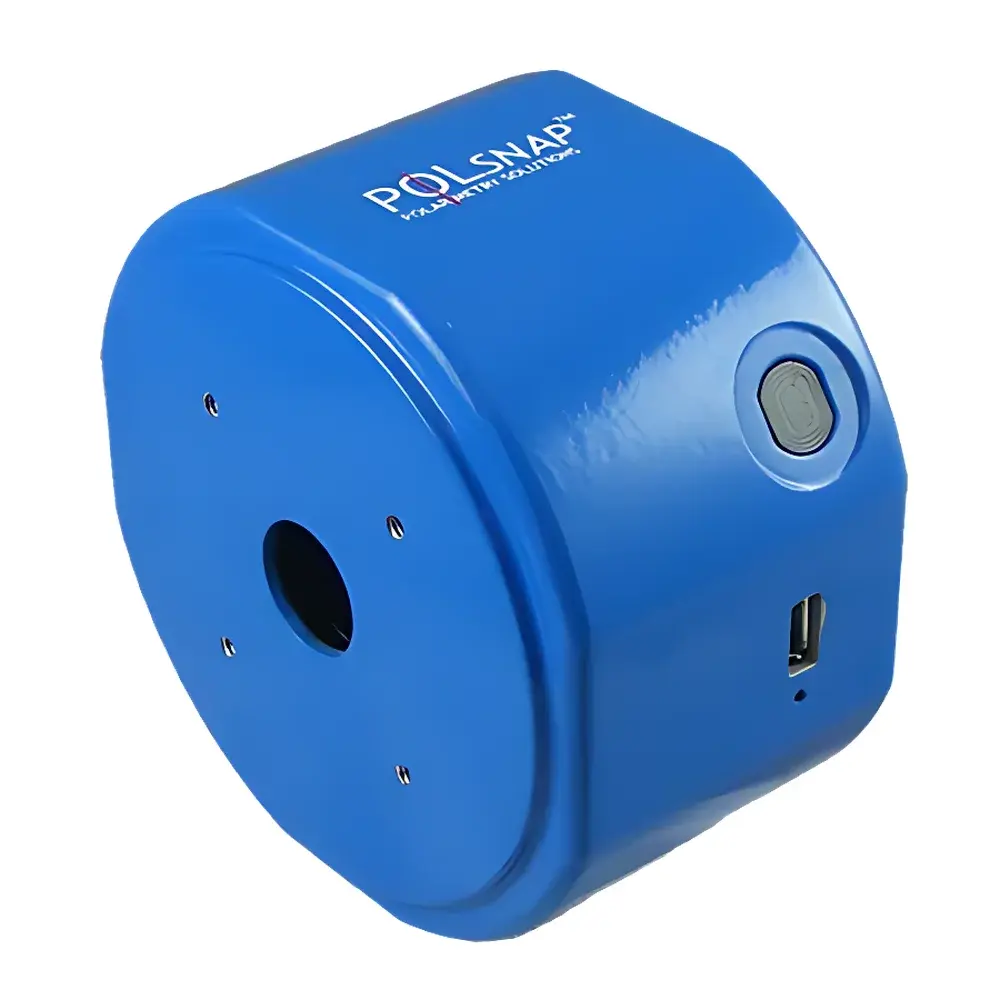
Hinds Instruments PolSNAP Compact Broadband Polarimetry Analyzer
| Brand | Hinds Instruments |
|---|---|
| Origin | USA |
| Manufacturer Type | Authorized Distributor |
| Product Category | Imported Instrument |
| Model | PolSNAP |
| Pricing | Available Upon Request |
| Sampling Rate | 2000 samples/s |
| Stokes Parameter Accuracy | <1% |
| Repeatability | ±0.06% |
| Form Factor | Handheld (≤120 × 85 × 45 mm) |
| Interface | USB 3.0 |
| Spectral Range | 400–1100 nm (standard broadband configuration) |
| Output | Full 4-element Stokes vector (S₀, S₁, S₂, S₃) in real time |
Overview
The Hinds Instruments PolSNAP Compact Broadband Polarimetry Analyzer is a high-speed, integrated polarimetric measurement system engineered for real-time characterization of polarization states across visible and near-infrared spectral bands (400–1100 nm). Based on division-of-amplitude polarimetry (DOAP), the PolSNAP employs a monolithic, all-in-one optical architecture—combining retardation optics, photoelastic modulators (PEMs), and quadrant photodetectors—within a single, thermally stable aluminum housing. Unlike traditional rotating-element or liquid-crystal-based polarimeters, the DOAP principle enables simultaneous acquisition of all four Stokes parameters without mechanical scanning or temporal modulation artifacts. This yields true instantaneous polarization state determination at up to 2000 Hz, supporting dynamic monitoring of rapidly varying sources such as mode-locked lasers, fiber-coupled diodes under thermal drift, or polarization-maintaining (PM) fiber alignment transients.
Key Features
- Integrated optoelectronic design: Optical train, drive electronics, and detection circuitry are co-packaged—no external controllers, power supplies, or synchronization hardware required.
- USB 3.0 plug-and-play interface: Direct connection to Windows/Linux host systems with minimal driver overhead; compatible with LabVIEW, Python (via PySerial/NumPy), and MATLAB instrument control toolboxes.
- Compact form factor: Dimensions of 120 × 85 × 45 mm and mass <350 g enable seamless integration into constrained optical benches, fiber test stations, or portable field setups.
- High-fidelity Stokes reconstruction: Achieves <1% absolute accuracy in S₁/S₂/S₃ relative to S₀ under NIST-traceable calibration conditions; repeatability maintained at ±0.06% RMS over 8-hour continuous operation.
- Real-time visualization suite: Simultaneous display of polarization state on Poincaré sphere, normalized Stokes bar chart, and time-series trajectory plot—all updated at native 2000 Hz frame rate.
Sample Compatibility & Compliance
The PolSNAP supports both free-space and fiber-pigtailed input configurations. Free-space operation accepts collimated beams with diameters from 1 mm to 6 mm (with optional beam expanders); fiber-coupled variants accept FC/PC or FC/APC connectors with SMF-28 or PM980 fiber pigtails. The analyzer complies with IEC 61340-5-1 (electrostatic discharge protection), RoHS 2011/65/EU, and FCC Part 15 Class B emission limits. Calibration certificates include traceability to NIST Standard Reference Material (SRM) 2069 for polarization state verification. For regulated environments, the included software supports audit trail logging and user access controls aligned with FDA 21 CFR Part 11 requirements when deployed with validated IT infrastructure.
Software & Data Management
The PolSNAP Control Suite (v4.2+) provides deterministic data acquisition, configurable averaging windows (1–1024 samples), and export in HDF5, CSV, and MAT formats. Raw Stokes vectors are timestamped with microsecond resolution using onboard FPGA-synchronized clocks. Batch analysis modules support DoP (Degree of Polarization) mapping, SOP (State of Polarization) drift quantification, and Mueller matrix estimation via sequential measurements. All software binaries undergo static code analysis per MISRA C guidelines and are validated against ISO/IEC 17025:2017 clause 5.9 for measurement software integrity.
Applications
- Real-time laser polarization stability assessment during cavity alignment or temperature tuning.
- Characterization of polarization-dependent loss (PDL) and polarization mode dispersion (PMD) in passive components (isolators, circulators, WDM filters).
- In-process verification of polarization extinction ratio (PER) in PM fiber splicing and connectorization.
- Dynamic SOP tracking in interferometric fiber sensors (e.g., current transformers, acoustic arrays).
- Optical system alignment feedback—especially in ellipsometry, Mueller matrix microscopy, and quantum optics setups requiring rapid SOP confirmation.
FAQ
What spectral range does the standard PolSNAP cover?
The base configuration operates from 400 nm to 1100 nm. Customized versions with extended NIR coverage (up to 1700 nm) are available upon request with InGaAs detector integration.
Can the PolSNAP measure depolarized light?
Yes—it computes the Degree of Polarization (DoP = √(S₁² + S₂² + S₃²)/S₀) directly from the full Stokes vector, enabling quantitative discrimination between fully polarized, partially polarized, and unpolarized states.
Is external triggering supported?
The device features TTL-compatible trigger input and output ports for synchronization with pulsed lasers, shutters, or motion stages—enabling gated acquisition or event-locked SOP capture.
How is calibration performed and how often is it required?
Factory calibration uses NIST-traceable quarter-wave and linear polarizers; end-user recalibration is recommended annually or after mechanical shock exceeding 25 g. A built-in self-test routine verifies optical alignment and electronic gain stability prior to each session.
Does the system support OEM integration?
Yes—Hinds Instruments provides SDKs with C/C++, Python, and .NET bindings, along with mechanical drawings and thermal derating profiles for embedded integration into larger instrumentation platforms.






