
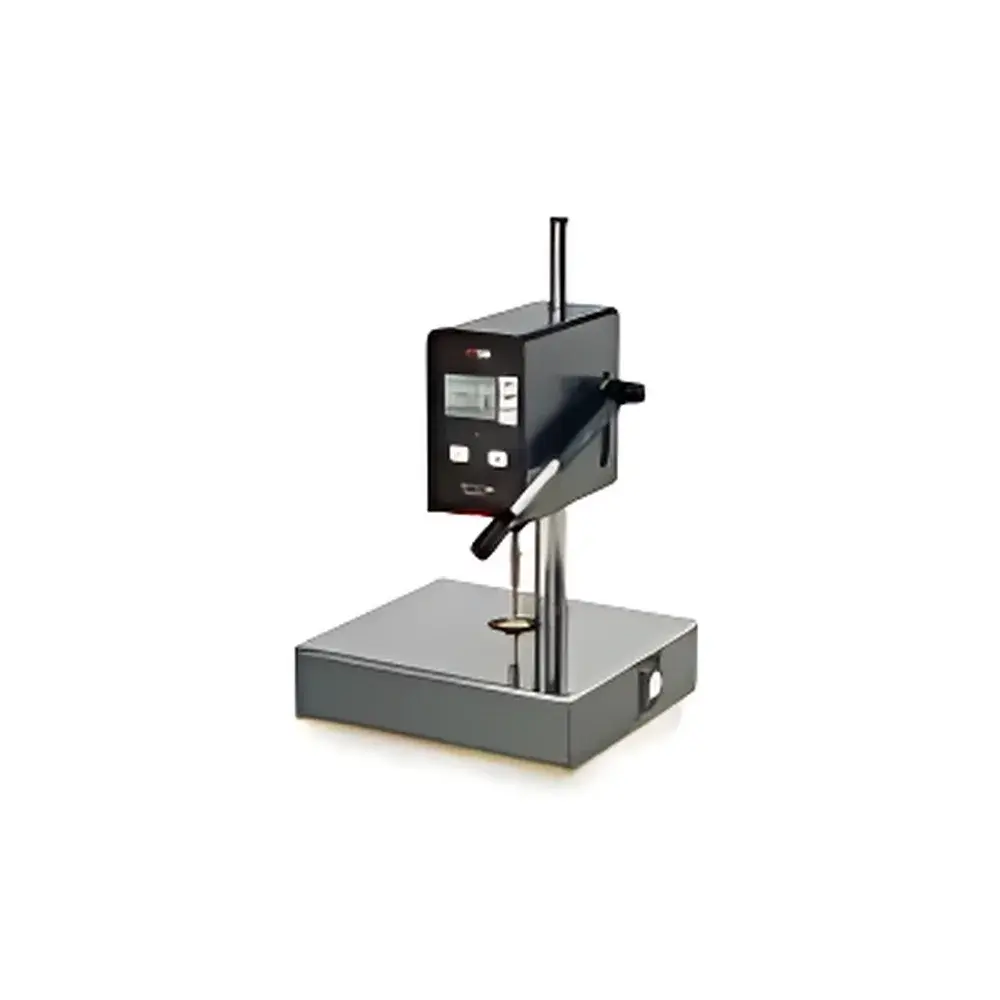
TQC SH1000 Series Cone-Plate Viscometer
| Brand | TQC |
|---|---|
| Origin | Guangdong, China |
| Manufacturer Type | Authorized Distributor |
| Product Origin | Domestic (China) |
| Model | SH1000 Series |
| Pricing | Available Upon Request |
| Measurement Range | 0–5 P, 0–10 P, 0–20 P, 5–50 P, 10–100 P |
| Accuracy | ±2% of full scale |
| Repeatability | ±0.5% of full scale |
| Temperature Control Range | 5–65 °C |
| Display | Digital LCD |
| Interface | RS232 & USB |
| Data Storage | 100 readings |
| Power Supply | 90–240 V AC, 50/60 Hz |
| Dimensions | 350 × 300 × 555 mm |
| Weight | 15 kg |
| Compliant Standards | BS 3900-A7, ASTM D4287, ISO 2884, GB/T 9751.1 |
Overview
The TQC SH1000 Series Cone-Plate Viscometer is a precision-engineered rotational viscometer designed for high-reproducibility viscosity measurements of low-to-medium viscosity Newtonian and near-Newtonian liquids under controlled shear conditions. It operates on the fundamental principle of cone-and-plate rheometry, where a precisely angled conical rotor rotates above a flat, thermostatically regulated plate, generating a uniform shear rate across the sample gap. This geometry ensures well-defined shear stress and shear rate profiles—critical for accurate determination of dynamic viscosity (η) in units of poise (P), centipoise (cP), pascal-seconds (Pa·s), or millipascal-seconds (mPa·s). The instrument is optimized for routine quality control and R&D applications in coatings, inks, adhesives, and surface treatment formulations where batch consistency, temperature-dependent flow behavior, and compliance with international test standards are essential.
Key Features
- Cone interchangeability: Multiple standardized cone angles (e.g., 1°, 2°, 4°) available to match viscosity ranges and sample volume requirements—enabling optimal sensitivity across the full 0–100 P measurement span.
- Programmable temperature control: Integrated Peltier-based heating system maintains sample temperature from 5 °C to 65 °C with ±0.3 °C stability, supporting ASTM D4287 and ISO 2884 thermal conditioning protocols.
- Multi-unit display and conversion: Real-time readout in P, cP, Pa·s, and mPa·s without manual calculation—ensuring seamless alignment with regulatory documentation and internal SOPs.
- Automated timing and threshold logic: User-definable test duration and upper/lower viscosity limits trigger audible or visual alerts—facilitating pass/fail decisions during inline QC checks.
- Dual digital interface: RS232 and USB ports support direct connection to PCs for real-time data logging, printer output, or integration into LIMS environments compliant with FDA 21 CFR Part 11 audit trail requirements.
- Onboard memory: Stores up to 100 sequential viscosity readings with timestamp and temperature metadata—eliminating manual transcription errors and supporting GLP traceability.
Sample Compatibility & Compliance
The SH1000 Series accommodates samples with low volatility and moderate thermal sensitivity, including solvent-borne and water-based paints, clear coats, UV-curable resins, and powder coating slurries post-dispersion. Its cone-plate geometry minimizes edge effects and sample evaporation during testing—particularly advantageous for fast-drying systems. All operational modes conform to internationally recognized viscosity test methodologies: BS 3900-A7 (paints and varnishes), ASTM D4287 (high-shear viscosity of paints and related materials), ISO 2884-1 (pigmented paints—determination of apparent viscosity at high shear rates), and GB/T 9751.1 (Chinese national standard for paint viscosity testing). Instrument calibration is traceable to NIST-certified reference oils, and routine verification follows manufacturer-recommended procedures aligned with ISO/IEC 17025 metrological practices.
Software & Data Management
While the SH1000 operates as a standalone unit, its RS232 and USB interfaces enable bidirectional communication with TQC’s optional ViscoLink™ PC software (v3.2+). This application supports automated method templates, multi-parameter trending (viscosity vs. temperature, time, or shear rate), statistical process control (SPC) charting, and export to CSV, PDF, or XML formats. Audit trails include operator ID, calibration status, environmental logs, and electronic signatures—meeting GMP documentation expectations for regulated manufacturing sites. Data integrity safeguards include write-protection for archived records and automatic backup to network drives per organizational IT policy.
Applications
- QC release testing of architectural and industrial coatings prior to canning or shipment
- Formulation development of high-gloss automotive clear coats requiring precise high-shear viscosity control
- Batch-to-batch consistency monitoring in decorative paint production lines
- Evaluation of rheological modifiers (e.g., fumed silica, associative thickeners) under controlled thermal conditions
- Pre-compliance screening for ISO 2884 certification of new powder coating dispersions
- Stability assessment of waterborne acrylic emulsions across storage temperature profiles
FAQ
What cone geometries are supported by the SH1000 Series?
Standard cones include 1°, 2°, and 4° angles—each calibrated for specific viscosity ranges. Cone selection is determined by expected sample viscosity and required shear rate; detailed guidance is provided in the Operator Manual Section 4.2.
Is the instrument compatible with LIMS integration?
Yes—via ASCII-based RS232 protocol or USB virtual COM port, enabling structured data ingestion into validated LIMS platforms supporting ASTM E1384 or ISO/IEC 17025 data exchange frameworks.
Does the SH1000 meet FDA 21 CFR Part 11 requirements?
The hardware itself does not enforce electronic signature controls; however, when paired with validated ViscoLink™ software and institutional procedural controls (e.g., role-based access, audit trail review workflows), it supports Part 11 compliance in regulated environments.
How often should calibration verification be performed?
Daily verification using certified reference oils (e.g., Cannon N25, N100) is recommended before first use and after any temperature or cone change. Full recalibration by an accredited service provider is advised annually or per internal QA schedule.
Can the SH1000 measure non-Newtonian behavior?
It provides single-point high-shear viscosity values per ASTM D4287. For full flow curves or yield stress analysis, a controlled-stress rheometer with programmable shear ramp capability is recommended.
Related Products






