
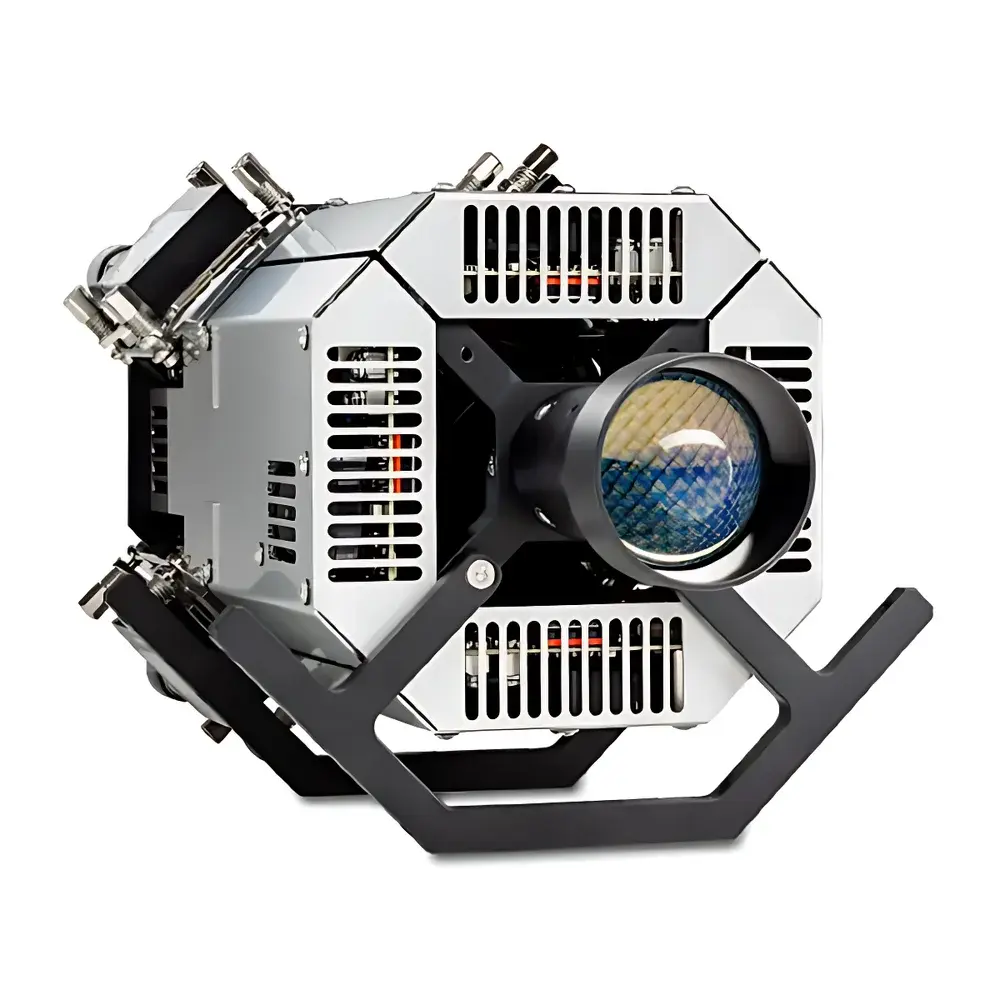
Auniontech ALE/2 Series 70W High-Power UV-LED Exposure Source for 12-inch Wafers
| Brand | Auniontech |
|---|---|
| Origin | Shanghai, China |
| Manufacturer Type | Authorized Distributor |
| Product Category | Domestic |
| Model | Tunable Broadband UV-LED Source |
| Light Source Type | UV-LED (i-line & broadband) |
| Output | 70 W @ 365 nm (i-line), 80 W @ 350–450 nm (broadband) |
| Numerical Aperture | NA 0.3 (±35° half-angle) |
| Power Supply | 110–240 VAC, 50–60 Hz, 1500 W max |
| ESS Dimensions | 21 × 21 × 36 cm, 4 kg |
| CSS Dimensions | 44 × 18 × 37 cm, 10 kg |
| Cooling | Integrated liquid-cooled heatsink (standard), optional external chiller |
| Control Interfaces | TTL/PLC, USB (serial), Ethernet / Modbus TCP/IP (optional) |
| Intensity Control | 10–100% resolution, <1 ms LED rise time |
| Optical Output Port | 16 mm × 16 mm square light pipe |
| Uniform Illumination Area | Up to 400 mm × 400 mm (with condenser optics) |
Overview
The Auniontech ALE/2 Series is a high-power, solid-state UV-LED exposure source engineered for precision photolithography and industrial UV curing applications on large-format substrates—specifically optimized for 12-inch (300 mm) and 8-inch (200 mm) wafers and masks. Unlike conventional mercury arc lamps, the ALE/2 leverages distributed, feedback-controlled UV-LED modules operating at discrete wavelengths—including 365 nm (i-line), 385 nm, 405 nm, and 436 nm—to deliver stable, spectrally defined irradiance without spectral drift or warm-up delay. Its core architecture separates the Exposure Subsystem (ESS) from the Control Subsystem (CSS), enabling modular integration into mask aligners, stepper platforms, collimated flood exposure tools, and high-dose UV curing stations. The system achieves radiometric output comparable to 5,000 W mercury vapor lamps in i-line mode and matches 2,000 W broadband mercury sources across 350–450 nm—while consuming less than 30% of the electrical power and generating negligible IR radiation or ozone.
Key Features
- High-output UV-LED engine with up to four independently addressable wavelength channels (365 nm, 385 nm, 405 nm, 436 nm)
- 70 W nominal optical power at 365 nm (i-line); 80 W total broadband output (350–450 nm)
- Closed-loop photodiode feedback control ensures ±1.5% irradiance stability over 8-hour operation
- No mercury, no UV-B/C emission, no electrode degradation—fully RoHS-compliant and GLP-aligned
- Integrated liquid-cooled thermal management (standard); optional external chiller for sustained high-power duty cycles
- Sub-millisecond LED switching (<1 ms rise/fall time) enables precise dose control in pulsed exposure modes
- 10–100% intensity adjustment with 0.1% resolution via analog or digital command interface
- Standard 16 mm × 16 mm square light pipe output, compatible with OEM condenser optics for uniformity >95% across 400 mm × 400 mm fields
Sample Compatibility & Compliance
The ALE/2 series supports rigid and flexible substrates up to 300 mm diameter, including silicon wafers, glass masks, ceramic carriers, and polyimide films. Its collimated output profile (NA 0.3, ±35° full divergence) meets ISO 10110-3 specifications for beam uniformity and angular distribution in lithographic illumination systems. The device complies with IEC 61000-6-3 (EMC emissions), IEC 62471 (photobiological safety—Risk Group 3 for UV-A), and CE marking requirements for industrial equipment. For regulated environments—such as semiconductor fabs operating under ISO 9001 or FDA 21 CFR Part 11—audit-ready logging of irradiance history, setpoint changes, and thermal telemetry is supported via Ethernet/Modbus TCP/IP with timestamped records.
Software & Data Management
The CSS provides native support for LabVIEW™, Python (PySerial, PyModbus), and MATLAB® via documented ASCII command protocols over USB or Ethernet. Real-time irradiance data, LED junction temperature, coolant flow rate, and operational hours are streamed continuously and logged to internal non-volatile memory (128 MB). Optional firmware upgrades enable GMP-compliant electronic signatures, user-access-level permissions, and 21 CFR Part 11–aligned audit trails—including operator ID, parameter change timestamps, and reason-for-change annotations. All configuration presets (e.g., “i-line wafer alignment”, “broadband encapsulant cure”) are stored and recalled without host dependency.
Applications
- Semiconductor photolithography: Mask alignment, proximity printing, and direct-write pre-alignment on 12-inch wafers
- Advanced packaging: Redistribution layer (RDL) patterning, fan-out wafer-level packaging (FOWLP), and underfill curing
- Micro-optics fabrication: UV-curable polymer lens arrays, diffractive optical elements (DOEs), and waveguide imprinting
- Wafer-level metrology: Uniform illumination for defect inspection, automated optical inspection (AOI), and dark-field imaging
- Industrial UV curing: Adhesive bonding, conformal coating, and 3D-printed resin post-curing on large-area substrates
- Research infrastructure: Customizable spectral output for photoresist sensitivity mapping, quantum dot activation, and photocatalytic studies
FAQ
What is the spectral bandwidth specification for the i-line configuration?
The i-line module delivers center wavelength 365 nm ± 3 nm with FWHM ≤ 12 nm, measured per ISO/DIS 13698.
Can the ALE/2 be integrated into a Class 10 cleanroom environment?
Yes—the ESS and CSS housings meet ISO Class 5 particulate limits when operated with filtered air intake; optional nitrogen purge ports are available.
Is optical power calibration traceable to NIST or PTB standards?
Each unit ships with a factory calibration certificate traceable to PTB (Physikalisch-Technische Bundesanstalt) via calibrated reference photodiodes.
Does the system support synchronized triggering with motion stages or shutter controllers?
Yes—TTL-compatible trigger input/output lines support sub-10 µs jitter synchronization with third-party motion controllers and mechanical shutters.
What maintenance intervals are recommended for long-term reliability?
No lamp replacement or electrode servicing required; only periodic verification of coolant level (liquid-cooled units) and optical window cleanliness every 6 months under continuous operation.




