
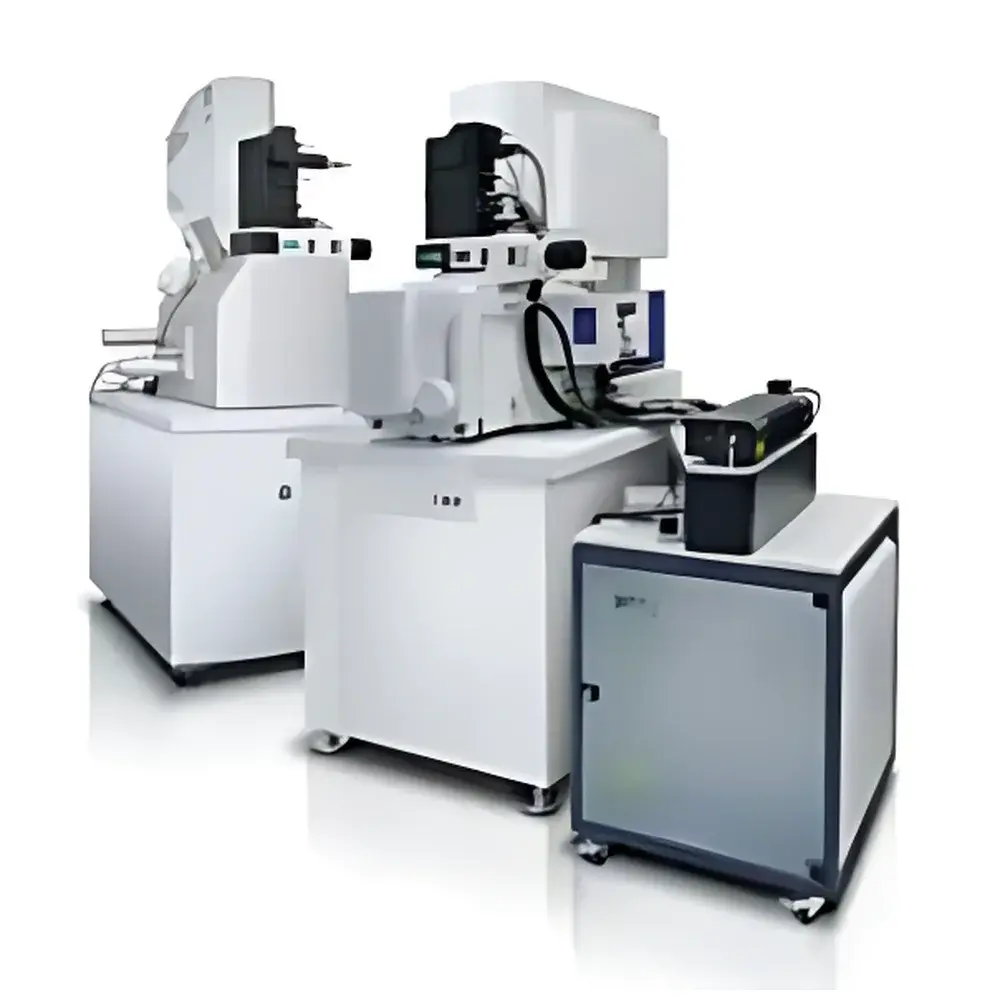
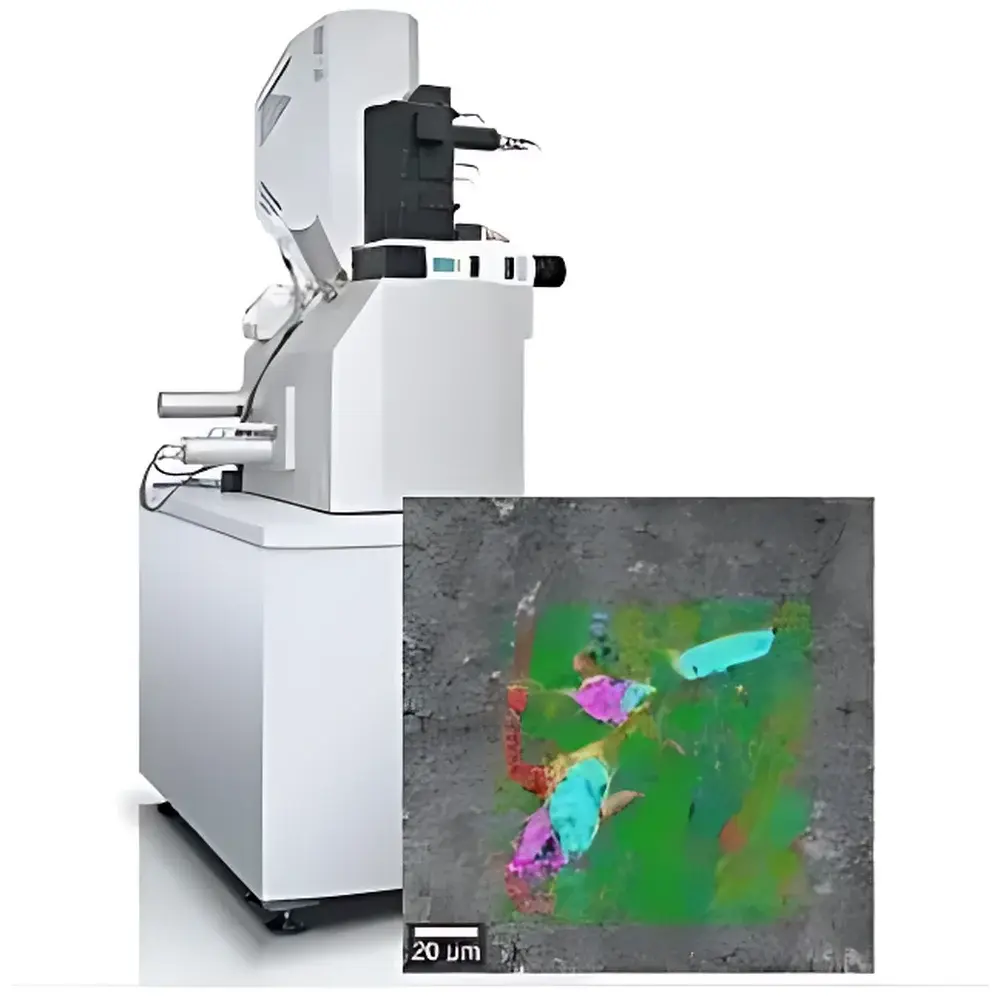
WITec RISE Microscopy System – Integrated Raman Imaging and Scanning Electron Microscopy
| Brand | WITec |
|---|---|
| Origin | Germany |
| Manufacturer | WITec GmbH (Oxford Instruments Distribution Partner) |
| Instrument Type | Confocal Raman Microscope Integrated with SEM |
| Spectral Range | 90–9000 cm⁻¹ |
| Spectral Resolution | ≤1 cm⁻¹ |
| Wavenumber Accuracy | ≤ ±0.02 cm⁻¹ |
| Spatial Resolution | Lateral 360 nm, Axial 900 nm |
| Minimum Detectable Wavenumber | 100 cm⁻¹ |
| Sensitivity | SNR >20:1 for Si third-order Raman peak |
Overview
The WITec RISE Microscopy System is an engineered platform for correlative nanoscale analysis, combining confocal Raman spectroscopy and scanning electron microscopy (SEM) within a single vacuum-compatible instrument architecture. Unlike post-acquisition data overlay methods, RISE performs true in-situ, sequential acquisition—first Raman spectral mapping, then SEM imaging (or vice versa)—without breaking vacuum or repositioning the sample manually. This co-located measurement approach ensures pixel-perfect spatial registration between topographic/morphological contrast (from secondary/backscattered electrons) and molecular fingerprinting (from vibrational Raman signatures), enabling unambiguous structure–composition correlation at sub-micron scales. The system operates on the principle of confocal laser excitation combined with high-throughput grating spectrometry and synchronized stage navigation, optimized for materials science, semiconductor failure analysis, geoscience, and advanced battery research where chemical heterogeneity must be resolved against structural context.
Key Features
- True vacuum-integrated dual-beam architecture: Raman optical path and SEM electron column share a common sample chamber, eliminating alignment drift and enabling automated beam switching via motorized mirror and aperture systems.
- High-fidelity confocal optics: Pinhole-based depth discrimination delivers axial resolution down to 900 nm, supporting 3D Raman tomography and stratified thin-film analysis.
- Ultra-stable spectral calibration: Real-time wavelength referencing using integrated neon lamp and active feedback loop ensures long-term wavenumber reproducibility ≤ ±0.02 cm⁻¹—critical for quantitative peak shift tracking in stress/strain or doping studies.
- Broad spectral coverage: 90–9000 cm⁻¹ range accommodates low-frequency lattice modes (e.g., phonons in 2D materials), mid-range functional group vibrations (C=O, C–H, O–H), and high-frequency overtones, all with ≤1 cm⁻¹ resolution.
- Automated workflow engine: Scriptable acquisition sequences support multi-modal grid mapping (e.g., Raman point spectra → SEM overview → high-mag SEM ROI → targeted Raman line scan), fully traceable via timestamped metadata logs.
Sample Compatibility & Compliance
RISE accepts standard SEM stub-mounted samples up to 25 mm diameter and 10 mm height, compatible with conductive and non-conductive specimens (including insulators requiring low-kV imaging or charge compensation). The system complies with IEC 61000-6-3 (EMC emissions) and IEC 61000-6-2 (immunity), and supports GLP/GMP-aligned operation through audit-trail-enabled software logging. All spectral data adhere to ASTM E1840 and ISO/IEC 17025 documentation requirements for analytical instrumentation; raw hyperspectral cubes are stored in vendor-neutral HDF5 format with embedded calibration and acquisition parameters, ensuring interoperability with third-party chemometric tools.
Software & Data Management
WITec Project FIVE software provides unified control of both Raman and SEM subsystems, including real-time spectral preview, multivariate curve resolution (MCR), PCA clustering, and false-color chemical map generation overlaid directly onto SEM micrographs. Data handling conforms to FDA 21 CFR Part 11 requirements: electronic signatures, role-based access control, immutable audit trails, and secure encrypted storage are natively supported. Batch processing pipelines enable automated baseline correction, cosmic ray removal, and peak deconvolution across hundreds of spectra. Export options include CSV, ASCII, and standardized JCAMP-DX files for regulatory submission or cross-platform validation.
Applications
- Failure analysis in microelectronics: Correlating localized carbonaceous residues (Raman D/G band ratios) with void formation or interfacial delamination (SEM BSE contrast) in Cu/low-k interconnect stacks.
- 2D material characterization: Mapping strain distribution in graphene monolayers via G-band shifts while simultaneously resolving grain boundaries and wrinkles using SEM topography.
- Pharmaceutical solid-state analysis: Identifying polymorphic domains (e.g., Form I vs. Form II carbamazepine) within tablet cross-sections and linking them to porosity and binder distribution observed in backscattered electron mode.
- Geological mineral identification: Differentiating structurally similar silicates (e.g., pyroxenes vs. amphiboles) by subtle Raman peak splitting while preserving textural context such as exsolution lamellae or fracture networks.
- Battery electrode degradation: Quantifying SEI composition (Li₂CO₃, ROCO₂Li) via Raman intensity ratios and correlating spatial distribution with particle cracking and current collector corrosion imaged by SEM.
FAQ
Is vacuum required for Raman acquisition in RISE?
Yes—both Raman and SEM measurements occur inside the same high-vacuum chamber (≤1×10⁻⁵ mbar), eliminating atmospheric interference and enabling consistent signal-to-noise across modalities.
Can RISE perform time-resolved or temperature-controlled experiments?
RISE supports integration with commercial heating/cooling stages (e.g., Linkam TS series) and time-gated detection modules for transient species analysis, subject to chamber port availability and vacuum compatibility.
What level of spectral calibration traceability does RISE provide?
Each spectrum includes embedded reference peaks from an internal neon lamp, calibrated against NIST-traceable standards; full calibration history is archived with every dataset for audit readiness.
How is lateral resolution achieved at 360 nm given diffraction limits?
The system employs high-NA objective lenses (up to 0.95 NA), optimized laser focusing, and precise piezo-scanned stage positioning—combined with confocal pinhole filtering—to achieve effective resolution beyond conventional Abbe limits in scattering-dominant samples.
Does RISE require external Raman or SEM expertise to operate?
Project FIVE’s guided workflows and context-sensitive help reduce dependency on specialist training; however, optimal interpretation of correlative datasets still benefits from cross-disciplinary knowledge in vibrational spectroscopy and electron microscopy principles.






