
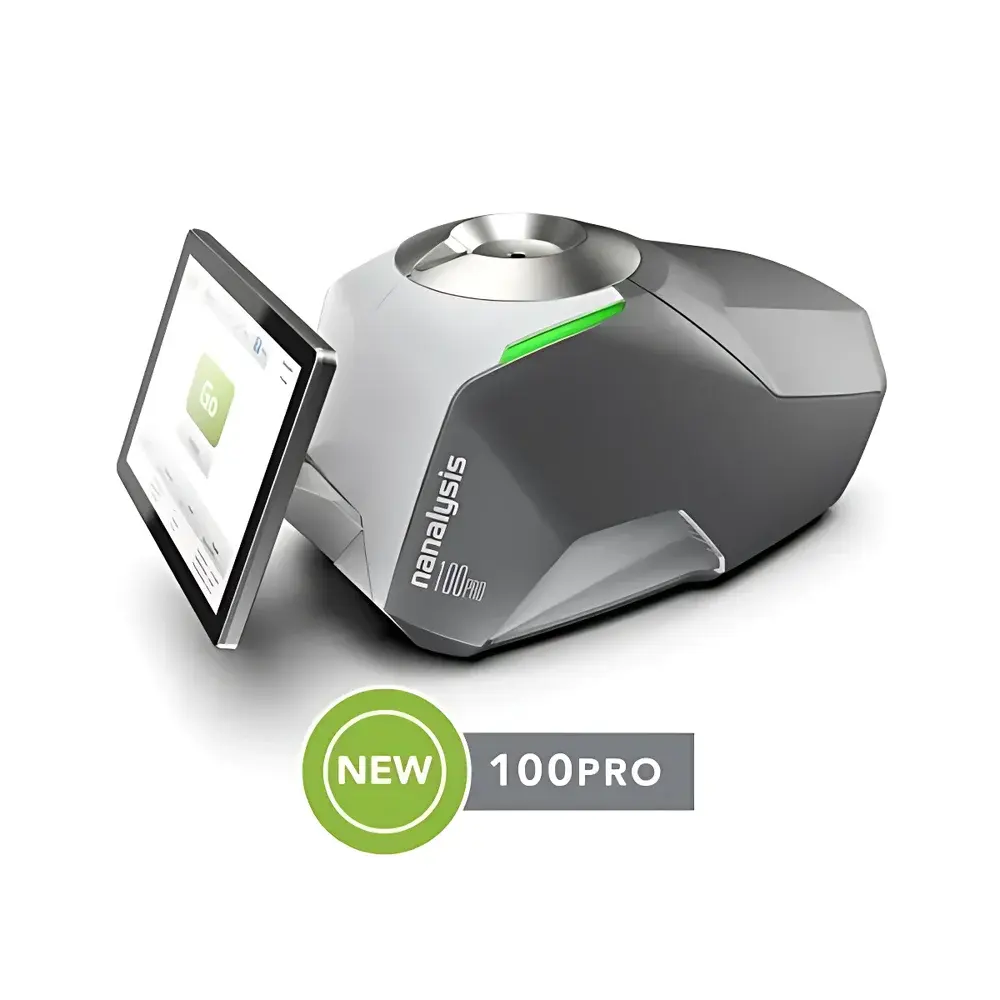
Nanalysis 100 MHz Benchtop Dual-Channel NMR Spectrometer
| Brand | Auniontech (HaoLiang) |
|---|---|
| Origin | Imported |
| Manufacturer Type | Authorized Distributor |
| Model | Nanalysis 100 MHz |
| Operating Frequency | 100 MHz (2.35 T) |
| Magnet Type | Permanent, Cryogen-Free |
| Nuclei Support | Dual-Tuned Probes (e.g., ¹H/¹³C, ¹H/³¹P, ¹H/¹⁹F, ¹H/¹¹B, ¹⁹F/⁷Li) |
| Lock Channel | ¹H or ²H |
| Sample Format | Standard 5 mm NMR tubes |
| Resolution | <1.0 Hz (at 100 MHz) |
| Sensitivity | 220:1 (1% ethylbenzene in CDCl₃) |
| Data Formats | JCAMP-DX, Delta, ACD/Labs, TopSpin, LabVIEW, MATLAB |
| Operating Temperature | 16–28 °C |
| Power Input | 100–240 VAC, 50–60 Hz |
| Dimensions | 37.1 × 41.4 × 65.5 cm (14.6 × 16.3 × 25.8 in) |
| Weight | 84 kg |
| User Interface | Integrated touchscreen PC + remote access capability |
| Compliance | Designed for GLP-compliant environments |
Overview
The Nanalysis 100 MHz Benchtop Dual-Channel NMR Spectrometer is a cryogen-free, permanent-magnet-based nuclear magnetic resonance system engineered for high-fidelity spectroscopic analysis in resource-constrained laboratory environments. Operating at a nominal Larmor frequency of 100 MHz (corresponding to a static magnetic field strength of 2.35 T), this instrument bridges the performance gap between low-field relaxometers and high-field superconducting NMR spectrometers. Its design leverages modern pulse sequence architecture, broadband probe technology, and digital signal processing to deliver quantitative and qualitative molecular characterization—without reliance on liquid helium or nitrogen infrastructure. The system is optimized for routine structural elucidation, reaction monitoring, purity assessment, formulation verification, and compositional quantification across pharmaceutical, food science, polymer, petrochemical, agrochemical, and materials research applications.
Key Features
- Cryogen-Free Permanent Magnet Architecture: Eliminates operational dependency on cryogens, reducing total cost of ownership and enabling deployment in teaching labs, QC facilities, and field-deployable analytical units.
- Dual-Tuned Broadband Probe Support: Configurable for simultaneous or sequential excitation/detection of multiple nuclei—including ¹H/¹³C, ¹H/³¹P, ¹H/¹⁹F, ¹H/¹¹B, and ¹⁹F/⁷Li—facilitating heteronuclear correlation experiments without hardware reconfiguration.
- Enhanced Spectral Resolution & Sensitivity: Achieves <1.0 Hz linewidth (measured on CHCl₃ singlet) and 220:1 signal-to-noise ratio under standardized conditions (1% ethylbenzene in CDCl₃), exceeding typical resolution benchmarks for benchtop platforms by up to 25%.
- Ergonomic Touchscreen Interface: Integrated Windows-based computer with tilt-and-rotate display ensures optimal operator access from seated or standing positions; front- and rear-mounted I/O ports simplify peripheral integration and cable management.
- Modular Data Export Framework: Native support for JCAMP-DX, Delta, ACD/Labs, Bruker TopSpin, LabVIEW, and MATLAB file formats enables seamless interoperability with third-party spectral processing, chemometric modeling, and LIMS environments.
Sample Compatibility & Compliance
The Nanalysis 100 MHz spectrometer accepts standard 5 mm outer-diameter NMR tubes and accommodates both solution-state and semi-solid samples within defined viscosity and conductivity limits. It is compatible with deuterated and non-deuterated solvents, including chloroform-d, DMSO-d₆, methanol-d₄, and water-based matrices when paired with appropriate shimming and lock strategies. From a regulatory standpoint, the platform supports Good Laboratory Practice (GLP) and Good Manufacturing Practice (GMP) workflows when deployed with validated software configurations that enforce electronic signatures, audit trails, and data integrity controls aligned with FDA 21 CFR Part 11 and ISO/IEC 17025 requirements. Instrument qualification documentation—including IQ/OQ protocols—is available upon request for regulated environments.
Software & Data Management
The system ships with Nanalysis’ proprietary acquisition and processing software, featuring intuitive pulse programming, real-time Fourier transformation, phase correction, baseline optimization, peak integration, and multiplet analysis tools. All raw FID data and processed spectra are stored in vendor-neutral formats to ensure long-term archival viability. Remote access via secure SSH or VNC allows off-site method development, data review, and instrument diagnostics. Integration with enterprise-level data management systems—including LIMS and ELN platforms—is supported through API-driven interfaces and scheduled batch exports. Audit-trail functionality logs user actions, parameter changes, and acquisition metadata to meet traceability mandates in regulated QA/QC laboratories.
Applications
This spectrometer serves as a primary analytical tool in diverse application domains: identification and conformational analysis of organic and organometallic compounds; quantification of active pharmaceutical ingredients (APIs) and impurities per USP and ICH Q2(R2); monitoring of polymerization kinetics and crosslinking density in thermosets; authentication and adulteration screening in edible oils and dairy products; determination of ethanol content and metabolite profiling in fermented beverages; characterization of lithium-ion battery electrolyte decomposition products; and rapid screening of cannabinoid profiles in hemp-derived extracts. Its compact footprint and robust mechanical design also make it suitable for process analytical technology (PAT) deployments in pilot-scale reactors and continuous manufacturing lines.
FAQ
Does the Nanalysis 100 MHz require cryogenic cooling?
No—it utilizes a temperature-stabilized permanent magnet assembly, eliminating the need for liquid helium or nitrogen.
Can I run 2D NMR experiments on this system?
Yes—dual-channel capability and flexible pulse programming support homonuclear (e.g., COSY, TOCSY) and heteronuclear (e.g., HSQC, HMBC) correlation experiments.
Is the instrument compliant with FDA 21 CFR Part 11?
The hardware and software architecture are designed to support Part 11 compliance when implemented with validated procedures, electronic signature modules, and audit-trail-enabled data handling workflows.
What sample preparation is required?
Standard NMR sample preparation applies: dissolution in deuterated solvent, filtration if particulates are present, and insertion into a 5 mm NMR tube with appropriate volume (typically 500–600 µL).
How is shimming performed?
Automated gradient shimming is available using the built-in shim coils and software-assisted optimization routines; manual fine-tuning is also supported via graphical interface controls.






