
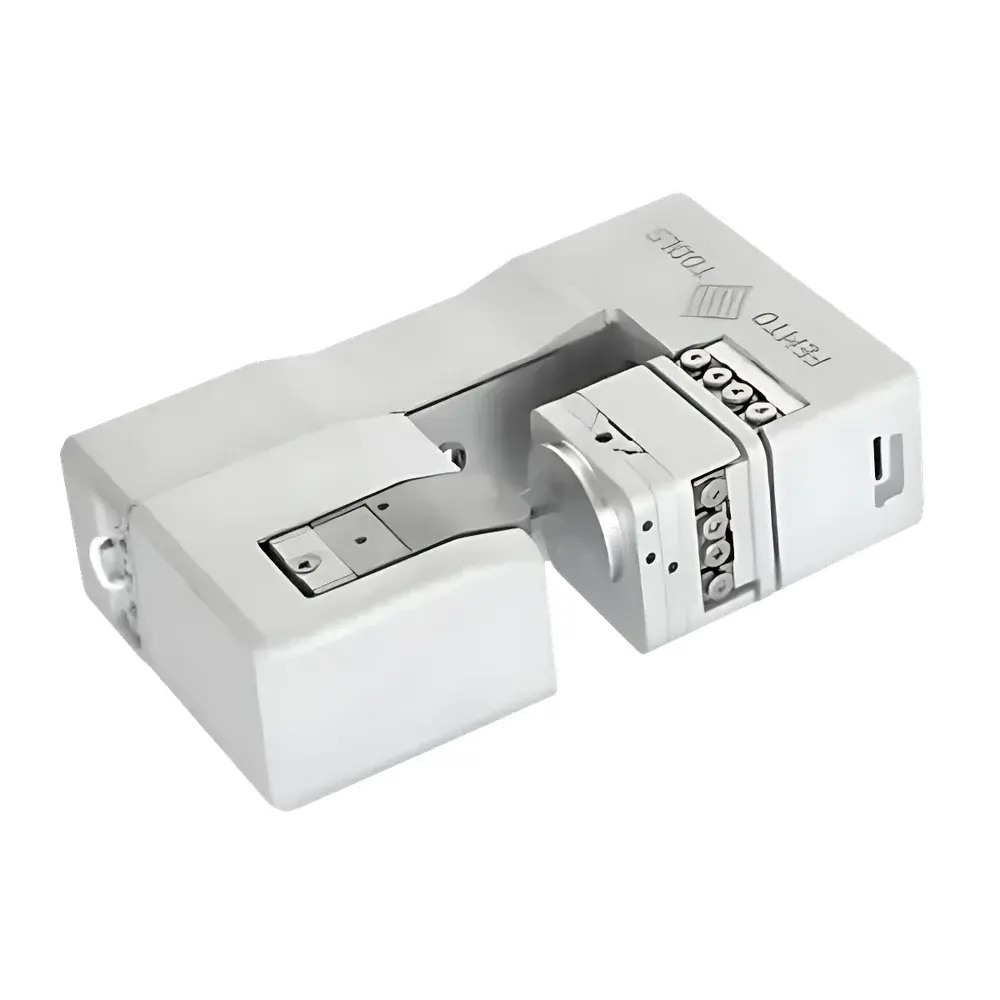
Oxford Instruments FT-NMT04 In-Situ SEM/FIB Nano-Mechanical Testing System
| Brand | Oxford Instruments |
|---|---|
| Origin | Switzerland |
| Model | FT-NMT04 |
| Load Range | 5 selectable full-scale channels, up to 2 N (FT-S2’000’000) |
| Load Resolution | 0.5 nN (FT-S200) |
| Displacement Range | 0.05 nm – 21 mm |
| Displacement Resolution | 0.05 pm |
Overview
The Oxford Instruments FT-NMT04 In-Situ SEM/FIB Nano-Mechanical Testing System is a high-precision, MEMS-based platform engineered for quantitative mechanical characterization of materials at micro- and nanoscales within scanning electron microscopes (SEM) and focused ion beam (FIB) systems. Leveraging over two decades of FemtoTools-developed MEMS transducer technology—licensed and integrated by Oxford Instruments—the FT-NMT04 operates on a closed-loop electrostatic actuation and capacitive sensing principle. This architecture enables true in-situ, real-time correlation between mechanical stimuli and structural response, captured simultaneously via high-resolution SEM imaging, EBSD mapping, or STEM observation. Unlike conventional nanoindenters relying on piezoelectric actuators and strain-gauge load cells, the FT-NMT04’s monolithic silicon MEMS sensor eliminates hysteresis, thermal drift, and frame compliance artifacts, delivering intrinsic force-displacement fidelity across its full dynamic range. It is specifically designed for rigorous investigation of localized deformation mechanisms—including dislocation nucleation, grain boundary sliding, phase transformation, and interfacial decohesion—in bulk metals, ceramics, thin films, nanowires, metamaterials, and MEMS devices.
Key Features
- Patented monolithic MEMS transducer with integrated capacitive displacement sensing and electrostatic actuation
- Five programmable load ranges (from sub-nN to 2 N), enabling seamless transition from ultra-low-force probing to macro-scale micromechanical testing
- True in-situ operation inside high-vacuum SEM/FIB chambers with minimal chamber footprint and no external vibration coupling
- Closed-loop three- or four-axis motorized stage with sub-100 nm positioning repeatability and integrated tilt compensation
- Continuous Stiffness Measurement (CSM) capability up to 500 Hz without dynamic calibration—enabled by real-time capacitance feedback and adaptive control algorithms
- Intrinsic displacement-control mode optimized for rapid unloading events (e.g., pop-in, fracture, buckling), with optional load-control or hybrid modes via PID feedback
- Integrated high-temperature module supporting isothermal mechanical testing up to 800 °C under vacuum or controlled atmosphere
- Modular probe interface accommodating Berkovich, cube-corner, flat-punch, micro-tensile dogbone, and custom micro-compression pillars
Sample Compatibility & Compliance
The FT-NMT04 accommodates a broad spectrum of specimen geometries and material classes: freestanding nanowires (diameter ≥200 nm), sputtered or ALD-deposited thin films (≥10 nm), FIB-prepared micropillars (diameter 0.5–5 µm), MEMS cantilevers, and brittle ceramic cross-sections. Its low-noise floor—500 pN force noise and 50 pm displacement noise—ensures reliable quantification of elastic modulus, hardness, fracture toughness (KIC), yield strength, and strain-rate sensitivity even in ultra-thin or compliant systems. The system complies with ASTM E2546 (Standard Guide for Mechanical Testing of Nanoscale and Microscale Materials), ISO 14577 (Metallic materials — Instrumented indentation test), and supports GLP/GMP-aligned audit trails when used with Oxford’s certified software configuration. Data acquisition meets FDA 21 CFR Part 11 requirements for electronic records and signatures when deployed in regulated R&D environments.
Software & Data Management
Control and analysis are performed via Oxford Instruments’ NMT Control Suite—a deterministic, real-time Windows-based application built on a deterministic RTOS kernel. The suite provides synchronized timestamping of SEM image frames, video streams, force-displacement curves, CSM stiffness spectra, and environmental parameters (temperature, vacuum pressure). All raw data are stored in HDF5 format with embedded metadata (probe geometry, calibration history, operator ID, timestamp, instrument configuration), ensuring FAIR (Findable, Accessible, Interoperable, Reusable) data principles. Batch processing scripts support automated area-mapping of modulus/hardness, statistical outlier removal, and Weibull analysis of strength distributions. Export modules generate publication-ready plots compliant with IEEE and Elsevier formatting standards, and support direct import into MATLAB, Python (via h5py), and Thermo Scientific Avizo for 3D reconstruction-integrated mechanical modeling.
Applications
- Quantitative micro-compression of single-crystal micropillars to extract size-dependent flow stress and dislocation starvation thresholds
- In-situ tensile testing of freestanding metallic nanowires inside SEM, correlating necking evolution with atomic-scale void coalescence
- Fracture mechanics assessment of thin-film/substrate interfaces using micro-cantilever bending with CSM-modulated loading
- High-temperature creep and stress relaxation studies of Ni-based superalloy coatings under isothermal vacuum conditions
- Mechanical mapping of heterogeneous composites (e.g., SiC-reinforced Al matrix) with spatial resolution down to 200 nm
- Dynamic fatigue cycling of MEMS polysilicon beams to quantify cycle-dependent stiffness degradation and crack initiation thresholds
FAQ
Can the FT-NMT04 be installed in existing SEM/FIB systems without major chamber modifications?
Yes—the system uses a standard SEM stub mount and requires only one feedthrough for power/data; installation typically completes within one working day.
Is the MEMS sensor replaceable in the field?
No—each MEMS transducer is factory-calibrated as a monolithic unit; replacement requires return-to-factory recalibration and traceable NIST-traceable certification.
Does the system support automated grid-based mechanical mapping?
Yes—integrated scripting enables fully autonomous XY rastering with user-defined dwell time, load protocol, and image capture triggers per point.
What environmental controls are available beyond temperature?
Optional gas inlet modules allow inert (Ar, N₂) or reactive (H₂, O₂) atmosphere testing; humidity control is not supported due to vacuum compatibility constraints.
How is probe area function calibrated?
Using a certified fused silica reference sample and an automated iterative algorithm that accounts for tip rounding, pile-up, and sink-in—results are traceable to NPL/NIST standards.
Related Products



