
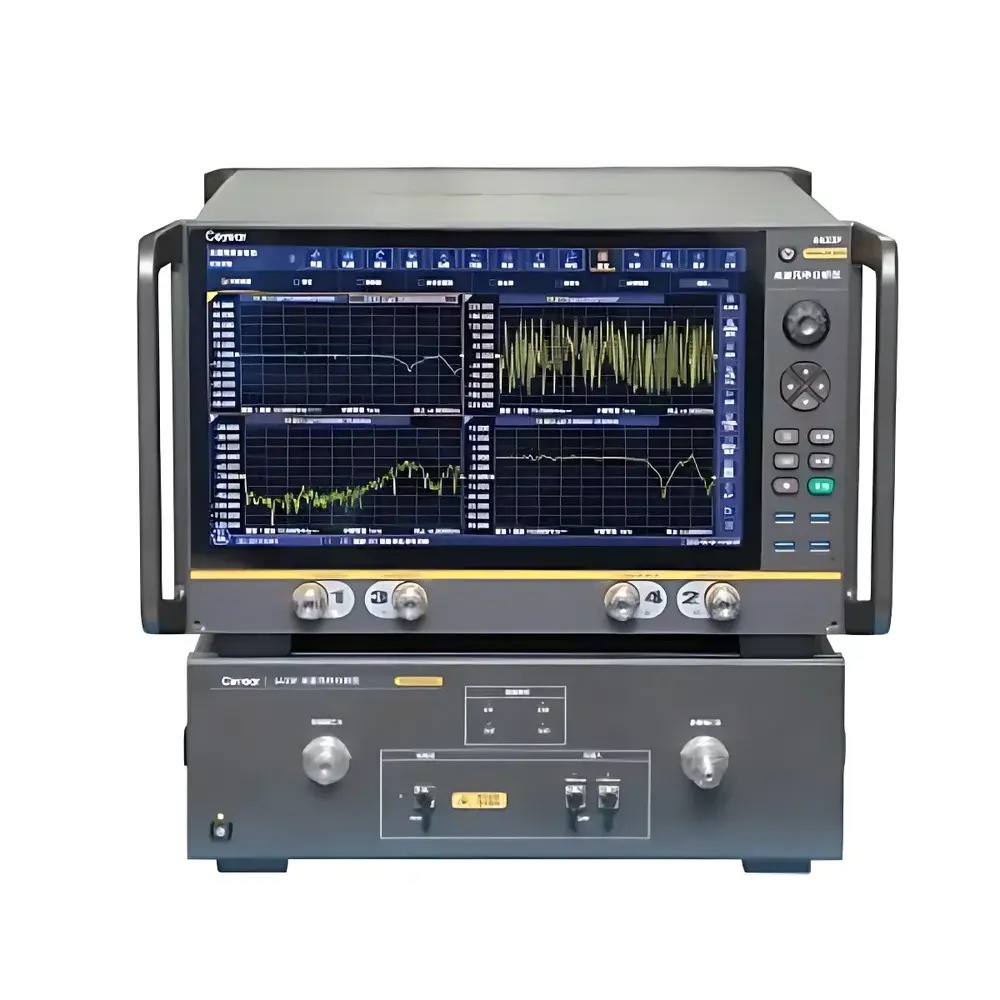
Auniontech 6433 Series Optical Wave Component Analyzer (10 MHz to 67 GHz)
| Brand | Auniontech |
|---|---|
| Origin | Shanghai, China |
| Model | 6433D / 6433F / 6433H / 6433L |
| Frequency Range | 10 MHz – 67 GHz |
| Frequency Resolution | 1 Hz |
| Measurement Modes | EO / OE / OO / EE |
| Calibration | Integrated electrical and optical guided calibration |
| Dynamic Range | >120 dB (typ.) |
| IF Bandwidth | Adjustable (1 Hz – 10 MHz) |
| Wavelength Support | 1260 nm – 1610 nm (external source), optimized for 1310 nm & 1550 nm bands |
| Compliance | Supports IEEE 1686-2019 (for photonic device characterization), compatible with IEC 61280-2-9 (optical modulator testing), and GLP-compliant data logging architecture |
Overview
The Auniontech 6433 Series Optical Wave Component Analyzer is a high-frequency, multi-mode photonic network analyzer engineered for precision characterization of electro-optic (E/O), opto-electric (O/E), and all-optical (O/O) components across the 10 MHz to 67 GHz bandwidth. Unlike conventional RF vector network analyzers adapted for optical use, the 6433 Series integrates dedicated broadband photonic signal generation, modulation, detection, and error-correction architectures into a single platform. Its core measurement principle relies on heterodyne-based frequency-domain analysis combined with real-time phase-coherent sampling, enabling simultaneous acquisition of complex S-parameters, group delay, phase linearity, amplitude-frequency response, and impedance characteristics. Designed specifically for R&D labs, photonic IC foundries, and high-speed transceiver module manufacturers, it supports full compliance with industry-standard test methodologies for high-speed optical interconnects—including those defined in ITU-T G.698.2 (coherent DWDM), IEEE 802.3cd (200G/400G Ethernet), and OIF CEI-112G specifications.
Key Features
- Four scalable models: 6433D (10 MHz–26.5 GHz), 6433F (10 MHz–43.5 GHz), 6433H (10 MHz–50 GHz), and 6433L (10 MHz–67 GHz), each sharing identical firmware, calibration framework, and user interface logic
- Unified four-domain measurement engine supporting EE (electrical-electrical), EO (electrical-optical), OE (optical-electrical), and OO (optical-optical) configurations within a single instrument session
- Guided calibration workflow with integrated electrical SOLT and optical photonic calibration kits—enabling traceable, NIST-compatible uncertainty budgets per ANSI/NCSL Z540-1
- Adjustable intermediate frequency (IF) bandwidth (1 Hz to 10 MHz) for dynamic range optimization—achieving >120 dB dynamic range at narrow IF settings and <0.005° phase noise floor at 1 GHz offset
- On-wafer probing support via de-embedding and fixture removal algorithms compliant with IPC-7351B layout standards and EM-simulation-assisted error modeling
- Dual-channel optical receiver architecture with absolute frequency response flatness better than ±0.25 dB from 10 MHz to 67 GHz, calibrated against NIST-traceable reference photodiodes
- Built-in wide-dynamic-range optical power meter (−70 dBm to +10 dBm, ±0.15 dB accuracy) for real-time input power monitoring during external laser source integration
Sample Compatibility & Compliance
The 6433 Series accommodates standard fiber-pigtailed devices (FC/APC, SC/PC), planar lightwave circuit (PLC) modules, silicon photonics PICs, and bare-die photonic integrated circuits via configurable RF/optical probe stations. It natively supports polarization-maintaining (PM) and single-mode (SMF-28) fiber interfaces, with optional polarization controller integration for MZI-based LiNbO3 modulator testing. All measurement data logs include embedded metadata required for ISO/IEC 17025 accreditation—such as environmental temperature/humidity stamps, calibration certificate IDs, operator credentials, and instrument firmware revision. The system architecture conforms to FDA 21 CFR Part 11 requirements for electronic records and signatures when configured with audit-trail-enabled software licensing.
Software & Data Management
Controlled by Auniontech’s PhotonSuite™ v4.x software, the analyzer delivers a unified GUI with synchronized time-domain and frequency-domain visualization, Smith chart overlays, TDR/TDT analysis, and automated pass/fail reporting per user-defined mask templates. Raw IQ data export is supported in HDF5, MAT, and Touchstone (S2P/S4P) formats—with full metadata preservation including wavelength, bias conditions, thermal state, and calibration epoch. Data integrity is ensured through SHA-256 hashing of all measurement sessions, and optional integration with LabArchives ELN or Benchling LIMS enables direct traceability to experimental protocols and QC workflows. Firmware updates are delivered via cryptographically signed packages verified against Auniontech’s public key infrastructure.
Applications
- Characterization of Mach-Zehnder modulators (MZMs), electro-absorption modulators (EAMs), and directly modulated lasers (DMLs) — including small-signal S21, S11, group delay ripple, and chirp parameter extraction
- Frequency response validation of high-speed photodetectors (PIN, APD, UTC-PD) and optical receivers—supporting 3 dB bandwidth determination, pulse response reconstruction, and eye diagram synthesis
- Passive component analysis of fiber Bragg gratings (FBGs), arrayed waveguide gratings (AWGs), and thin-film filters under swept-wavelength and swept-frequency excitation
- Photonic integrated circuit (PIC) debugging—enabling on-die S-parameter mapping, crosstalk isolation assessment, and thermal drift profiling across operational bias sweeps
- Research-grade dispersion measurement of specialty fibers and microresonators using phase-derived group index calculation
FAQ
Does the 6433 Series support automatic calibration with third-party optical calibration kits?
Yes—it accepts user-defined calibration kit definitions conforming to IEC 61280-2-9 Annex B format, including custom-defined reflection coefficients, delay values, and loss profiles.
Can the instrument perform time-domain reflectometry (TDR) on photonic waveguides?
Yes—via inverse Fourier transform of frequency-domain S-parameters, with windowing options (Hamming, Kaiser-Bessel) and impedance normalization to 50 Ω or user-defined Z0.
Is external laser source control integrated into the software?
Yes—PhotonSuite™ provides GPIB, USB-TMC, and SCPI-over-TCP/IP drivers for seamless synchronization with tunable lasers (e.g., Keysight, Santec, Yenista) and optical attenuators.
What is the minimum measurable optical power level during OE mode?
The built-in optical receiver achieves −70 dBm sensitivity (1550 nm, 10 GHz BW) with RMS noise floor below −125 dBm/Hz.
Are firmware updates provided free of charge for the lifetime of the hardware?
All minor version updates (v4.x.y) are included at no cost; major version upgrades (v5.x) require a valid maintenance agreement.





