
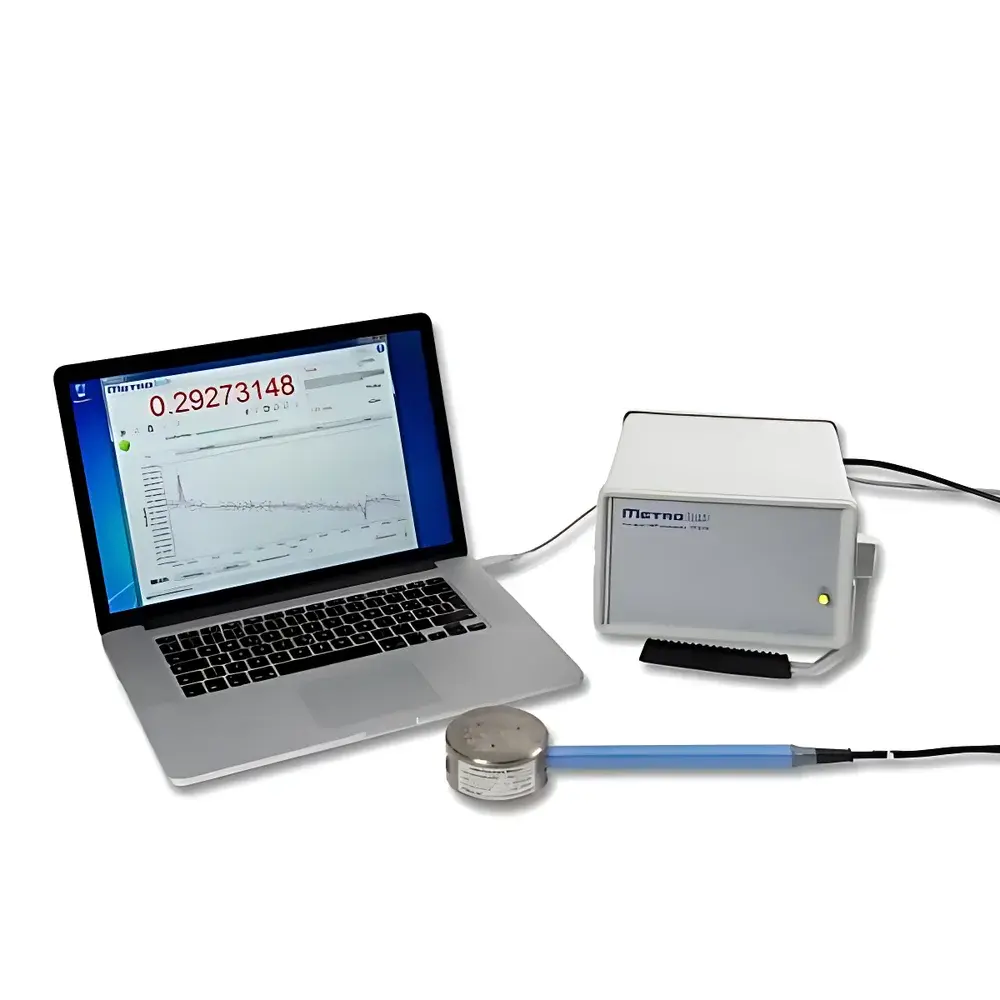
Metrolab PT2026 Nuclear Magnetic Resonance Gaussmeter
| Brand | Auniontech |
|---|---|
| Origin | Shanghai, China |
| Manufacturer Type | Authorized Distributor |
| Regional Classification | Domestic (PRC) |
| Model | PT2026 NMR Gaussmeter |
| Instrument Type | NMR Field Meter (not MRI scanner) |
| Operating Frequency Range | 1 MHz – 1.1 GHz |
| Frequency Resolution | ±0.1 Hz |
| Absolute Accuracy | ±5 ppm |
| Magnetic Field Range | 38 mT to 30 T (proton/deuterium probe dependent) |
| Max. Spatial Gradient Tolerance | >1000 ppm/cm |
| Measurement Rate | up to 33 Hz (single-point) |
| Probe Series | 1326, 1426, 1526 |
| Interface | USB (USBTMC), Ethernet (VXI-11), IEEE 488.2 (GPIB), 10 MHz Ref I/O |
| Power | 100–240 VAC, 50/60 Hz, ≤50 VA |
Overview
The Metrolab PT2026 Nuclear Magnetic Resonance Gaussmeter is a high-precision, laboratory-grade field measurement instrument engineered for absolute magnetic flux density quantification using the fundamental quantum mechanical principle of pulsed nuclear magnetic resonance (NMR). Unlike Hall-effect or fluxgate magnetometers, the PT2026 exploits the Larmor precession frequency of atomic nuclei—primarily protons (1H) and deuterons (2H)—in a static magnetic field, where B₀ = fL / γ. This relationship is intrinsically traceable to the gyromagnetic ratio (γ), a SI-defined constant with negligible temperature dependence, enabling long-term stability and metrological-grade accuracy. The PT2026 achieves an absolute uncertainty of ±5 ppm across its full operational range (38 mT to 30 T), independent of ambient temperature fluctuations—a critical requirement for superconducting magnet characterization, accelerator dipole calibration, and ultra-stable field monitoring in quantum computing infrastructure. Its 1 MHz–1.1 GHz RF bandwidth supports both conventional proton-based measurements (up to ~23 T with optimized probes) and high-field deuteron detection (theoretically up to 153 T), extending utility beyond standard MRI and fusion magnet applications into extreme-field physics research.
Key Features
- Pulsed NMR measurement principle with intrinsic SI-traceability and zero drift over time
- Frequency resolution of ±0.1 Hz under low-gradient, stable-field conditions
- Extended gradient tolerance (>1000 ppm/cm), enabling reliable operation in highly inhomogeneous fields—e.g., near magnet edges or in fringe-field zones
- High-speed acquisition mode: up to 33 Hz single-point measurement rate, configurable via software trade-off between precision and temporal resolution
- Integrated 3-axis Hall sensor for sub-second auto-search initiation—reducing idle time from ~10 s (PT2025) to <1 s
- Modular probe architecture: 1326 (broadband, MRI-compatible), 1426 (cryogenic-rated), and 1526 (ultra-miniature, 6.5 mm diameter, radiation-hardened)
- Dual-reference timing: internal 10 MHz oscillator or external 10 MHz reference input for synchronization with master lab clocks, eliminating periodic recalibration
- Trigger I/O support: TTL-compatible trigger-in for synchronized acquisition and trigger-out for event-driven control of auxiliary equipment (e.g., power supplies, data loggers)
Sample Compatibility & Compliance
The PT2026 is designed for non-contact, non-perturbative measurement of static (DC) magnetic fields in environments ranging from cryogenic bore tubes (4 K) to high-radiation zones (e.g., synchrotron beamlines, nuclear test facilities). Its probe electronics are electrically isolated and housed in non-magnetic stainless-steel enclosures compliant with IEC 61000-6-3 (EMC emission) and IEC 61000-6-2 (immunity). While not a medical device, the system adheres to general-purpose laboratory instrumentation standards including ISO/IEC 17025 traceability frameworks when used with certified NMR reference probes. It supports audit-ready data logging with timestamped metadata, compatible with GLP/GMP workflows requiring 21 CFR Part 11–compliant electronic records when integrated with validated third-party software platforms.
Software & Data Management
The PT2026 ships with Metrolab’s proprietary FieldMaster™ software, offering real-time visualization of time-domain FID signals, FFT spectra, field homogeneity maps, and statistical metrics (mean, std dev, min/max). All interfaces comply with industry-standard protocols: SCPI command set over USBTMC or VXI-11/Ethernet, full LabVIEW® driver support (NI-VISA), and Python/C++ SDKs. Raw NMR signal waveforms can be streamed to external oscilloscopes via analog output for diagnostic validation. Data export supports CSV, HDF5, and MATLAB .mat formats, with optional encryption and digital signature modules for regulated environments. Firmware updates are delivered via signed packages with SHA-256 verification.
Applications
- Calibration and mapping of superconducting magnets in particle accelerators (CERN, Fermilab) and fusion reactors (ITER, SPARC)
- In-situ field uniformity verification during MRI magnet installation and QA/QC maintenance
- Long-term drift monitoring of permanent magnet arrays in precision motion systems
- Characterization of pulsed-field magnets under ramping conditions (with gated acquisition)
- Reference-grade field validation in national metrology institutes (NMIs) and accredited calibration labs
- Low-temperature magnetometry in dilution refrigerators and high-field cryostats
FAQ
What is the difference between the PT2026 and PT2025?
The PT2026 improves upon the PT2025 in five key areas: (1) 33× faster maximum measurement rate (33 Hz vs. 1 Hz), (2) doubled gradient tolerance in inhomogeneous fields, (3) sub-second auto-search via integrated 3-axis Hall sensor, (4) extended field range via new probe designs (e.g., 1526 series for confined spaces), and (5) enhanced timing flexibility with dual 10 MHz reference options.
Can the PT2026 measure time-varying fields?
It is optimized for static (DC) and quasi-static fields. For rapidly varying fields (>1 Hz modulation), users must employ gated acquisition synchronized to the field waveform; real-time tracking of fast transients is not supported.
Is probe calibration required before each use?
No. Probes are factory-calibrated against NIST-traceable standards and retain calibration for the lifetime of the unit under normal operating conditions. Only periodic verification against a known reference field is recommended per ISO/IEC 17025 guidelines.
Does the system support remote operation in hazardous environments?
Yes. The “remote probe” configuration separates the sensitive RF front-end from the measurement head via coaxial cable (up to 5 m), enabling deployment in high-radiation, ultra-high-vacuum, or cryogenic chambers while housing electronics in shielded, accessible locations.
How is traceability ensured for metrological applications?
Traceability is maintained through the fundamental NMR equation and the SI-defined gyromagnetic ratio of 1H (γp = 267.52218744 × 10⁶ rad·s⁻¹·T⁻¹), which links measured frequency directly to magnetic flux density without intermediate transfer standards.






