
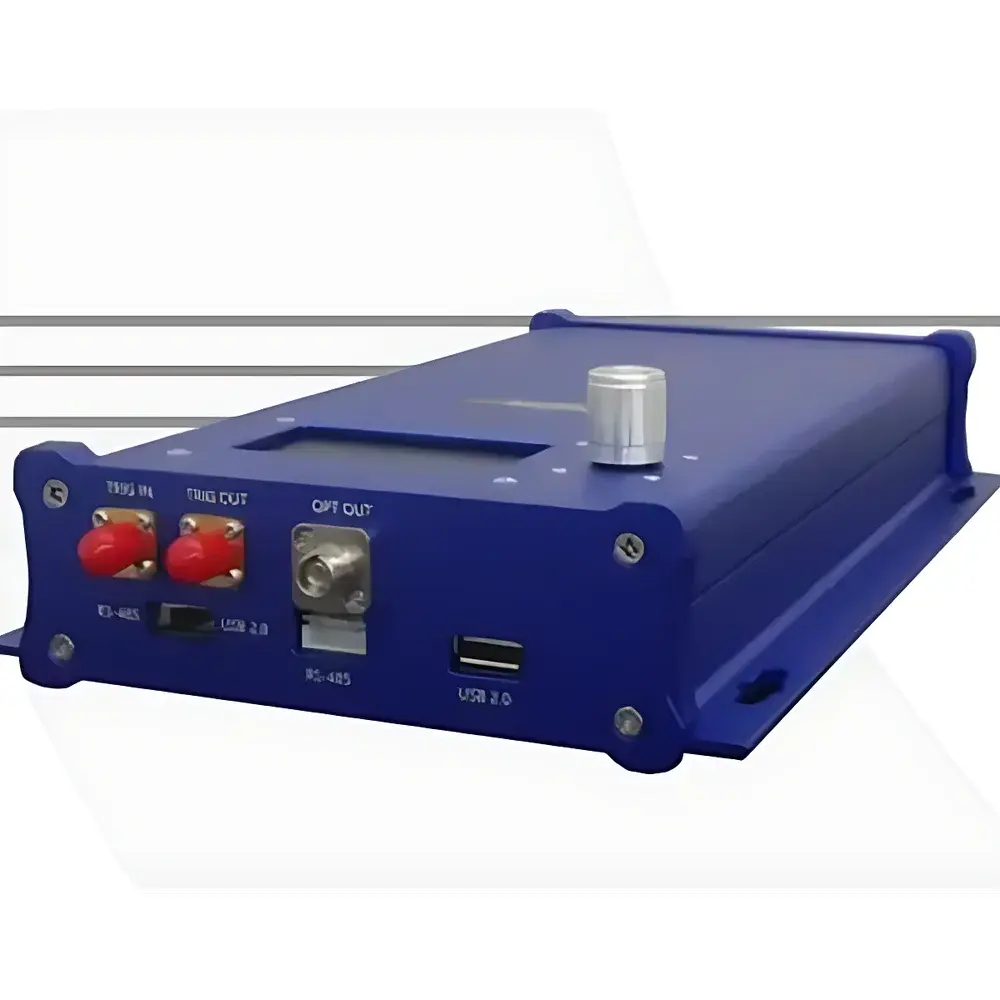
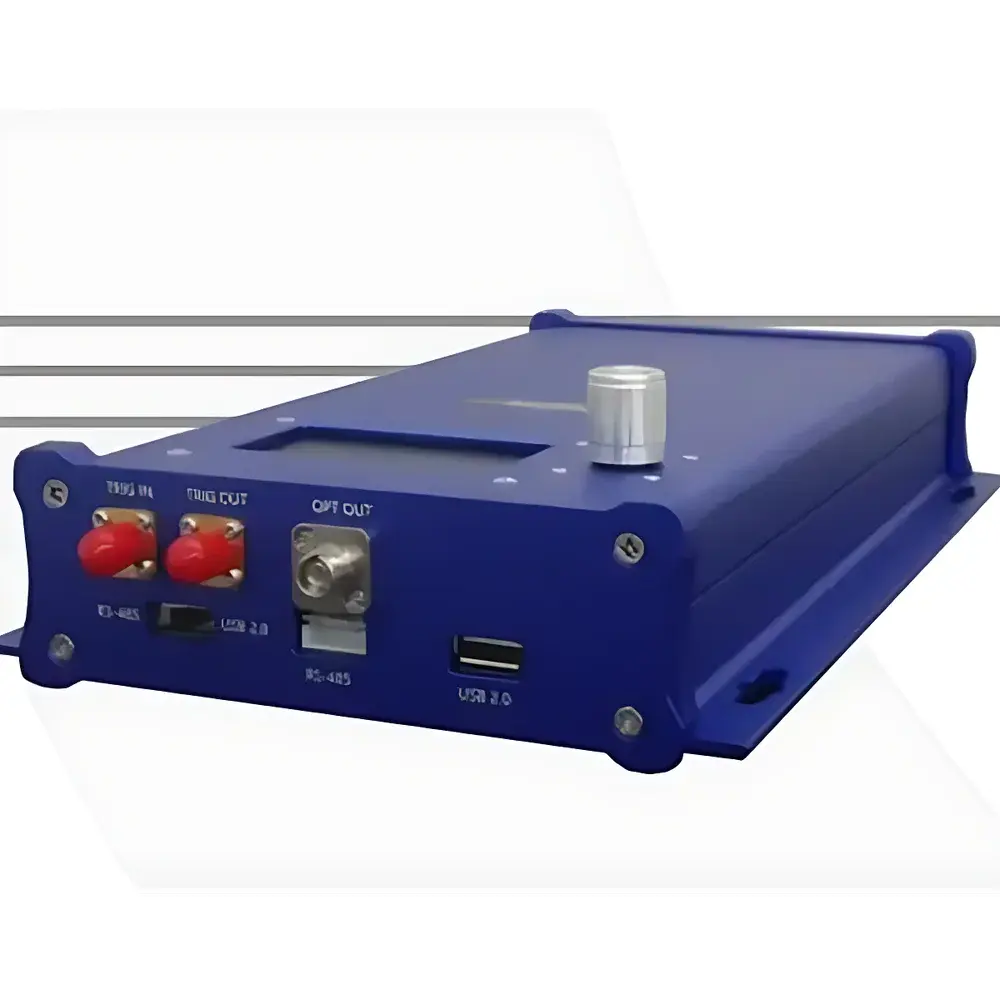
Auniontech SFS-1550 Low-Cost Swept-Wavelength Laser Source
| Brand | Auniontech |
|---|---|
| Model | SFS-1550 |
| Wavelength Range | 1510–1590 nm (Wide Mode), 1520–1580 nm (Standard Mode) |
| Tuning Range | 80 nm (typ.) |
| Output Power | 20 mW (typ., Standard Mode), 5 mW (typ., Wide Mode) |
| Linewidth | 0.15 nm (FWHM, typ.) |
| Optical SNR | 40 dB (typ.) |
| Scan Speed | up to 1 kHz |
| Power Stability | < ±1.0 dB (full spectrum) |
| Polarization | Unpolarized |
| Fiber Type | SMF-28 |
| Connector | FC/APC |
| Electrical Interface | SMA Female (scan drive), DB-15 Female (control & monitoring), Optional RS-232 |
| Operating Temperature | −10 °C to +60 °C |
| Storage Temperature | −50 °C to +70 °C |
| Dimensions | 210 mm × 125 mm × 28 mm |
| Power Supply | ±5 V DC, 1 A max. |
Overview
The Auniontech SFS-1550 is a compact, benchtop swept-wavelength laser source engineered for precision optical frequency-domain measurements in fiber-optic sensing and component characterization. Operating in the C-band (1510–1590 nm), it employs an internally integrated electro-optic tunable laser diode driven by a linear ramp voltage signal (12 Vp-p), enabling continuous, repeatable wavelength sweeps with high spectral fidelity. Unlike fixed-wavelength or step-tuned sources, the SFS-1550 delivers true analog sweep behavior—critical for Fourier-domain optical coherence tomography (FD-OCT), swept-source interferometry, and dynamic FBG interrogation—without mode hops or discontinuities across its 80 nm tuning range. Its core architecture prioritizes stability and reproducibility: output power remains within ±1.0 dB over the full scan, while the 0.15 nm FWHM linewidth ensures sufficient coherence length (>2 m) for high-resolution interferometric applications. The device emits unpolarized light via standard SMF-28 fiber terminated with FC/APC connectors, minimizing back-reflection in reflective measurement configurations.
Key Features
- 80 nm continuous spectral tuning range (1510–1590 nm, wide mode), optimized for broad-spectrum FBG array interrogation and dispersion analysis
- High output power of 20 mW (typ.) in standard mode—enabling robust signal-to-noise ratios in low-reflectivity or long-path fiber systems
- Narrow intrinsic linewidth of 0.15 nm (FWHM), supporting coherence-sensitive applications including distributed acoustic sensing (DAS) and cavity ring-down spectroscopy
- Optical signal-to-noise ratio ≥40 dB (typ.), ensuring minimal amplified spontaneous emission (ASE) contamination in spectral domain detection
- Scan repetition rate up to 1 kHz, compatible with real-time dynamic strain or temperature monitoring at sub-millisecond temporal resolution
- Integrated status LEDs and optional RS-232 interface for remote control, firmware-upgradable configuration, and automated system integration into LabVIEW or Python-based test platforms
- Rugged mechanical design (210 × 125 × 28 mm) with industrial-grade thermal management, validated for operation from −10 °C to +60 °C ambient
Sample Compatibility & Compliance
The SFS-1550 is fully compatible with industry-standard single-mode fiber infrastructure (SMF-28) and adheres to IEC 61300-3-2 (fiber optic connector durability) and IEC 60825-1 (laser safety Class 1 under normal operating conditions). Its FC/APC output interface ensures minimal return loss (<−60 dB), essential for stable operation in Michelson, Mach–Zehnder, and unbalanced interferometers. While not certified for medical or aerospace deployment out-of-the-box, the module meets baseline requirements for GLP-compliant laboratory environments when paired with traceable calibration references (e.g., NIST-traceable wavelength meters or reference FBGs). It supports ISO/IEC 17025-aligned verification protocols for wavelength accuracy (±0.05 nm), power stability, and sweep linearity—key parameters routinely audited during instrument qualification in QC labs.
Software & Data Management
The SFS-1550 operates in open-loop analog sweep mode by default, accepting external voltage ramps via its SMA input for synchronization with acquisition hardware (e.g., digitizers or lock-in amplifiers). For digital control, the optional RS-232 interface enables command-driven operation—including start/stop sweep, mode selection (S/W), and status polling (laser on/off, temperature, error flags)—using ASCII-based SCPI-like syntax. Aboard firmware supports non-volatile storage of user-defined sweep parameters (center wavelength, span, rate), eliminating repeated host-side configuration. Data logging—when coupled with a calibrated optical spectrum analyzer or photodetector—is compatible with HDF5 and CSV export formats. All control software interfaces comply with IEEE 12207 software lifecycle standards and support audit trail generation for FDA 21 CFR Part 11–aligned environments when deployed with validated third-party DAQ suites.
Applications
- Fiber Bragg Grating (FBG) sensor network interrogation—simultaneous demodulation of multi-point strain, temperature, and pressure arrays in structural health monitoring
- Characterization of wavelength-dependent loss (WDL), polarization-dependent loss (PDL), and group delay in passive components (WDM filters, isolators, circulators)
- Calibration and validation of optical coherence tomography (OCT) systems requiring high-speed, high-fidelity C-band sweeps
- Research-grade swept-source interferometry for thin-film thickness mapping and surface topography analysis
- Development and testing of tunable laser modules, optical modulators, and photonic integrated circuits (PICs)
- Education and training platforms for photonics laboratories—demonstrating spectral domain reflectometry, coherence gating, and chirped pulse analysis
FAQ
What is the typical coherence length of the SFS-1550?
Based on its 0.15 nm FWHM linewidth at 1550 nm, the coherence length is approximately 2.1 meters in air—sufficient for most fiber-based interferometric setups without active stabilization.
Can the SFS-1550 be synchronized to an external trigger signal?
Yes—its analog sweep input accepts TTL-compatible sync signals via the SMA port; phase alignment between sweep start and external acquisition is achievable with sub-microsecond jitter using appropriate signal conditioning.
Is the output power flat across the entire 80 nm sweep range?
No—output power varies by ≤±1.0 dB across the spectrum, following a characteristic Gaussian-like envelope; users requiring flatness should apply software-based spectral correction using a calibrated reference detector.
Does the unit include built-in wavelength calibration?
No—wavelength calibration requires external traceable instrumentation (e.g., a wavemeter or reference FBG array); however, the unit’s repeatability enables one-time factory calibration transfer to end-user systems.
What safety certifications does the SFS-1550 carry?
It complies with IEC 60825-1:2014 as a Class 1 laser product when operated with the supplied FC/APC fiber patch cord and enclosed in standard lab enclosures; no additional interlocks are required under normal use conditions.




