
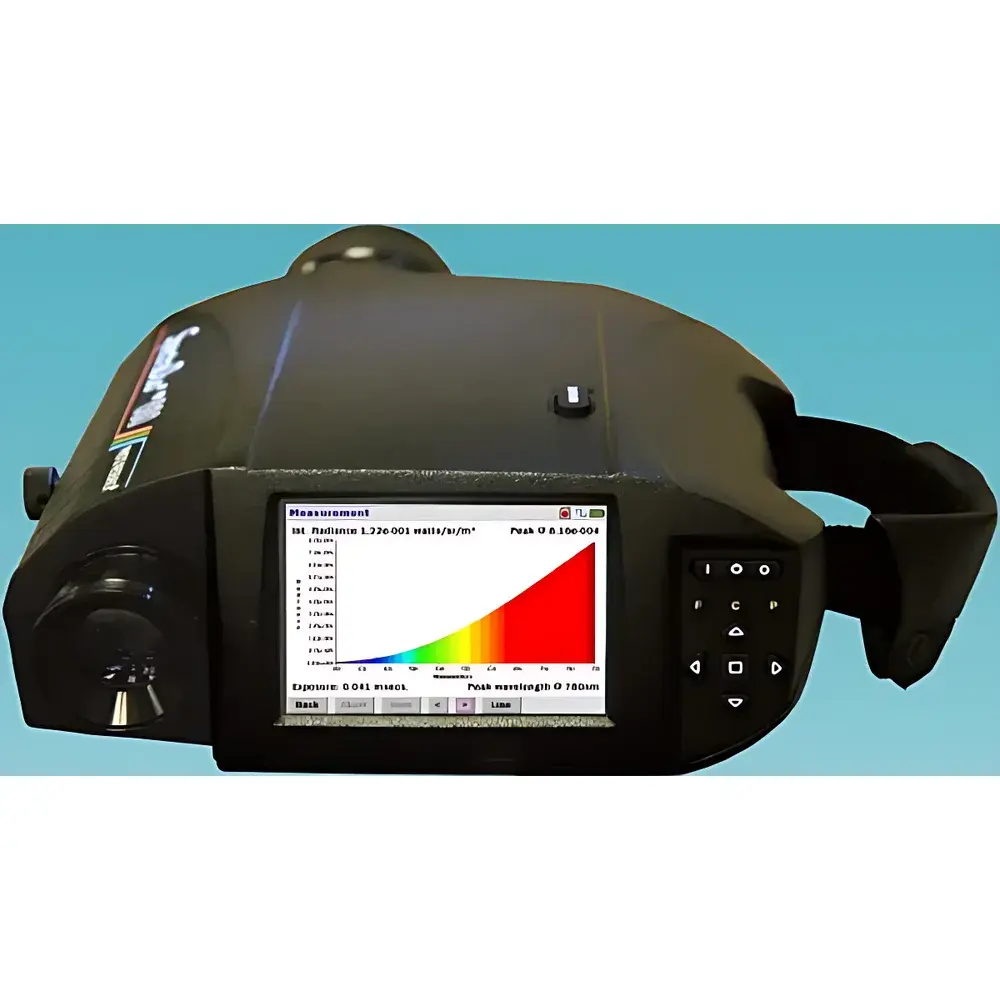
Photo Research PR-655 Spectroradiometer
| Brand | Photo Research |
|---|---|
| Origin | USA |
| Model | PR-655 |
| Spectral Resolution | 3.12 nm/pixel |
| Detector Array | 128-element CCD |
| Standard Aperture | 1° |
| Optional Apertures | 0.5° |
| Measurement Modes | Luminance, Radiance, Illuminance, Chromaticity, CCT, CRI, Dominant Wavelength, SPD |
| Sync Capability | AutoSync with AC mains or source flicker frequency |
| Interface | USB 2.0, Bluetooth (optional), RS-232 (via emulator driver) |
| Data Storage | SD card (included) |
| Power | Rechargeable Li-ion battery (≥12 h continuous operation) |
| Display | 2.25" × 3" full-color touchscreen + 5-way keypad |
| Compliance | NIST-traceable calibration, ISO/IEC 17025–accredited calibration labs |
Overview
The Photo Research PR-655 Spectroradiometer is a portable, battery-powered, high-precision instrument engineered for spectral radiance and luminance measurement across research, manufacturing, and quality assurance environments. Operating on the principle of grating-based dispersive spectrometry, the PR-655 captures full spectral power distributions (SPDs) from 380 nm to 780 nm with 3.12 nm spectral resolution per pixel using a thermoelectrically stabilized 128-element CCD detector array. Its optical architecture is optimized for low-stray-light performance and high photometric linearity, enabling traceable measurements compliant with CIE S 026/E:2015, ISO/CIE 11664 (colorimetry), and IEC 62471 (photobiological safety). Designed as the direct successor to the widely deployed PR-650, the PR-655 integrates field-proven radiometric accuracy with enhanced operational flexibility—including AutoSync synchronization to AC-powered or PWM-driven light sources—ensuring stable integration during pulsed or flickering emission events.
Key Features
- Portable, self-contained operation: No external PC required for real-time spectral acquisition, calculation, and display.
- High-resolution color touchscreen interface (2.25″ × 3″) with intuitive menu navigation and five-way keypad for glove-compatible use in lab or field settings.
- AutoSync function automatically detects and locks to the fundamental frequency of AC-powered or digitally modulated light sources (e.g., LED drivers, LCD backlights), eliminating aliasing and ensuring repeatable integration timing.
- Dual-aperture system: Standard 1° field-of-view; optional 0.5° aperture available for high-spatial-resolution measurements of small emitters or display subpixels.
- Extended dynamic range achieved via dual-gain analog front-end and four selectable integration speeds—supporting measurements from 10⁶ cd/m² (sunlight-bright displays).
- Onboard SD card storage supports >5,000 full-spectrum records with metadata (timestamp, aperture, integration time, user notes), formatted for direct import into SpectraWin or third-party analysis tools.
- Rechargeable lithium-ion battery provides ≥12 hours of continuous operation—validated under typical measurement duty cycles (1–5 s per reading, ambient temperature 20–25°C).
Sample Compatibility & Compliance
The PR-655 accommodates diverse sample geometries and measurement configurations through a modular accessories ecosystem. It supports direct viewing of planar emitters (displays, signage), fiber-coupled remote sensing (for inaccessible or hazardous locations), cosine-corrected irradiance/illuminance heads (compliant with ISO/CIE 19125-1), and CIE 127-compliant LR-127 LED test fixtures for total flux and spatial uniformity assessment. All factory calibrations are NIST-traceable and performed in Photo Research’s ISO/IEC 17025-accredited laboratories—each maintaining documented uncertainty budgets per ANSI/NCSL Z540 and ILAC-P10. The instrument meets electromagnetic compatibility requirements per FCC Part 15 Class B and CE EN 61326-1. For regulated industries (medical device validation, pharmaceutical lighting QC), measurement data logs include full audit trail metadata compatible with FDA 21 CFR Part 11–aligned software workflows when used with SpectraWin v7.5+.
Software & Data Management
SpectraWin software (v7.5 or later) provides comprehensive control, analysis, and reporting capabilities via USB or Bluetooth. It supports automated multi-point mapping routines, pass/fail tolerance band overlays against industry standards (e.g., VESA DisplayHDR, ISO 3664), and export of CIE 1931 xy, u’v’, and Jzazbz coordinates. Remote operation is enabled via ASCII command protocol over USB virtual COM port or Bluetooth SPP—enabling integration into automated test equipment (ATE) platforms, PLC-controlled production lines, or custom Python/Matlab scripts. The included RS-232 emulator driver allows legacy system compatibility without hardware modification. All spectral data files (.spc) embed calibration coefficients, aperture ID, and environmental sensor readings (optional integrated ambient temperature/humidity module), ensuring long-term measurement reproducibility and metrological integrity.
Applications
- Display characterization: Luminance uniformity, chromaticity shift vs. viewing angle, temporal response of OLED/LCD/Mini-LED panels.
- LED and solid-state lighting R&D: Spectral binning, CRI (R1–R15), TM-30-20 fidelity and gamut indices, phosphor degradation monitoring.
- Automotive HMI validation: Instrument cluster, head-up display (HUD), and interior ambient lighting compliance with UNECE R112 and SAE J1757-2.
- Print and packaging QC: Spectral reflectance of inks, substrates, and security features per ISO 13655 and ASTM E308.
- Dental and medical colorimetry: Shade matching verification against VITA Classical/3D-Master scales under standardized illuminants (D50, D65).
- Human factors and vision science: Mesopic photometry, scotopic/photopic ratio analysis, circadian stimulus (CS) calculation per UL 24480.
- Projection system homogeneity testing: Simultaneous multi-point brightness and color uniformity mapping using up to 15 remote photometric probes.
FAQ
Is the PR-655 calibrated to NIST standards?
Yes—every unit ships with a certificate of calibration traceable to NIST through Photo Research’s network of ISO/IEC 17025-accredited laboratories. Calibration includes spectral responsivity, photopic weighting, and angular response characterization.
Can the PR-655 measure both luminance and irradiance?
Yes—when fitted with the optional cosine-corrected irradiance head (e.g., PR-500 series diffusers), it measures illuminance (lux) and spectral irradiance (W/m²/nm); the base configuration measures radiance (W/sr/m²/nm) and luminance (cd/m²).
What is the minimum measurable luminance level?
With the standard 1° aperture and longest integration time, the PR-655 achieves a noise floor of ≤0.0005 cd/m²—sufficient for measuring deep-black states in HDR displays and low-output micro-LED arrays.
Does the PR-655 support automated production-line integration?
Yes—its ASCII remote command set, TTL trigger input, and USB/Bluetooth interfaces enable seamless integration into ATE systems. Custom drivers and LabVIEW/VB.NET SDKs are available upon request.
Are legacy PR-650 accessories compatible with the PR-655?
Yes—mechanical, optical, and electrical interfaces are fully backward-compatible; all PR-650 probe heads, apertures, lens attachments, and mounting hardware operate identically on the PR-655 platform.





