
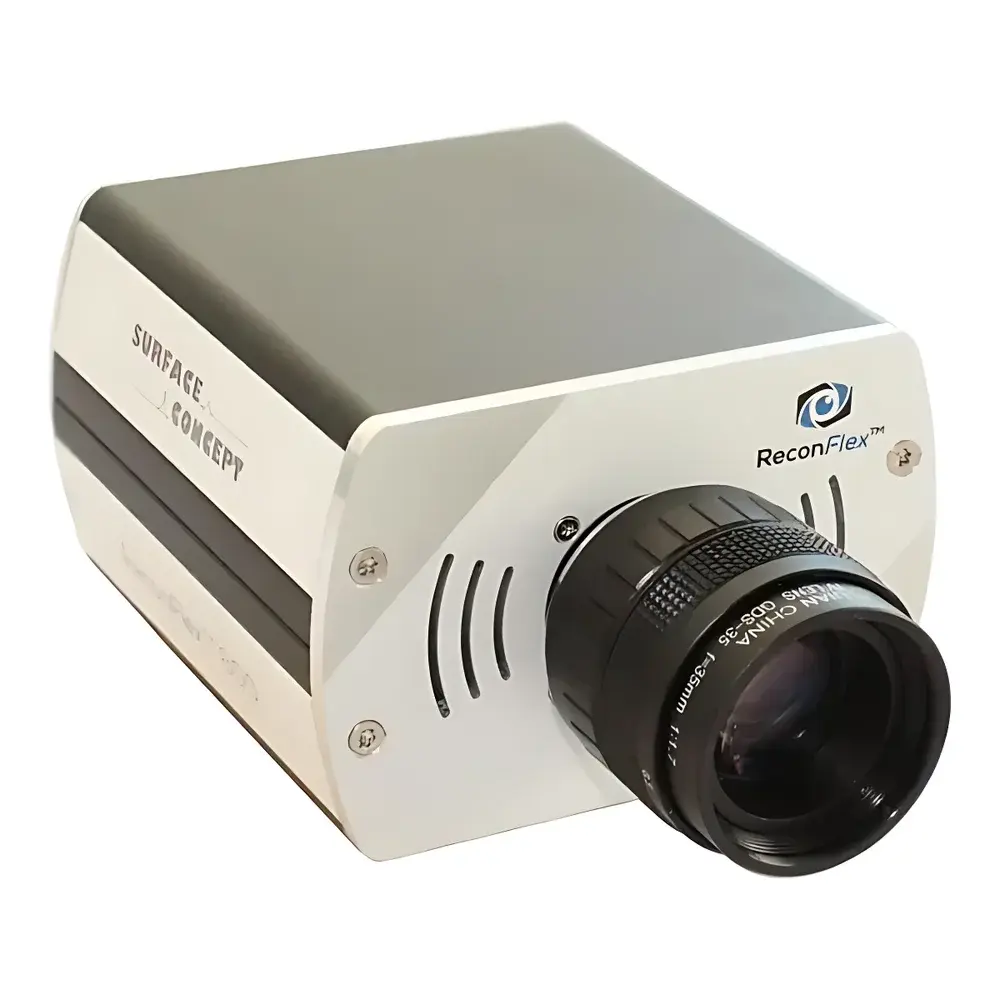
Auniontech ReconFlex High-Speed Single-Molecule Localization CMOS Camera
| Brand | Auniontech |
|---|---|
| Origin | Shanghai, China |
| Model | ReconFlex Series (1920R / 800) |
| Sensor Format | CMOS, 2/3" (1920R) / 1/1.7" (800) |
| Shutter Type | Global Shutter |
| Resolution | 1920 × 1440 (1920R) / 800 × 624 (800) |
| Pixel Size | 4.5 µm × 4.5 µm (1920R) / 9 µm × 9 µm (800) |
| Read Noise (typ.) | <3 e⁻ (1920R) / <6 e⁻ (800) |
| Dynamic Range | 80 dB |
| Exposure Time | 4 µs – 10 s (1920R) / 2 µs – 10 s (800) |
| Bit Depth | 8-bit & 12-bit output |
| Max Image Buffer | 32-bit |
| Frame Rate (Full Resolution) | 417 fps (8-bit, 1920R) / 1577 fps (8-bit, 800) |
| Frame Rate (ROI Mode) | 5555 fps (8-bit, 1920R) / 7092 fps (8-bit, 800) |
| Onboard Memory | 500 MB |
| Trigger I/O | Supported |
| ADC Options | 16-bit (optional) |
| Spot Detection Modes | Configurable (Options B, S) |
| Super-Resolution Mode | Option S |
| Data Interfaces | USB 3.0 & Gigabit Ethernet |
Overview
The Auniontech ReconFlex High-Speed Single-Molecule Localization CMOS Camera is engineered for quantitative fluorescence microscopy applications requiring precise photon-limited detection, temporal fidelity, and deterministic centroid localization at kilohertz frame rates. Based on scientific-grade global-shutter CMOS sensor architecture, the ReconFlex platform implements real-time, hardware-accelerated peak coordinate estimation—enabling direct integration into single-molecule localization microscopy (SMLM) workflows such as STORM, dSTORM, and PALM without external processing latency. Its dual-interface design (USB 3.0 and Gigabit Ethernet) ensures deterministic data streaming under high-throughput acquisition conditions, while the onboard 500 MB frame buffer supports sustained burst capture for transient event capture in live-cell or dynamic biophysical assays. The camera operates with sub-microsecond timing resolution and calibrated exposure control, making it suitable for time-resolved single-particle tracking, fluorescence correlation spectroscopy (FCS), and intensity-based kinetic analysis where photon budget, temporal jitter, and spatial reproducibility are critical.
Key Features
- Global-shutter CMOS sensors optimized for low-noise, high-speed photon counting: <3 e⁻ read noise (1920R) and <6 e⁻ (800) enable reliable detection of sparse, weak-emitting fluorophores.
- Dual high-bandwidth interfaces: USB 3.0 (5 Gbps) and Gigabit Ethernet (1 Gbps) support synchronized multi-camera operation and deterministic trigger distribution in distributed imaging systems.
- Hardware-accelerated spot detection: On-chip algorithmic centroid computation (Option S) delivers real-time (x,y) coordinates per localized emitter, reducing host CPU load and enabling closed-loop feedback in adaptive microscopy.
- Configurable bit-depth and dynamic range: Simultaneous 8-bit and 12-bit output modes, coupled with 80 dB dynamic range, accommodate both high-sensitivity single-molecule detection and wide-intensity-range sample screening.
- Flexible ROI programming: Region-of-interest readout enables >5 kHz effective frame rates (e.g., 5555 fps at 8-bit, 1920R), essential for tracking rapid intracellular transport or fast conformational dynamics.
- Industrial-grade synchronization: TTL-compatible trigger input/output with sub-microsecond jitter supports precise alignment with laser excitation pulses, stage motion, or auxiliary detectors in multimodal setups.
Sample Compatibility & Compliance
The ReconFlex series is compatible with standard epifluorescence, TIRF, and HILO illumination configurations used in super-resolution and single-molecule biophysics. Its quantum efficiency profile (peak QE >70% at 500–650 nm) aligns with common organic dyes (e.g., Alexa Fluor 647, Cy5) and fluorescent proteins (mEos, Dronpa). The camera’s firmware and driver stack comply with GenICam v3.1 standards, ensuring interoperability with third-party acquisition platforms including Micro-Manager, NIS-Elements, and MATLAB-based custom pipelines. While not certified for clinical diagnostics, its performance characteristics meet typical requirements for GLP-compliant research environments—including stable gain calibration, non-volatile exposure parameter storage, and timestamped metadata embedding per frame (ISO/IEC 11172-3 compliant timecode). All units undergo factory calibration for dark current uniformity and pixel response nonlinearity, with certificate traceable to NIST-traceable photometric standards.
Software & Data Management
Auniontech provides a cross-platform SDK (C/C++, Python, MATLAB) supporting low-level register access, real-time ROI configuration, and programmable trigger sequencing. The included acquisition software offers integrated spot detection visualization, drift correction preview, and export in TIFF, HDF5, and OME-TIFF formats—ensuring compatibility with downstream SMLM reconstruction tools (e.g., ThunderSTORM, Picasso, RapidSTORM). Metadata preservation includes exposure time, gain setting, temperature (via onboard sensor), and hardware timestamps synchronized to system clock (±100 ns accuracy). For regulated environments, optional audit trail logging and user-access controls can be enabled to support FDA 21 CFR Part 11 compliance when deployed within validated laboratory information management systems (LIMS).
Applications
- Single-molecule localization microscopy (SMLM): Direct integration into STORM/dSTORM/PALM pipelines with hardware-accelerated emitter fitting and minimal latency.
- Live-cell single-particle tracking (SPT): High-frame-rate ROI mode enables nanometer-precision trajectory reconstruction of membrane receptors or cytosolic complexes.
- Fluorescence fluctuation spectroscopy: Sub-millisecond sampling supports autocorrelation and cross-correlation analysis for diffusion coefficient and binding kinetics quantification.
- High-speed particle detection in microfluidics: Real-time centroid output allows inline decision-making for sorting or trapping actuation in lab-on-a-chip systems.
- Weak-contrast dynamic imaging: 80 dB dynamic range and low read noise permit simultaneous visualization of bright structural markers and dim functional reporters in multiplexed assays.
FAQ
What is the minimum exposure time supported by the ReconFlex cameras?
The ReconFlex 1920R supports exposures down to 4 µs; the 800 model supports down to 2 µs—both enabling high-temporal-resolution capture of rapid fluorescence transients.
Is hardware triggering supported for synchronization with pulsed lasers?
Yes—both models feature TTL-compatible trigger input and output with sub-microsecond timing precision, supporting external master-clock synchronization and gated acquisition.
Can the camera operate in a continuous streaming mode without frame buffering limitations?
While the onboard 500 MB buffer supports sustained high-speed bursts, continuous streaming requires host-side DMA management via USB 3.0 or GigE; sustained full-resolution 8-bit streaming at >200 fps is achievable with adequate host memory bandwidth and optimized driver configuration.
Are calibration files provided for flat-field and dark-current correction?
Yes—each unit ships with factory-measured dark frame libraries and pixel gain maps, accessible via SDK for offline or real-time correction in quantitative workflows.
Does the camera support 16-bit analog-to-digital conversion?
16-bit ADC is available as an optional upgrade (Option A/B/S); standard configuration uses 12-bit digitization with 8-bit packed output for high-speed streaming.





