
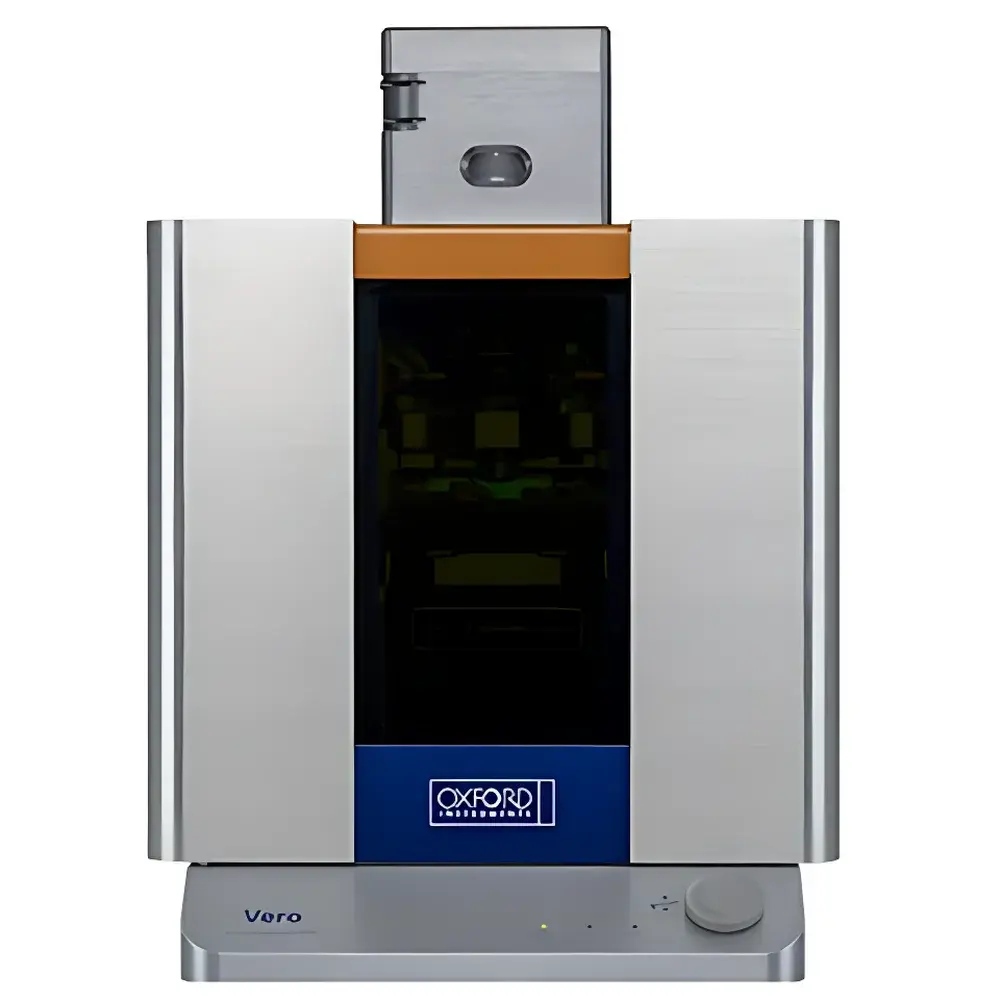
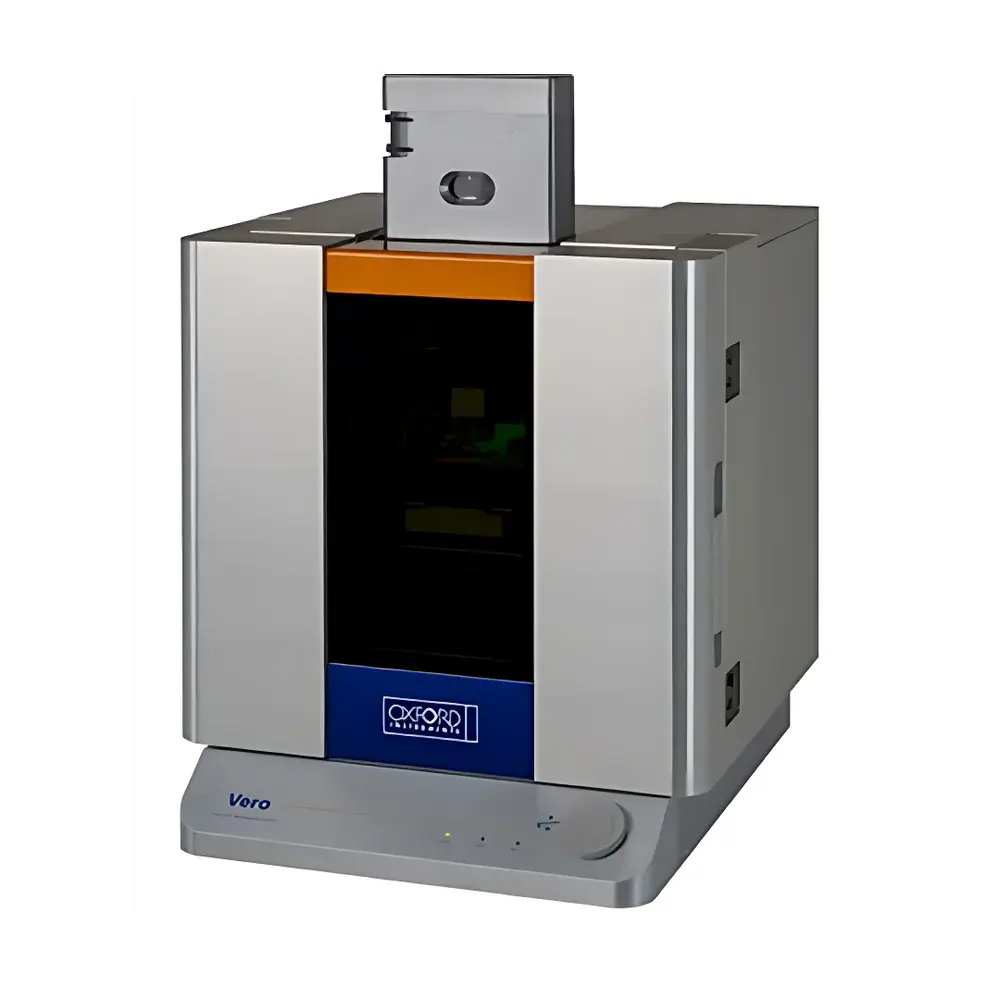
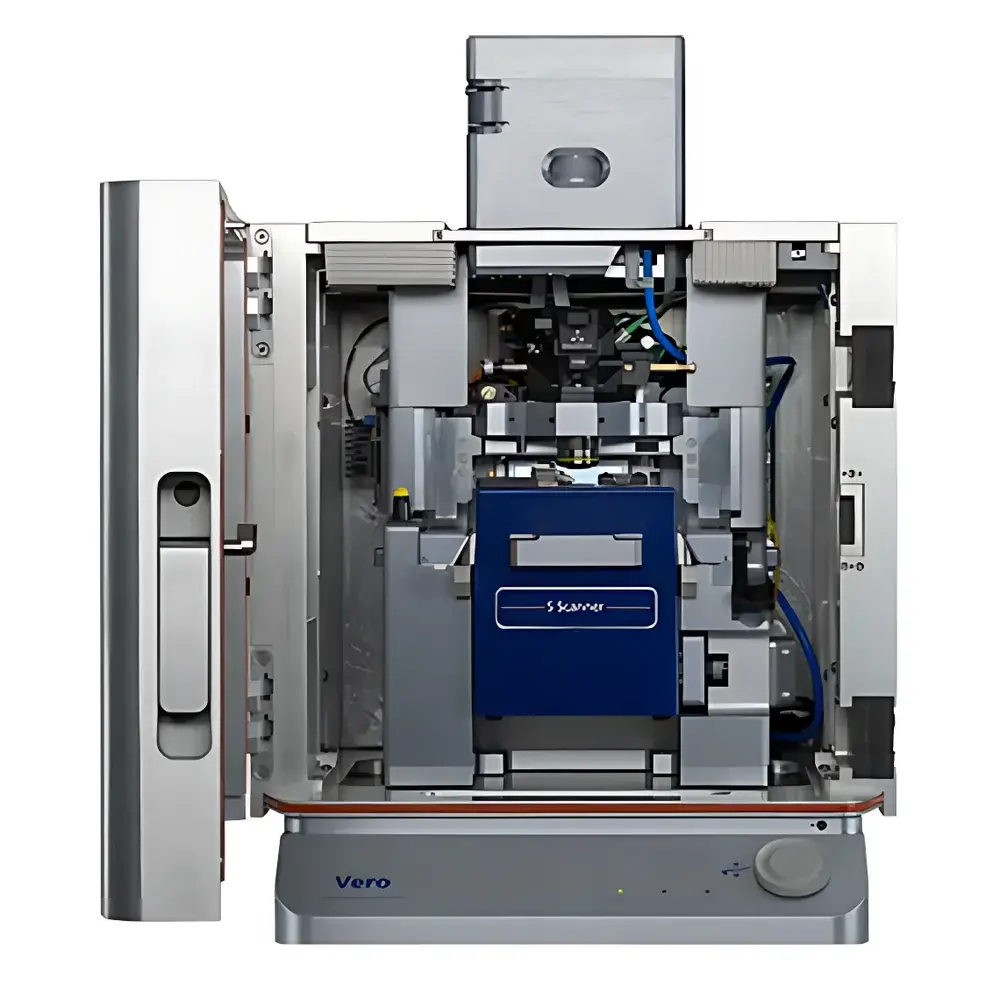
Oxford Instruments Asylum Research Vero Interferometric Atomic Force Microscope
| Brand | Oxford Instruments |
|---|---|
| Origin | USA |
| Manufacturer Type | Authorized Distributor |
| Origin Category | Imported |
| Model | Vero |
| Price | Upon Request |
| Instrument Type | Atomic Force Microscope (AFM) |
| Application Class | Materials Science AFM |
| Position Detection Noise | X&Y Sensor Noise < 60 pm, Z Sensor Noise < 50 pm |
| Sample Dimensions | Up to 15 mm in diameter, 7 mm in thickness |
Overview
The Oxford Instruments Asylum Research Vero Interferometric Atomic Force Microscope represents a fundamental advancement in quantitative nanomechanical characterization. Unlike conventional optical beam deflection (OBD)–based AFMs, the Vero implements Quadrature Phase-Difference Interferometry (QPDI)—a patented, fully interferometric detection method that directly measures the absolute vertical and lateral displacement of the AFM probe tip with sub-picometer resolution. This physical principle eliminates reliance on geometric assumptions inherent in OBD systems—such as lever arm calibration, laser spot position stability, or photodiode linearity—and instead anchors measurement traceability to the wavelength of light, enabling SI-traceable, artifact-free quantification. Engineered for materials science laboratories requiring high reproducibility across diverse sample classes—including soft polymers, 2D materials, biological membranes, and hard ceramics—the Vero builds upon the field-proven mechanical and thermal stability architecture of the award-winning Cypher platform while introducing a new paradigm in signal fidelity and metrological rigor.
Key Features
- Quadrature Phase-Difference Interferometry (QPDI): Direct, real-time measurement of true probe tip displacement—decoupled from cantilever bending mode artifacts and independent of optical alignment drift.
- Sub-60 pm X/Y and sub-50 pm Z position detection noise floor—enabling stable imaging and force spectroscopy at atomic lattice resolution under ambient and controlled environments.
- Zero cross-talk between vertical and lateral displacement channels—eliminating the fundamental coupling error present in dual-beam OBD configurations and ensuring unambiguous separation of normal and shear forces.
- Integrated environmental control compatibility: Supports operation in air, nitrogen, vacuum, and liquid environments via optional enclosures and fluid cells.
- Cypher-derived mechanical design: Monolithic scanner architecture with low thermal drift (< 0.1 nm/min), passive damping, and vibration isolation—optimized for long-duration, high-resolution mapping without active feedback compensation.
Sample Compatibility & Compliance
The Vero accommodates standard AFM substrates and custom specimens up to 15 mm in diameter and 7 mm in thickness, compatible with common silicon, mica, glass, and conductive ITO-coated slides. Its open-sample-stage design allows for in situ electrical biasing, heating stages (up to 300 °C), and electrochemical cell integration. From a regulatory standpoint, the system supports GLP/GMP-aligned workflows through audit-trail-enabled software logging, user-access controls, and electronic signature compliance per FDA 21 CFR Part 11 when configured with Asylum’s compliant software suite. All QPDI calibration procedures are documented per ISO/IEC 17025 guidelines for metrological traceability, and instrument performance verification follows ASTM E2539 and ISO 25178-6 standards for surface topography instrumentation.
Software & Data Management
Acquisition and analysis are performed using Asylum Research’s Interactive Mode™ software—built on a modular, Python-extensible framework. The software provides real-time QPDI signal demodulation, automated cantilever tuning, multi-channel lock-in acquisition (including higher harmonic and bimodal modes), and batch-processing pipelines for large-area mosaic stitching and statistical roughness analysis. Raw interferometric data is stored in HDF5 format with embedded metadata (timestamp, environmental conditions, calibration parameters), ensuring FAIR (Findable, Accessible, Interoperable, Reusable) data principles. Export options include TIFF, ASCII, and standardized SPM file formats compatible with third-party tools such as Gwyddion, MountainsSPIP, and MATLAB-based custom analysis scripts.
Applications
The Vero is routinely deployed in academic and industrial R&D settings for quantitative nanoscale characterization tasks including: nanomechanical mapping of viscoelastic moduli in polymer blends; high-fidelity topographic and phase imaging of graphene and transition metal dichalcogenides; force-distance curve analysis of protein unfolding kinetics; nanoscale dielectric contrast imaging in ferroelectric thin films; and in situ electrochemical AFM of battery electrode interfaces during cycling. Its QPDI architecture is especially advantageous for applications demanding absolute displacement metrology—such as calibration of nanoindenter displacement sensors, interfacial adhesion quantification, and dynamic nanomechanical spectroscopy under variable temperature or humidity.
FAQ
How does QPDI differ fundamentally from optical beam deflection (OBD)?
QPDI measures the absolute optical path difference between reference and probe arms of a Michelson-type interferometer, yielding direct displacement values traceable to the He–Ne laser wavelength (632.8 nm). OBD infers displacement indirectly via photodiode intensity centroid shifts, which depend on laser alignment, cantilever reflectivity, and detector linearity.
Is the Vero compatible with existing Cypher accessories?
Yes—Vero shares identical stage geometry, electrical interface pinouts, and software API structure with Cypher systems, enabling seamless integration of existing environmental chambers, electrical modules, and heating stages.
What level of training is required to operate the Vero for quantitative force spectroscopy?
Operators with foundational AFM experience can perform routine topographic imaging within one day. Quantitative force spectroscopy and QPDI-specific parameter optimization require a two-day application workshop—available through Oxford Instruments’ certified application scientists.
Does the Vero support fast scanning modes?
While optimized for ultra-stable, high-fidelity static and quasi-static measurements, the Vero supports resonant AC modes up to 2 MHz with appropriate cantilevers, though its primary design emphasis remains metrological accuracy over speed.
Can QPDI be retrofitted onto older Cypher instruments?
No—QPDI requires dedicated interferometric optics, custom photodetector arrays, and real-time FPGA-based demodulation hardware not present in legacy Cypher platforms.




