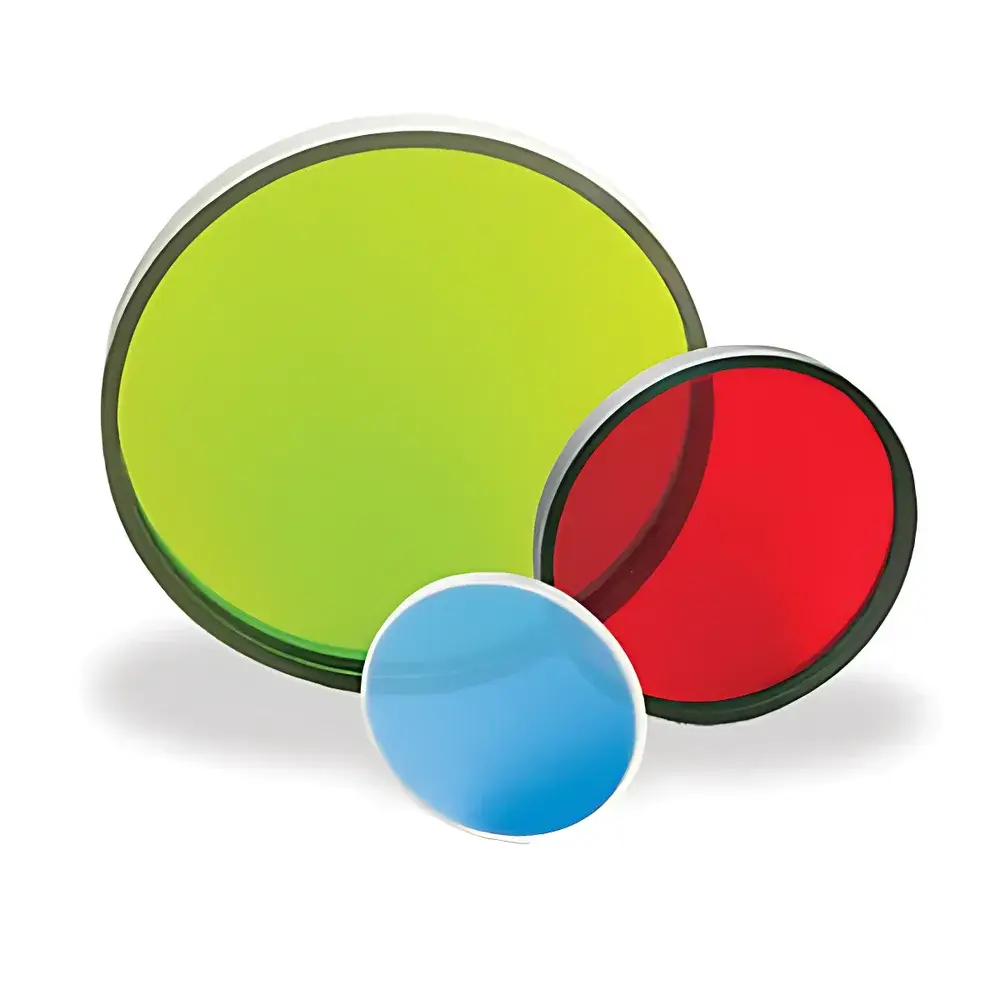
Chroma Bandpass Filters (Optical Interference Filters)
| Brand | Auniontech (Authorized Distributor of Chroma Technology Corp.) |
|---|---|
| Origin | Shanghai, China |
| Manufacturer Type | Authorized Distributor |
| Product Origin | Domestic (PRC) |
| Model Designation | Standard & Custom Bandpass Filter Series |
| Pricing | Available Upon Request |
Overview
Chroma Bandpass Filters are high-precision optical interference filters engineered for demanding spectral selection tasks in research, industrial, and clinical instrumentation. Based on multilayer dielectric thin-film technology—specifically advanced magnetron sputtering with argon-ion bombardment—each filter consists of 200–300 precisely controlled layers deposited onto a single, un-bonded optical substrate (e.g., fused silica or BK7). This monolithic architecture eliminates adhesive-related degradation, enabling exceptional environmental stability across temperature (–40 °C to +85 °C), humidity (up to 95% RH, non-condensing), and mechanical stress. The filters operate on the principle of constructive and destructive interference within the thin-film stack, delivering sharp spectral transitions (steep edge slopes), deep out-of-band rejection (OD6–OD8+), and peak transmission exceeding 95% within the designated passband. Their spectral coverage spans 200 nm to 3500 nm—encompassing deep UV, visible, NIR, and short-wave IR—making them suitable for both broadband and ultra-narrowband applications (down to <1 nm FWHM in custom configurations).
Key Features
- High peak transmittance: ≥95% at center wavelength (CWL), optimized via front-surface hard-coated interference stack and rear-surface anti-reflection (AR) coating to minimize ghosting and maximize system throughput
- Exceptional blocking performance: Optical density (OD) ≥6–8 across UV-VIS-NIR stopbands, effectively suppressing excitation leakage, autofluorescence, and ambient stray light
- Steep spectral edges: Transition widths (10%–90% transmission) typically <5% of CWL, ensuring precise spectral isolation critical for multiplexed fluorescence detection
- Environmental robustness: Sputtered hard coatings withstand thermal cycling, high-humidity exposure, and abrasion—certified per MIL-C-48497A and ISO 9211-4 for durability
- Batch-to-batch consistency: Tight manufacturing tolerances (±0.25 nm CWL, ±0.5 nm bandwidth for standard catalog parts) supported by in-process spectral metrology traceable to NIST standards
- Customization capability: Full design-to-manufacture support for non-standard CWLs, bandwidths (1–100 nm), angle-of-incidence (AOI) optimization (0°–45°), and substrate material selection (e.g., UV-grade fused silica, CaF₂, or IR-transmissive materials)
Sample Compatibility & Compliance
Chroma bandpass filters are compatible with standard optical mounts (e.g., SM1, RMS, or custom kinematic cells) and integrate seamlessly into OEM instruments requiring ISO/IEC 17025-aligned optical calibration. They comply with RoHS 2015/863/EU and REACH (EC 1907/2006) directives. For regulated life science applications—including IVD devices under FDA 21 CFR Part 820 and EU IVDR—filter specifications are documented with full traceability (lot-level spectral scans, coating thickness profiles, and environmental test reports). All standard filters meet ISO 10110-7 surface quality requirements (scratch-dig 20–10) and are supplied with individual spectral certification data (T(λ) and R(λ) curves, OD vs. λ plots) in CSV and PDF formats.
Software & Data Management
While inherently passive optical components, Chroma filters are fully supported within industry-standard optical design and system validation workflows. Spectral data files (including measured transmission, reflection, and OD curves) are provided in standardized ASCII format compatible with Zemax OpticStudio, CODE V, FRED, and MATLAB-based spectral modeling tools. For OEM integration, Chroma supplies spectral tolerance envelopes and Monte Carlo sensitivity analyses to support tolerance stacking in fluorescence microscope, flow cytometer, and DNA sequencer optical trains. Traceability logs—including deposition run ID, spectrophotometer calibration certificate (NIST-traceable PerkinElmer Lambda 1050+), and environmental aging test summaries—are archived for ≥10 years to satisfy GLP/GMP audit requirements.
Applications
- Life Sciences: Fluorescence microscopy (widefield, confocal, TIRF, STED), flow cytometry, qPCR/dPCR, high-content screening, FISH, FRET, and super-resolution imaging (STORM/PALM)
- Clinical Diagnostics: POCT analyzers, automated pathology scanners, digital pathology, and clinical chemistry analyzers requiring multi-color fluorescence discrimination
- Spectral Analysis: Raman spectroscopy (laser line cleanup and Stokes/anti-Stokes isolation), LIBS, and absorption spectroscopy systems
- Industrial Imaging: Machine vision (SWIR, multispectral, hyperspectral), colorimetry, laser-based inspection, and semiconductor wafer metrology
- Aerospace & Remote Sensing: Star tracker calibration, Earth observation sensors (NDVI, atmospheric gas sensing), LIDAR receivers (eye-safe 1550 nm filtering), and space-qualified instrument modules (tested per ECSS-Q-ST-70-08C)
- Astronomy: Narrowband nebula imaging (Hα, OIII, SII), adaptive optics wavefront sensing, and solar telescope feed optics
FAQ
What is the typical damage threshold for Chroma bandpass filters under continuous-wave laser illumination?
Chroma’s sputtered filters exhibit LIDT values ≥500 MW/cm² (1064 nm, 10 ns, 10 Hz) and ≥10 J/cm² (355 nm, 10 ns); exact values depend on CWL, substrate, and AOI—consult the specific product datasheet.
Can Chroma filters be used at non-normal angles of incidence?
Yes; many catalog filters are specified for 0° AOI, but custom designs support AOIs up to 45° with compensated shift correction (e.g., CWL blue-shift compensation for oblique use in epifluorescence paths).
Do you provide spectral certification for every filter shipment?
Yes—each filter lot includes full spectral characterization (T(λ), R(λ), OD(λ)) measured on a double-beam spectrophotometer calibrated against NIST-traceable standards.
Are there options for mounting or packaging to meet cleanroom or vacuum-compatible requirements?
Standard filters ship in Class 100 cleanroom-packaged anodized aluminum rings; vacuum-compatible versions (outgassing tested per ASTM E595) and kinematic mounts are available upon request.
How does Chroma ensure batch consistency for high-volume OEM programs?
Through proprietary in-line spectral monitoring during sputter deposition, automated post-coating metrology, and statistical process control (SPC) with Cpk ≥1.33 maintained across all critical parameters (CWL, bandwidth, peak T, blocking OD).