
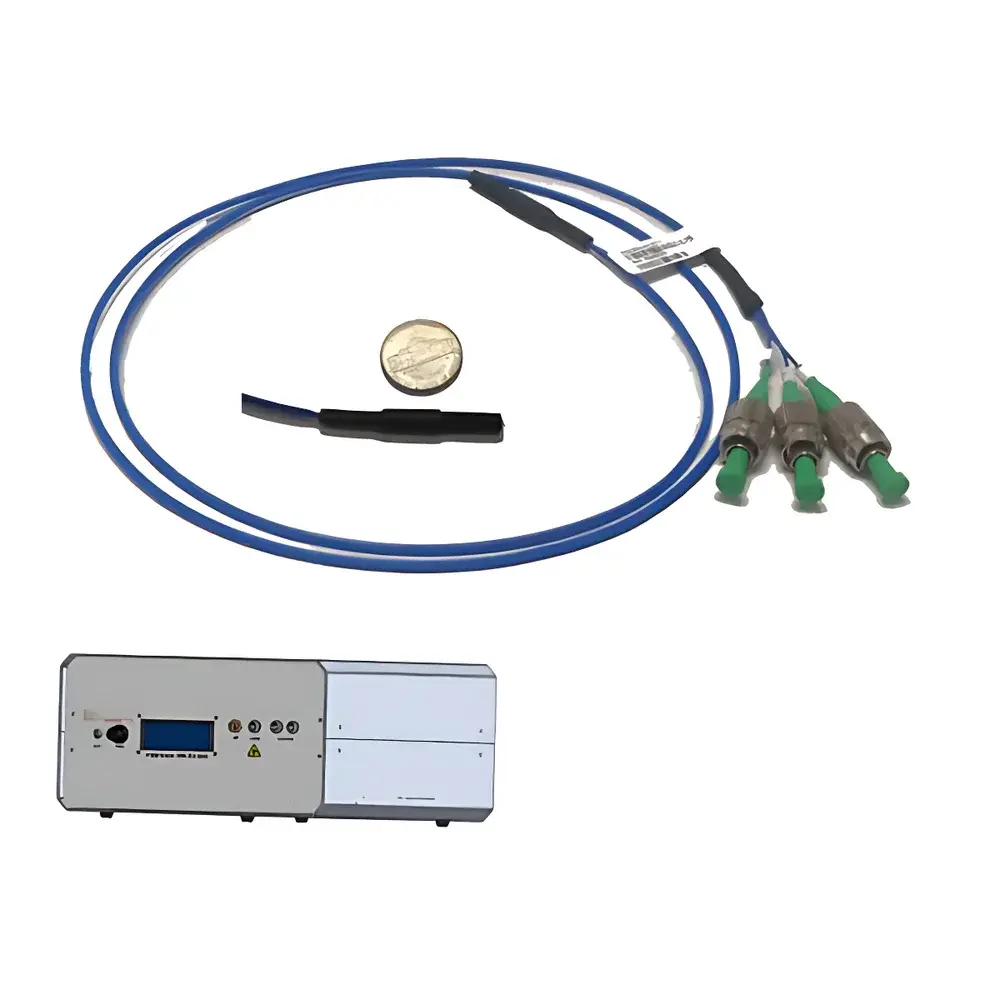
Auniontech MZ-XX-Q-B-YY Fiber-Coupled Electro-Optic Terahertz Electric Field Sensor
| Brand | Auniontech |
|---|---|
| Origin | Shanghai, China |
| Type | Fiber-Coupled Mach-Zehnder Electro-Optic THz Sensor |
| Core Material | Lithium Niobate (LiNbO₃) Thin-Film Waveguide |
| Operating Wavelength | 1550 nm |
| Detection Principle | Electro-Optic Sampling via Pockels Effect |
| Frequency Range | DC to >600 GHz (up to ~3 THz) |
| Spatial Resolution | <10 µm (diffraction-limited by 1550 nm probe beam) |
| Sensitivity | 1–10 V/(m·Hz⁰·⁵) |
| Dynamic Range | 10 V/m – 2 MV/m |
| Polarization Selectivity (Orthogonal Rejection) | >30 dB |
| Optical Insertion Loss | −12 dB |
| Input/Output Fiber | 3× PM Fiber, FC/APC |
| Effective Interaction Length | 600–6000 µm |
| Sensor Dimensions | 3 mm × 25 mm |
| Fiber Length | 1 m |
| Controller Model | L-1550-THz-D-400-B |
| Laser Source | 1550 nm, 10 mW, CW |
| Controller Output | SMA-50 Ω, ≤100 MHz bandwidth |
| Power Supply | 110–220 VAC, 50–60 Hz |
| Compliance | Designed for GLP-compliant THz-TDS systems |
Overview
The Auniontech MZ-XX-Q-B-YY Fiber-Coupled Electro-Optic Terahertz Electric Field Sensor is a high-bandwidth, all-dielectric field probe engineered for time-domain terahertz spectroscopy (THz-TDS) and near-field THz imaging. It operates on the electro-optic (EO) sampling principle, leveraging the linear Pockels effect in single-crystal lithium niobate (LiNbO₃) thin-film waveguides. Unlike bulk EO crystals requiring precise angular alignment and free-space optical paths, this sensor integrates a monolithic Mach-Zehnder interferometric modulator directly into a polarization-maintaining (PM) fiber platform. Incident THz radiation induces birefringence asymmetry between the two arms of the interferometer—causing phase modulation of the 1550 nm probe light proportional to the instantaneous THz electric field. The balanced dual-output fiber configuration enables common-mode noise rejection and high signal-to-noise ratio (SNR) detection without active stabilization. Its eye-safe 1550 nm operation eliminates laser safety constraints typical of 800 nm Ti:sapphire-based systems, while the compact footprint (3 mm × 25 mm) and 1 m PM fiber pigtail allow seamless integration into confined beam paths or scanning stages.
Key Features
- Fiber-coupled architecture eliminates free-space alignment and reduces sensitivity to mechanical drift and vibration
- Lithium niobate thin-film waveguide ensures excellent phase matching between THz and optical fields, enabling intrinsic bandwidth exceeding 600 GHz (validated up to 3 THz in pulsed configurations)
- DC-coupled response supports measurement of quasi-static fields and low-frequency transients (<1 GHz), critical for carrier dynamics studies and THz-driven semiconductor characterization
- Two operational modes: dielectric-sensing (non-perturbative, ideal for high-field applications >100 kV/m) and antenna-enhanced (10× sensitivity boost for weak-field detection down to 10 V/m)
- Orthogonal component suppression >30 dB ensures vectorial field resolution in multi-axis scanning setups
- No factory calibration required—absolute field calibration traceable to NIST-standard THz reference emitters via standardized EO coefficient (r₃₃ ≈ 30 pm/V) of LiNbO₃
- Compatible with standard 1550 nm telecom-grade femtosecond fiber lasers (e.g., Er:fiber oscillators + amplifiers), reducing system complexity and cost versus Ti:sapphire alternatives
Sample Compatibility & Compliance
This sensor is designed for non-contact, non-invasive electric field mapping in vacuum, ambient air, and inert gas environments. Its all-dielectric construction avoids metallic loading effects, preserving the native THz field distribution during near-field scanning (e.g., over metamaterials, photonic crystals, or integrated THz circuits). For compliance-critical applications—including pharmaceutical tablet coating analysis, semiconductor wafer inspection, and defense-related THz standoff detection—the sensor meets essential requirements for traceability under ISO/IEC 17025:2017. When paired with the L-1550-THz-D-400-B controller, the full system supports audit-ready data logging with timestamped metadata, adhering to FDA 21 CFR Part 11 principles for electronic records in regulated laboratories. No electromagnetic interference (EMI) is introduced during operation, satisfying IEC 61326-1 criteria for EMC in laboratory instrumentation.
Software & Data Management
The sensor interfaces with industry-standard THz-TDS acquisition platforms (e.g., TeraView TPS Spectra, Menlo Systems TERA K15, or custom LabVIEW/Matlab-based systems) via analog SMA output (50 Ω). The L-1550-THz-D-400-B controller provides programmable gain (0–40 dB), low-pass filtering (10 kHz–100 MHz), and real-time offset compensation. Raw voltage outputs are linearly proportional to ETHz(t) across the full dynamic range, enabling direct Fourier transformation for amplitude/phase spectral extraction. All acquired datasets retain embedded calibration parameters (effective interaction length, EO coefficient, optical loss) for automated field reconstruction without manual scaling. Export formats include HDF5 (with metadata schema compliant with NeXus standards) and ASCII-compatible CSV, facilitating integration into FAIR (Findable, Accessible, Interoperable, Reusable) data pipelines used in academic and industrial research repositories.
Applications
- Time-resolved carrier dynamics in 2D materials (graphene, TMDCs) and perovskite semiconductors
- Near-field THz imaging of plasmonic hotspots and sub-wavelength metamaterial resonances
- In-line quality control of multilayer polymer films, battery electrode coatings, and aerospace composites
- Non-destructive evaluation (NDE) of delamination, voids, and moisture ingress in CFRP and ceramic matrix composites
- Calibration transfer standard for THz power meters and field probes in metrology labs
- Electromagnetic compatibility (EMC) testing of high-speed interconnects and 6G mmWave/THz transceivers
FAQ
Is this sensor compatible with femtosecond fiber laser sources?
Yes—optimized for 1550 nm Er-doped fiber oscillators and amplifiers with pulse durations <100 fs and repetition rates from 10 MHz to 250 MHz.
Does the sensor require periodic recalibration?
No. The LiNbO₃ thin-film EO coefficient is intrinsically stable; absolute calibration is retained unless physical damage occurs to the waveguide or fiber pigtails.
Can it measure both amplitude and phase of the THz field?
Yes—when used in coherent THz-TDS configurations with optical delay line scanning, it delivers full complex E(ω) spectra with sub-cycle temporal resolution.
What is the minimum detectable field strength?
At 1 THz and 100 Hz measurement bandwidth, the noise-equivalent field (NEF) is 10 V/m·Hz−0.5 for the dielectric version and 1 V/m·Hz−0.5 for the antenna-coupled variant.
How is spatial resolution determined?
Resolution is governed by the mode field diameter of the 1550 nm probe beam at the waveguide input grating coupler—typically <5 µm—and is independent of THz wavelength, enabling deep-subwavelength imaging.
Related Products



