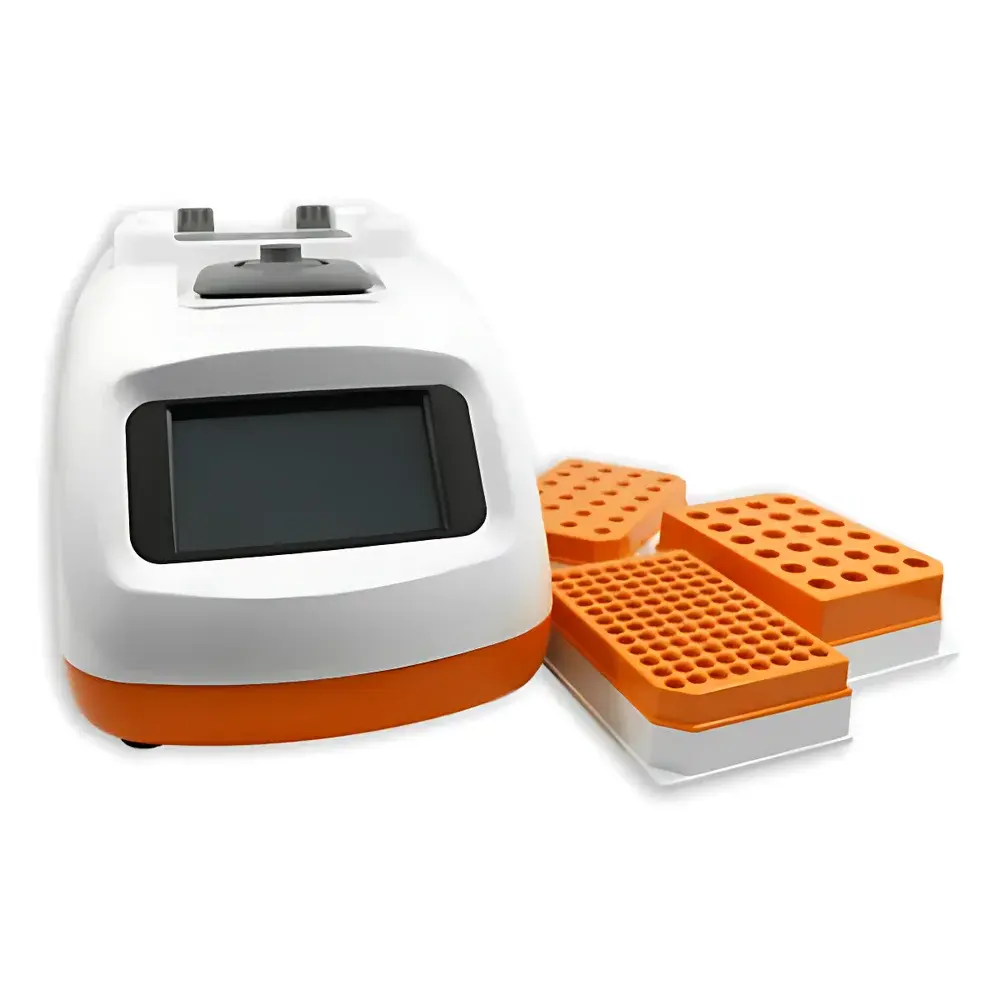
Vitl Co-mix Programmable Dual-Mode Vortex and Orbital Shaker
| Brand | Vitl Life Science Solutions |
|---|---|
| Origin | United Kingdom |
| Model | Co-mix |
| Type | Laboratory Benchtop Mixing Instrument |
| Orbital Speed | 200–3000 rpm |
| Vortex Speed | 700–3500 rpm |
| Orbit Radius | 3 mm |
| Timer Range (Orbital) | 5 s – 28 days |
| Timer Range (Vortex) | 2 min – 60 min |
| Preset Programs | 91 |
| User-Programmable Protocols | Up to 190 |
| Dimensions (L×W×H) | 190 × 350 × 200 mm |
| Weight | 7 kg |
| Power Input | 100–240 VAC, 50/60 Hz |
Overview
The Vitl Co-mix is a laboratory-grade, dual-mode programmable shaker engineered for precision mixing in molecular biology, clinical diagnostics, and analytical chemistry workflows. It integrates two independent motion mechanisms—orbital shaking and vortexing—within a single compact benchtop platform. Orbital mixing operates on the principle of controlled circular displacement (3 mm orbit radius), generating gentle yet effective suspension of particulates and viscous solutions without foaming or splashing. Vortex mixing employs high-frequency rotational agitation to rapidly resuspend dense pellets or homogenize heterogeneous suspensions. Unlike conventional single-mode shakers, the Co-mix enables synchronized or independent operation of both modules—allowing concurrent microplate orbital mixing and tube-based vortexing—thereby significantly improving throughput in high-volume assay preparation, nucleic acid extraction, and immunoassay workflows.
Key Features
- Dual independent motion control: Orbital shaker (200–3000 rpm) and vortex module (700–3500 rpm) operate separately or simultaneously
- Intuitive 4.3-inch LCD touchscreen interface supporting multi-step protocol programming with adjustable speed, time, and temperature ramping (when used with optional heating modules)
- High-capacity protocol memory: 91 factory-preset methods plus up to 190 user-defined protocols stored non-volatile memory
- Universal sample compatibility: Accommodates full-skirted, half-skirted, and skirtless 96-well and 384-well microplates; 0.2 mL PCR tubes; and 0.5 / 1.5 / 2.0 mL microcentrifuge tubes
- Low-noise, low-vibration architecture: Integrated anti-slip rubber feet and balanced motor housing minimize bench resonance and acoustic emission during extended runs
- No-splash design: Optimized orbital trajectory and vortex head geometry prevent cross-contamination and sample loss—even at maximum speeds
- Modular adapter system: Interchangeable plate carriers and tube holders support rapid reconfiguration between applications without tools
Sample Compatibility & Compliance
The Co-mix meets mechanical safety requirements per IEC 61010-1:2010 for laboratory electrical equipment. Its structural design complies with ISO 8573-1 for compressed air–free operation and eliminates reliance on external gas sources—critical for cleanroom and GLP-compliant environments. While not a medical device per FDA 21 CFR Part 820 or EU MDR Annex II classification, the instrument supports workflows aligned with CLIA, CAP, and ISO 15189–accredited laboratories when integrated into validated SOPs. All plastic components contacting sample carriers are manufactured from autoclavable, USP Class VI–compliant polymers. The absence of exposed moving parts and enclosed drive mechanism satisfies IP20 ingress protection standards for dry indoor laboratory use.
Software & Data Management
The Co-mix operates via embedded firmware with no PC dependency; however, optional USB export functionality allows transfer of protocol logs and run history (timestamp, speed, duration, mode selection) for audit trail generation. Each saved program includes metadata fields for operator ID, batch number, and application notes—facilitating traceability under 21 CFR Part 11–aligned documentation practices when paired with institutional LIMS integration. Firmware updates are delivered via secure USB key and include version-controlled release notes compliant with ISO/IEC 17025 clause 5.9.2 for measurement equipment software validation.
Applications
- Resuspension of cell pellets, magnetic beads, and silica-based nucleic acid binding matrices in automated DNA/RNA isolation protocols
- Homogenization of viscous biological fluids (e.g., serum, lysates, glycerol stocks) prior to qPCR or NGS library prep
- Uniform mixing of ELISA coating buffers, detection antibodies, and enzyme conjugates to ensure reproducible signal intensity
- Bradford, BCA, and Lowry protein quantification assays requiring precise reagent dispersion and incubation kinetics
- Reporter gene assays (β-galactosidase, luciferase) where consistent substrate–enzyme contact time directly impacts luminescence linearity
- Pre-analytical sample conditioning for clinical chemistry analyzers—including dilution series preparation and calibrator mixing
- Stabilization of nanoparticle suspensions and colloidal formulations in material science R&D
FAQ
Is the Co-mix suitable for use with hazardous or volatile solvents?
Yes—the unit features sealed electronics and a non-sparking brushless DC motor certified for Class I, Division 2 environments per NEC 500. It is compatible with common organic solvents (e.g., ethanol, isopropanol, chloroform) when used within ventilated enclosures and following institutional chemical hygiene plans.
Can I validate mixing performance across different vessel types?
Absolutely. Vitl provides a downloadable IQ/OQ protocol template—including speed calibration verification using a certified tachometer, orbit radius confirmation via laser displacement sensor, and repeatability testing across 10 consecutive runs per vessel format—that aligns with ASTM E2500-13 guidance for equipment qualification.
Does the Co-mix support temperature-controlled mixing?
The base model does not integrate heating or cooling; however, it is mechanically and electrically compatible with third-party thermal plates (e.g., Thermo Fisher CryoPlate, Grant Bio MPC-100) mounted beneath microplate carriers—enabling ambient-temperature-controlled orbital mixing within ±0.5 °C stability when paired with external PID controllers.
How frequently should maintenance be performed?
No scheduled lubrication or belt replacement is required. Annual visual inspection of motor mounts, vibration-dampening feet, and touchscreen responsiveness is recommended. Firmware updates should be applied upon release to maintain cybersecurity compliance and feature parity.