
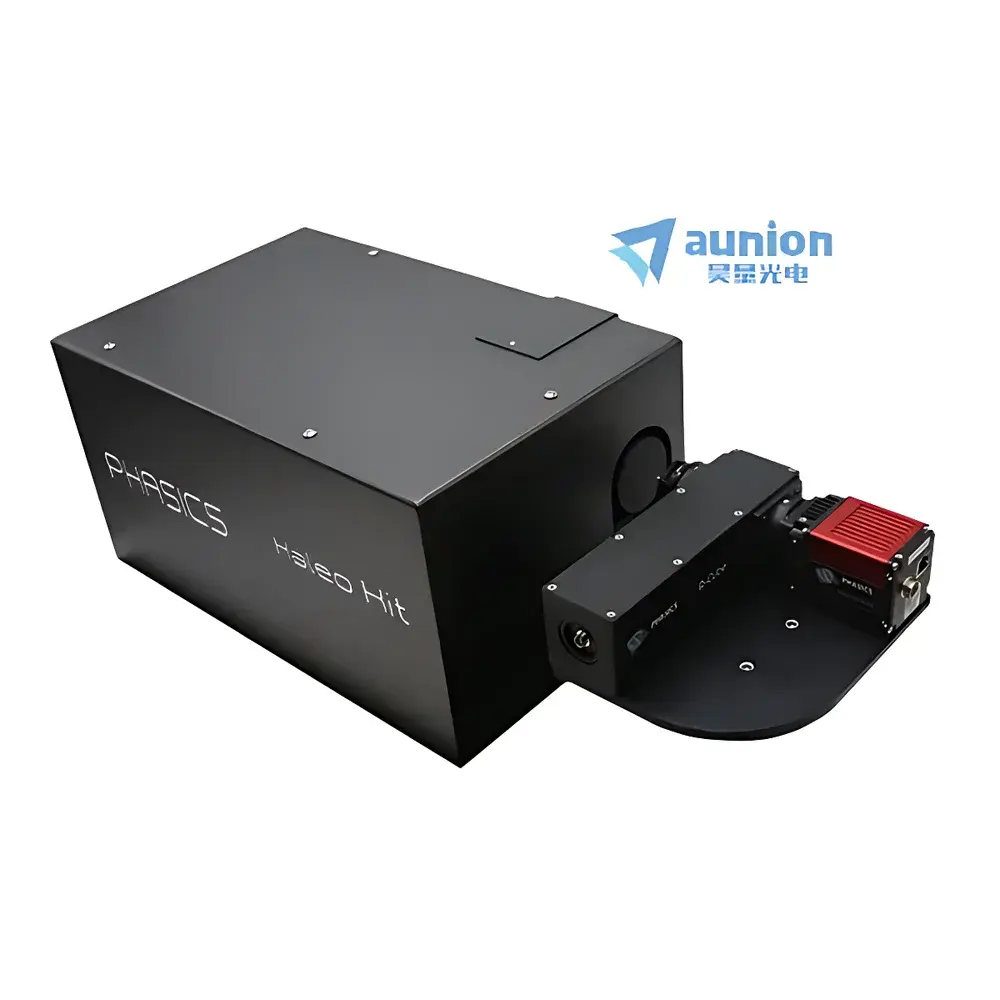
Phasics KALEO Multi-Wavelength Laser Interferometry Module
| Brand | Phasics |
|---|---|
| Model | KALEO |
| Measurement Principle | Quadriwave Lateral Shearing Interferometry (QLSI) |
| Wavelength Range | 365–3900 nm (UV to LWIR) |
| Sensor Options | SID4 UV / SID4 / SID4-HR / SID4-SWIR / SID4 SWIR-HR / SID4-DWIR / R-Cube |
| Aperture Compatibility | 8–130 mm (via expandable beam delivery) |
| Optical Configuration | Non-collimated, achromatic, alignment-free operation |
| Dynamic Range | >100 µm PV wavefront deviation |
| Phase Sensitivity | <1 nm RMS |
| Output Data | Wavefront map, MTF, PSF, Zernike coefficients, Strehl ratio, aberration decomposition |
Overview
The Phasics KALEO Multi-Wavelength Laser Interferometry Module is a modular, high-precision optical metrology platform engineered for quantitative wavefront characterization across ultraviolet, visible, near-infrared, short-wave infrared, mid-wave infrared, and long-wave infrared spectral bands. Unlike conventional interferometers relying on reference beams and stringent alignment requirements, the KALEO system employs Phasics’ proprietary Quadriwave Lateral Shearing Interferometry (QLSI) — a self-referencing, common-path technique that eliminates sensitivity to environmental vibrations and thermal drift. This enables robust, single-shot acquisition of full-field phase maps with sub-nanometer resolution, independent of collimation. The system delivers comprehensive optical performance metrics in real time, including wavefront error (WFE), modulation transfer function (MTF), point spread function (PSF), Zernike polynomial decomposition, Strehl ratio, and diffraction-limited spot analysis — all from one exposure without scanning or mechanical reconfiguration.
Key Features
- Multi-spectral flexibility: Seamless integration with interchangeable wavefront sensors (SID4 UV, SID4-HR, SID4-SWIR, SID4-DWIR, R-Cube) supporting discrete wavelengths from 365 nm to 3900 nm — enabling cross-band validation of coatings, materials, and optical designs.
- Achromatic, non-collimated operation: Eliminates need for precision alignment or reference optics; accepts divergent, convergent, or collimated beams directly — ideal for testing aspheric lenses, freeform optics, and unmounted elements in situ.
- High-dynamic-range wavefront sensing: Capable of measuring wavefront deviations exceeding 100 µm peak-to-valley while maintaining <1 nm RMS phase sensitivity — suitable for both low-aberration precision optics and highly deformed surfaces.
- Modular beam delivery architecture: Expandable pupil diameters (8 mm to 130 mm) via calibrated beam expanders and F-number-matched objectives (f/0.6 to f/10), ensuring optimal sampling and diffraction-limited resolution across magnification scales.
- Real-time, standards-compliant data output: Native export of ISO 10110–7 compliant wavefront reports, ASTM E2822-22 traceable MTF curves, and USP –aligned particle-induced scatter diagnostics for cleanroom-compatible optical assembly verification.
Sample Compatibility & Compliance
The KALEO module supports direct measurement of plano, spherical, aspherical, and freeform optical components — including singlets, doublets, lens arrays, micro-optics, IR-transmissive materials (Ge, ZnSe, CaF₂), and coated substrates. Its vibration-insensitive QLSI architecture meets ISO 10110–5 (surface irregularity), ISO 14999–3 (interferometric testing), and MIL-PRF-13830B scratch-dig inspection workflows. For regulated environments, the system supports audit-ready data logging with timestamped metadata, user access controls, and optional 21 CFR Part 11–compliant electronic signatures when paired with Phasics’ QSense software suite.
Software & Data Management
Controlled via QSense v5.x — a deterministic, multi-threaded application built on Qt and Python-based scientific computing libraries (NumPy, SciPy, OpenCV). The software provides automated calibration routines (including sensor flat-field correction and wavelength-dependent dispersion compensation), batch processing for production-line throughput, and API access (C++/Python SDK) for integration into factory automation systems (SECS/GEM, OPC UA). All raw interferograms and derived metrics are stored in HDF5 format with embedded provenance metadata — facilitating GLP/GMP traceability, version-controlled report generation, and third-party analysis in MATLAB or Zemax OpticStudio.
Applications
- Development and qualification of EUV lithography optics and synchrotron beamline mirrors
- In-process metrology of diamond-turned IR optics for aerospace and defense systems
- Verification of AR/HR coating uniformity and stress-induced birefringence
- Characterization of adaptive optics deformable mirrors and liquid crystal spatial light modulators
- End-to-end MTF validation of multispectral imaging systems (e.g., hyperspectral push-broom sensors)
- Root-cause analysis of thermal lensing in high-power laser cavities and fiber collimators
FAQ
Does the KALEO system require a reference optic or vacuum environment?
No. QLSI is a self-referencing, common-path technique — no reference mirror, vacuum chamber, or active stabilization is needed.
Can it measure off-axis or tilted wavefronts?
Yes. The system inherently accommodates up to ±15° field angles without recalibration, supporting wide-field optical testing and oblique incidence characterization.
Is calibration traceable to NIST or PTB standards?
Yes. Phasics provides factory calibration certificates traceable to PTB (Physikalisch-Technische Bundesanstalt) for phase sensitivity and spatial frequency response, with optional on-site recalibration services.
What level of training is required for routine operation?
Operators require ≤2 hours of hands-on instruction for basic measurements; advanced analysis (e.g., Zernike fitting, tolerance stack-up simulation) is supported by integrated context-sensitive help and online knowledge base (accessible via QSense).
Are custom mechanical interfaces or OEM integration options available?
Yes. Phasics offers mechanical mounting kits (C-mount, SM1, kinematic flanges), electrical I/O modules (TTL triggers, analog outputs), and full turnkey integration support under NDA for OEM partners.





