
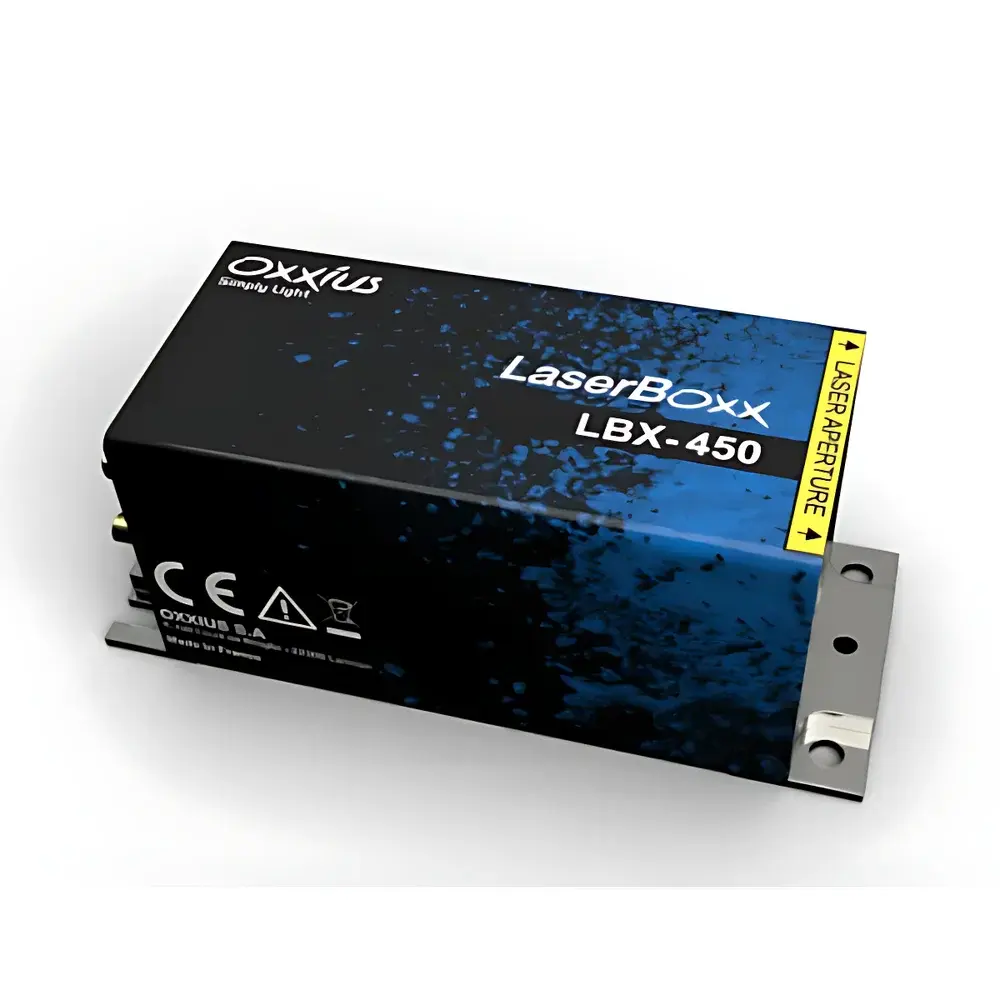
Oxxius L4Cc-Series High-Value Single-Transverse-Mode Semiconductor Laser Systems
| Brand | Oxxius |
|---|---|
| Origin | France |
| Model | L4Cc-Series |
| Wavelength Options | 450 nm, 785 nm, 808 nm, 915 nm, 980 nm, 1064 nm |
| Output Power Range | Up to 500 mW (model-dependent) |
| Beam Mode | TEM₀₀ (Single Transverse Mode) |
| Modulation | TTL & Analog (up to 500 kHz) |
| Compliance | CDRH Class 3B / IEC 60825-1 |
| Interface | USB 2.0 + RS-232 |
| Control | Embedded Smart Chip with Real-Time Diagnostics |
| Form Factor | Compact OEM Module or Benchtop Plug-and-Play Unit |
| Software Support | Oxxius Lasea™ v3.x (Windows/macOS/Linux) |
| Regulatory | CE, RoHS, FDA 21 CFR Part 11 Ready (Audit Trail & Electronic Signature Optional) |
Overview
The Oxxius L4Cc-Series represents a class of high-value, single-transverse-mode semiconductor laser systems engineered for precision applications in scientific instrumentation and industrial integration. Based on distributed feedback (DFB) and ridge-waveguide semiconductor diode architectures, these lasers deliver diffraction-limited beam quality (M² < 1.1) with intrinsic spatial coherence—critical for applications requiring tight focusability, high modulation fidelity, and long-term pointing stability. Unlike multi-mode or free-running diodes, the L4Cc-Series employs monolithic cavity design and active thermal stabilization to ensure stable TEM₀₀ output across ambient temperature fluctuations (±0.01 °C regulation). Designed and manufactured in Nantes, France, each unit undergoes 100% factory spectral verification and power calibration traceable to national metrology institutes (LNE, France). The platform supports both continuous-wave (CW) operation and high-fidelity analog/TTL modulation—enabling seamless integration into fluorescence lifetime imaging (FLIM), time-resolved spectroscopy, and closed-loop optical trapping systems.
Key Features
- TEM₀₀ output with M² < 1.1 and beam divergence ≤ 1.2 mrad (full angle), enabling efficient coupling into single-mode fibers (SMF-28) and high-NA microscope objectives
- Integrated smart controller with embedded EEPROM storing serial number, calibration coefficients, lifetime logs, and fault history—accessible via Lasea™ software
- Real-time diagnostics including junction temperature, photodiode current, driver voltage, and optical power drift compensation—supporting predictive maintenance and remote troubleshooting
- CDRH-compliant plug-and-play configuration (Class 3B) with interlock-ready safety circuitry and automatic power ramping; OEM variants offer bare-board mounting and custom pinout options
- Multi-wavelength compatibility: designed as primary modules for the L4Cc and L6Cc multi-line combiner platforms—enabling synchronized, collinear output of up to six wavelengths without mechanical alignment
- Low power consumption (typically 3–8 W electrical input per module) and compact footprint (≤ 120 × 60 × 35 mm for OEM version) facilitate integration into space-constrained instruments such as portable Raman spectrometers and handheld cytometers
Sample Compatibility & Compliance
The L4Cc-Series is validated for use with standard optical components rated for its specified wavelength and power range—including fused silica lenses, dielectric mirrors (R > 99.8% @ target λ), and UV-VIS-NIR photodetectors. All units comply with IEC 60825-1:2014 (Edition 3) for laser product safety and carry CE marking under the EU Machinery Directive 2006/42/EC. For regulated environments, optional firmware enables 21 CFR Part 11 compliance: electronic signatures, audit trails, user role-based access control, and immutable session logs are fully supported within Lasea™. Units meet ISO 13485-aligned manufacturing protocols and are routinely deployed in GLP-compliant labs conducting USP photometric validation and ASTM E2912-13 fluorescence excitation testing.
Software & Data Management
Oxxius Lasea™ v3.x provides native support for Windows, macOS, and Linux (64-bit), offering both GUI-driven operation and Python/C++ SDKs for automated instrument control. The software implements IEEE 1451.4 TEDS-compatible metadata embedding—allowing automatic recognition of calibration curves, spectral width, and polarization extinction ratio upon USB enumeration. All operational parameters (power setpoint, modulation depth, temperature setpoint) are logged at user-configurable intervals (10 ms to 1 h resolution) and exportable in HDF5 or CSV format. Remote access is secured via TLS 1.2 encrypted API endpoints, permitting secure cloud-based monitoring and firmware updates without exposing internal network infrastructure.
Applications
- Super-resolution microscopy (STED, PALM, STORM): 785 nm and 808 nm variants provide optimal excitation for silicon-rhodamine (SiR) and Janelia Fluor® dyes with minimal phototoxicity
- Confocal and multiphoton imaging: TEM₀₀ stability ensures consistent Airy disk formation and Z-stack reproducibility across 10,000+ frame acquisitions
- Flow cytometry and spectral cytometry: TTL-modulated 450 nm and 980 nm sources enable precise pulse gating and time-gated detection of lanthanide chelates
- Optogenetics stimulation: 473 nm and 607 nm options (via external frequency-doubled modules) support ChR2 and ReaChR activation with sub-millisecond latency
- Raman spectroscopy excitation: 785 nm and 1064 nm models minimize fluorescence background in pharmaceutical and polymer analysis per ASTM E1840-22
- Industrial laser marking and UV-curable polymer initiation: integrated analog modulation supports grayscale engraving and controlled photopolymerization kinetics
FAQ
What is the typical spectral linewidth for the L4Cc-Series?
Full-width-at-half-maximum (FWHM) is ≤ 1.5 MHz for DFB-based models (e.g., 785 nm, 980 nm) and ≤ 2.5 MHz for FP-based variants (e.g., 450 nm, 808 nm), measured with a high-finesse scanning Fabry–Pérot interferometer.
Can the laser be integrated into a vacuum environment?
OEM modules are rated for operation at pressures down to 10⁻³ mbar; however, outgassing characterization reports and hermetic sealing options must be requested at order stage.
Is there built-in temperature stabilization for wavelength drift?
Yes—each module incorporates a TEC-controlled mount with ±0.01 °C stability and factory-trimmed PID parameters; wavelength drift is typically < 0.005 nm/°C over 15–35 °C ambient range.
How is power calibration maintained over lifetime?
Embedded photodiode feedback loop continuously adjusts drive current to compensate for diode aging; recalibration is recommended every 12 months or after 5,000 operating hours—traceable to NIST-traceable reference standards.
Do you support third-party DAQ synchronization?
Yes—TTL sync input/output ports support hardware-triggered start/stop and phase-locked modulation with National Instruments PXIe-6363 and Thorlabs K-Cube controllers.




