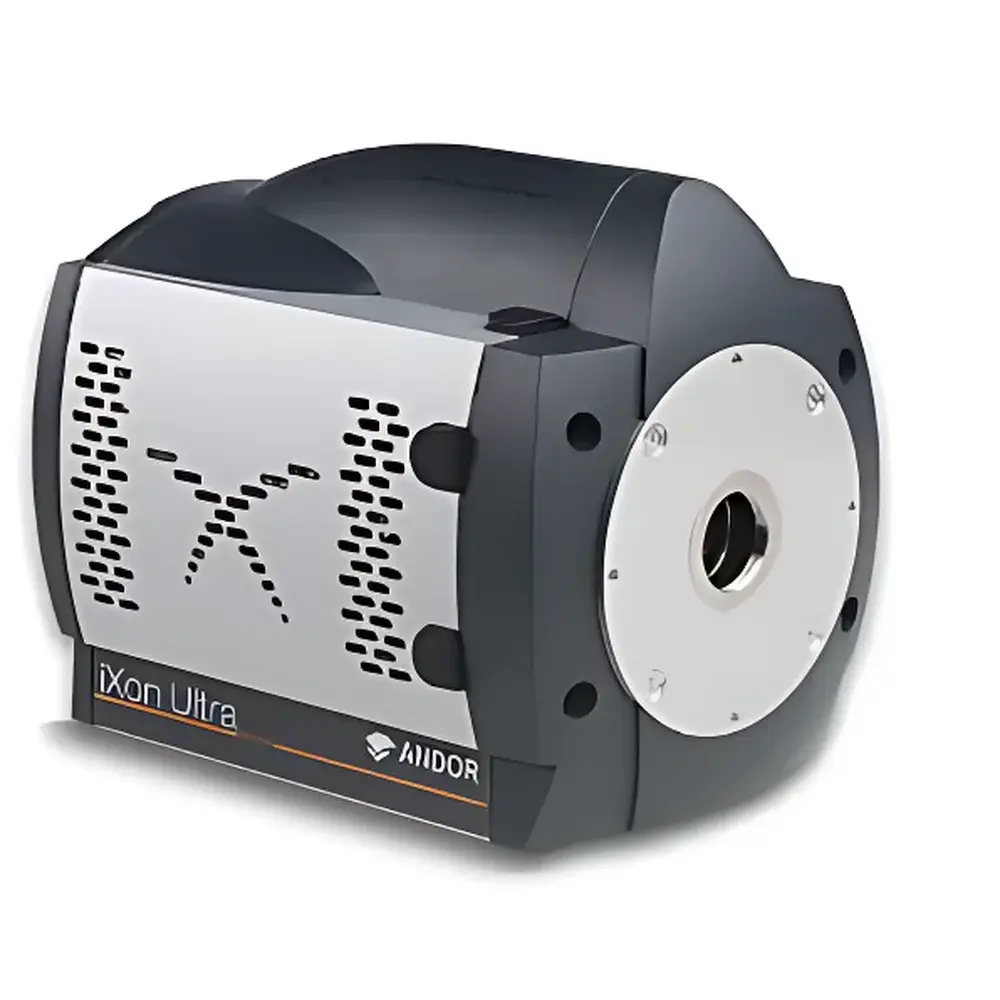
Oxford Instruments Andor iXon 888 EMCCD Camera
| Brand | Oxford Instruments |
|---|---|
| Origin | United Kingdom |
| Model | iXon 888 |
| Pixel Size | 13 µm |
| Sensor Type | Back-Illuminated Electron-Multiplying CCD |
| Quantum Efficiency | >95% (peak) |
| Cooling | Thermoelectric (−80 °C typical operating temperature) |
| Readout Modes | EMCCD and conventional CCD |
| Frame Rate | Up to 30 fps at full resolution (configurable via ROI and binning) |
| Interface | USB 3.0 |
Overview
The Oxford Instruments Andor iXon 888 is a high-performance, back-illuminated electron-multiplying charge-coupled device (EMCCD) camera engineered for quantitative low-light scientific imaging. Operating on the principle of impact ionization within a specialized multiplication register, the iXon 888 achieves effective single-photon detection sensitivity without compromising temporal resolution or spatial fidelity. Unlike conventional CCDs or even modern sCMOS sensors—whose read noise limits detection in ultra-low-signal regimes—the iXon 888’s electron multiplication gain (EM gain) amplifies photoelectrons prior to readout, effectively rendering read noise negligible across all practical readout speeds. This architecture enables photon-starved experiments—such as single-molecule fluorescence localization microscopy (SMLM), live-cell total internal reflection fluorescence (TIRF), or time-resolved luminescence spectroscopy—to maintain high signal-to-noise ratio (SNR) and statistical integrity, even at sub-millisecond exposure times.
Key Features
- Back-illuminated sensor architecture delivering >95% peak quantum efficiency (QE) in the visible to near-UV range (300–700 nm), maximizing photon capture efficiency.
- Integrated thermoelectric cooling to −80 °C (typical), reducing dark current to <0.001 e⁻/pixel/sec—critical for long-exposure applications requiring minimal thermal noise.
- Dual-readout capability: seamless switching between high-gain EMCCD mode for photon-limited imaging and conventional CCD mode for high-dynamic-range, low-noise intensity quantification.
- USB 3.0 interface enabling high-bandwidth data transfer and deterministic frame timing—essential for synchronization with pulsed lasers, galvo scanners, or electrophysiology rigs.
- Hardware-based EM gain calibration and real-time gain monitoring ensure traceable, reproducible amplification across experimental sessions.
- On-chip overscan region and correlated double sampling (CDS) minimize fixed-pattern noise and reset noise, supporting quantitative pixel-level analysis compliant with GLP/GMP workflows.
Sample Compatibility & Compliance
The iXon 888 is compatible with standard C-mount and F-mount optical interfaces, facilitating integration into inverted and upright microscopes, spectrographs, and custom optical benches. Its compact form factor and low power consumption support benchtop and enclosed-system deployments. From a regulatory standpoint, the camera’s firmware supports audit-trail-enabled acquisition logs, metadata embedding (including exposure time, gain setting, temperature, and timestamp), and export formats compliant with FAIR data principles (e.g., TIFF with embedded OME-XML). While not certified as a medical device, its performance characteristics meet common requirements for ISO/IEC 17025-accredited laboratories conducting fluorescence-based assays, and its acquisition software (Andor Solis) offers optional 21 CFR Part 11 compliance modules—including electronic signatures, user access controls, and immutable acquisition records—for regulated environments.
Software & Data Management
The iXon 888 is fully supported by Andor’s Solis software suite, a modular, scriptable platform designed for both interactive operation and automated experiment control. Solis provides real-time image processing (background subtraction, flat-field correction, drift correction), multi-channel time-series registration, and direct export to HDF5, NRRD, or OME-TIFF—formats widely adopted in open-source bioimage analysis pipelines (e.g., Python-based Napari, Fiji/ImageJ, or MATLAB). Advanced users may leverage the Andor SDK (C++, Python, LabVIEW) to integrate the camera into custom acquisition frameworks, including those implementing SRRF-Stream super-resolution reconstruction or real-time adaptive illumination control. All acquired datasets retain embedded calibration metadata, ensuring traceability from raw photon count to final publication-ready figure.
Applications
- Single-molecule tracking and localization microscopy (PALM, STORM, DNA-PAINT)
- Live-cell TIRF and spinning-disk confocal imaging under physiological conditions
- Ultrafast luminescence decay measurements in materials science and photophysics
- Low-light Raman spectroscopy and resonance-enhanced Raman imaging
- Quantitative Förster resonance energy transfer (FRET) and fluorescence lifetime imaging (FLIM) with time-gated acquisition
- Neuroimaging of calcium dynamics in primary neuronal cultures using GCaMP variants
FAQ
What is the difference between EMCCD and sCMOS for low-light imaging?
EMCCD provides deterministic, analog gain before readout, eliminating read noise floor dependence on frame rate—making it superior for photon counting at very low flux (<1 photon/pixel/frame). sCMOS excels in speed and field-of-view but retains ~1–2 e⁻ RMS read noise, limiting its single-photon discrimination capability.
Can the iXon 888 be used for quantitative intensity measurements?
Yes—when operated in conventional CCD mode with calibrated EM gain = 1×, the sensor delivers linear response over >4 orders of magnitude (typically 0–65,535 ADU), with pixel-wise gain and offset correction enabled via Solis.
Is hardware triggering supported?
Yes—the iXon 888 features TTL-compatible input/output triggers for precise synchronization with external devices such as lasers, shutters, or stage controllers.
Does the camera support binning?
Yes—both on-chip hardware binning (2×2, 3×3, etc.) and software binning are available, enabling trade-offs between sensitivity, resolution, and frame rate.
What cooling performance is achievable without liquid nitrogen?
Thermoelectric cooling reaches −80 °C under ambient conditions (25 °C), sufficient to suppress dark current to <0.001 e⁻/pixel/sec—eliminating the need for cryogenic infrastructure in most life science labs.