
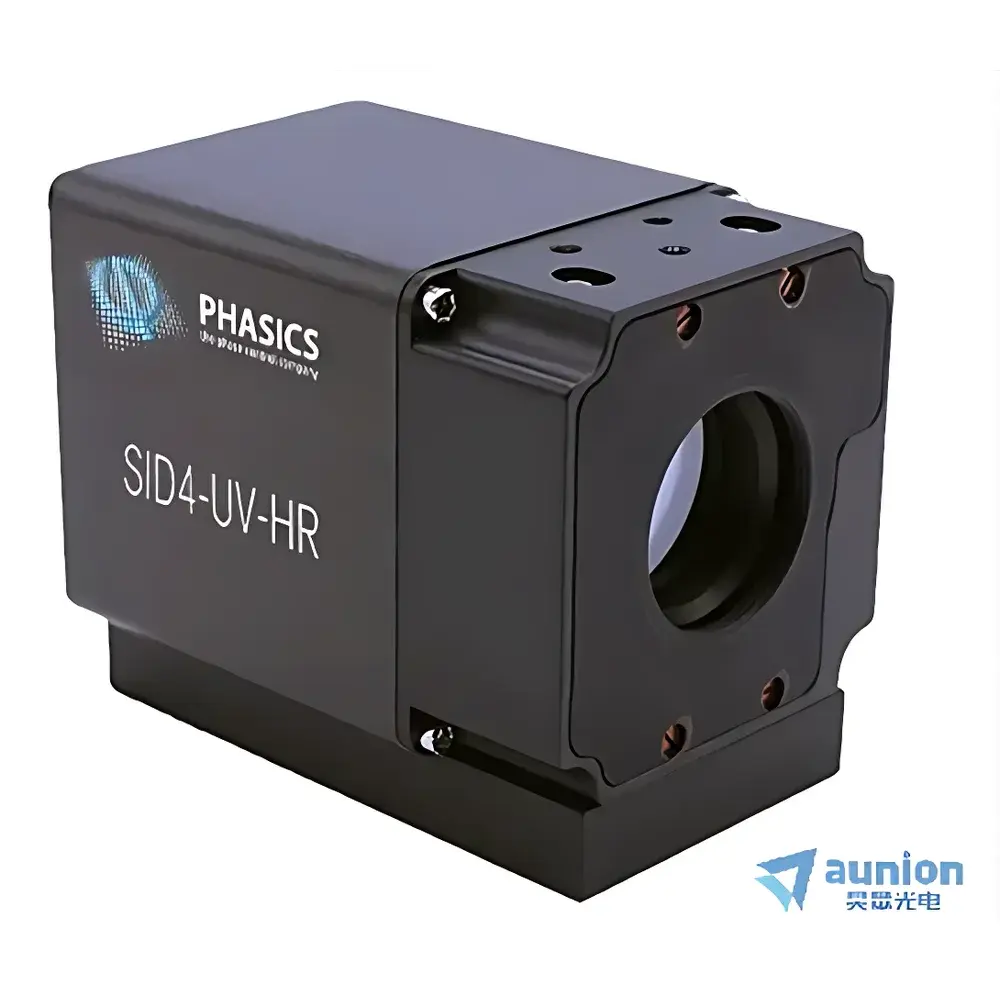
Phasics SID4-UV-HR High-Resolution Ultraviolet Wavefront Sensor
| Brand | Phasics |
|---|---|
| Model | SID4-UV-HR |
| Wavelength Range | 190–400 nm |
| Active Area | 13.8 × 10.88 mm² |
| Spatial Resolution | 38.88 µm |
| Sampling Resolution | 355 × 280 pixels |
| Phase Sensitivity | 1 nm RMS |
| Absolute Accuracy | 10 nm RMS |
| Frame Rate | 30 fps |
| Real-Time Processing Speed | >3 fps (full resolution) |
| Interface | CameraLink |
Overview
The Phasics SID4-UV-HR is a high-resolution, quantitative wavefront sensor engineered for precise optical metrology in the deep ultraviolet (DUV) spectral range. Unlike conventional Shack–Hartmann or interferometric sensors requiring reference optics or stringent alignment, the SID4-UV-HR employs Phasics’ proprietary four-wave lateral shearing interferometry (4WSI) — a self-referencing, common-path technique inherently insensitive to mechanical vibration and thermal drift. This principle enables robust, single-shot wavefront reconstruction without calibration against a known flat or spherical reference surface. Designed specifically for wavelengths from 190 nm to 400 nm, the sensor supports critical applications in semiconductor lithography development, DUV laser characterization, and high-precision surface form metrology of lenses, masks, and silicon wafers. Its monolithic, solid-state architecture eliminates moving parts, ensuring long-term stability and repeatability essential for GLP-compliant optical testing environments.
Key Features
- Deep UV sensitivity down to 190 nm — optimized for excimer lasers (e.g., ArF at 193 nm), frequency-tripled Nd:YAG (355 nm), and broadband DUV sources
- Quantitative phase measurement with 1 nm RMS sensitivity and 10 nm RMS absolute accuracy across full field
- High spatial sampling density: 355 × 280 independent phase points over a 13.8 × 10.88 mm² active area
- Lateral shearing geometry provides intrinsic immunity to environmental perturbations — no active stabilization or vacuum enclosures required
- Simultaneous acquisition of wavefront phase map and intensity distribution in a single exposure
- Real-time wavefront analysis at >3 fps at full resolution; up to 30 fps in subsampled mode for dynamic beam monitoring
- CameraLink interface ensures deterministic data transfer latency and compatibility with industrial vision systems and OEM integration platforms
Sample Compatibility & Compliance
The SID4-UV-HR is compatible with collimated, convergent, and divergent beams without external relay optics — enabling in-situ placement at any location within a UV optical train. It meets key requirements for ISO 10110-5 (surface irregularity specification), ISO 14999-3 (interferometric testing of optical components), and ASTM E2682 (laser beam profiling standards). When integrated into controlled manufacturing environments, the system supports audit-ready documentation workflows aligned with FDA 21 CFR Part 11 (electronic records and signatures) through optional timestamped metadata logging and user-access-controlled software modules. No consumables or alignment-sensitive optics are required, minimizing operational overhead in cleanroom or Class 1000 semiconductor fabrication settings.
Software & Data Management
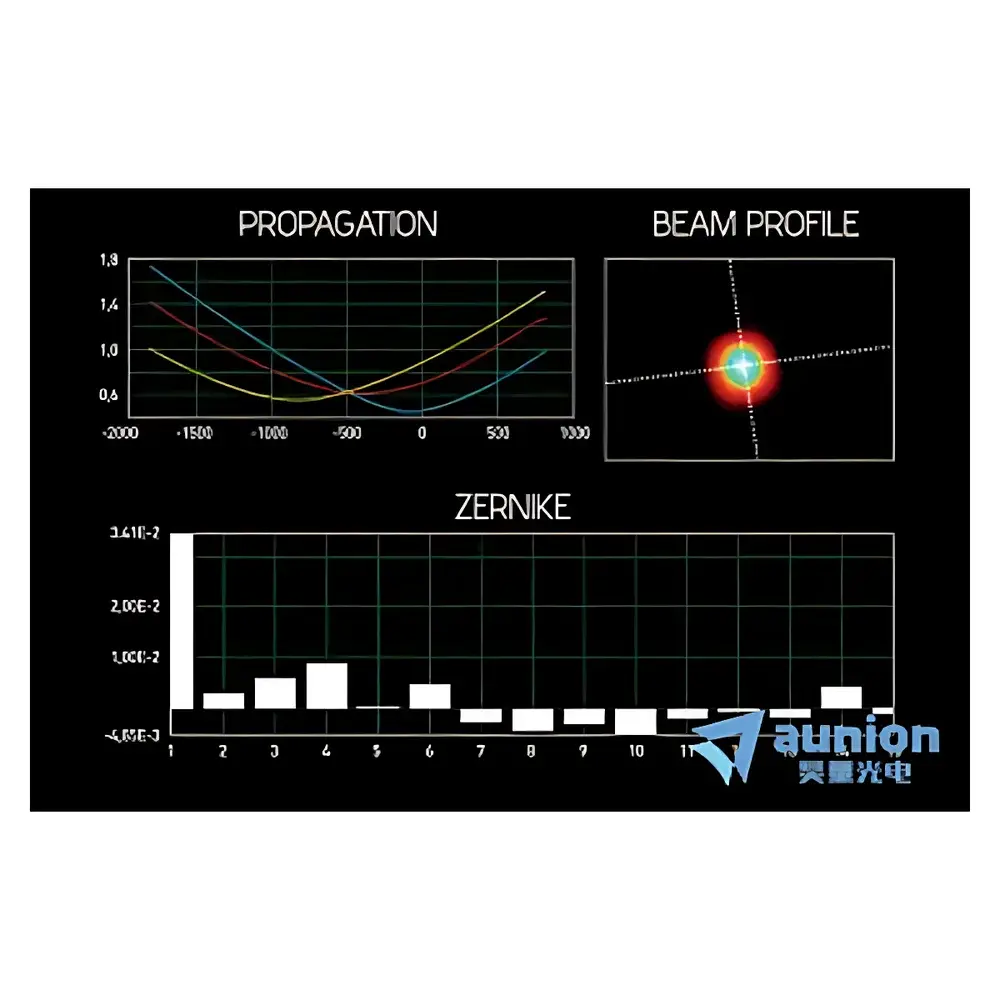
The sensor operates with Phasics’ native QWLS3 software suite, providing turnkey wavefront analysis including Zernike decomposition, PV/RMS wavefront error calculation, M² estimation, beam centroid tracking, and focal plane scanning via motorized stage synchronization. All raw interferograms and processed results are stored in HDF5 format with embedded metadata (wavelength, exposure time, sensor temperature, user ID), ensuring traceability per ISO/IEC 17025 requirements. API support (C/C++, Python, MATLAB) allows seamless integration into custom automation frameworks used in photolithography tool qualification, adaptive optics control loops, or wafer inspection line feedback systems. Software validation packages are available upon request for GMP-regulated R&D labs.
Applications
- Characterization of DUV excimer lasers (193 nm ArF, 248 nm KrF) used in immersion lithography tools
- In-process metrology of aspheric UV lenses, reflective EUV optics substrates, and photomask blanks
- Wavefront error mapping of wafer steppers’ projection optics during maintenance and calibration cycles
- Real-time closed-loop correction in UV adaptive optics systems for synchrotron beamlines and free-electron laser facilities
- Validation of optical design simulations (e.g., Zemax, Code V) under actual UV illumination conditions
- Non-contact surface topography of polished fused silica and CaF₂ optics without risk of UV-induced damage from contact probes
FAQ
Does the SID4-UV-HR require external calibration with a reference optic?
No — its four-wave shearing architecture is self-referencing and does not rely on external flat or spherical references.
Can it measure strongly divergent or focused UV beams directly?
Yes — the sensor accepts beams with numerical apertures up to 0.2 without relay optics, enabling direct placement at focus or near-field positions.
Is vacuum operation supported for wavelengths below 190 nm?
The sensor head is rated for ambient air use down to 190 nm; operation below this threshold requires purged nitrogen or vacuum-compatible housing (available as custom option).
How is thermal drift compensated during extended measurements?
Built-in temperature monitoring and factory-characterized thermal coefficients enable real-time phase offset correction within the QWLS3 software pipeline.
What level of software validation support is provided for regulated industries?
IQ/OQ documentation templates, installation verification protocols, and 21 CFR Part 11-compliant audit trail configuration are available under NDA for pharmaceutical and medical device R&D customers.





