
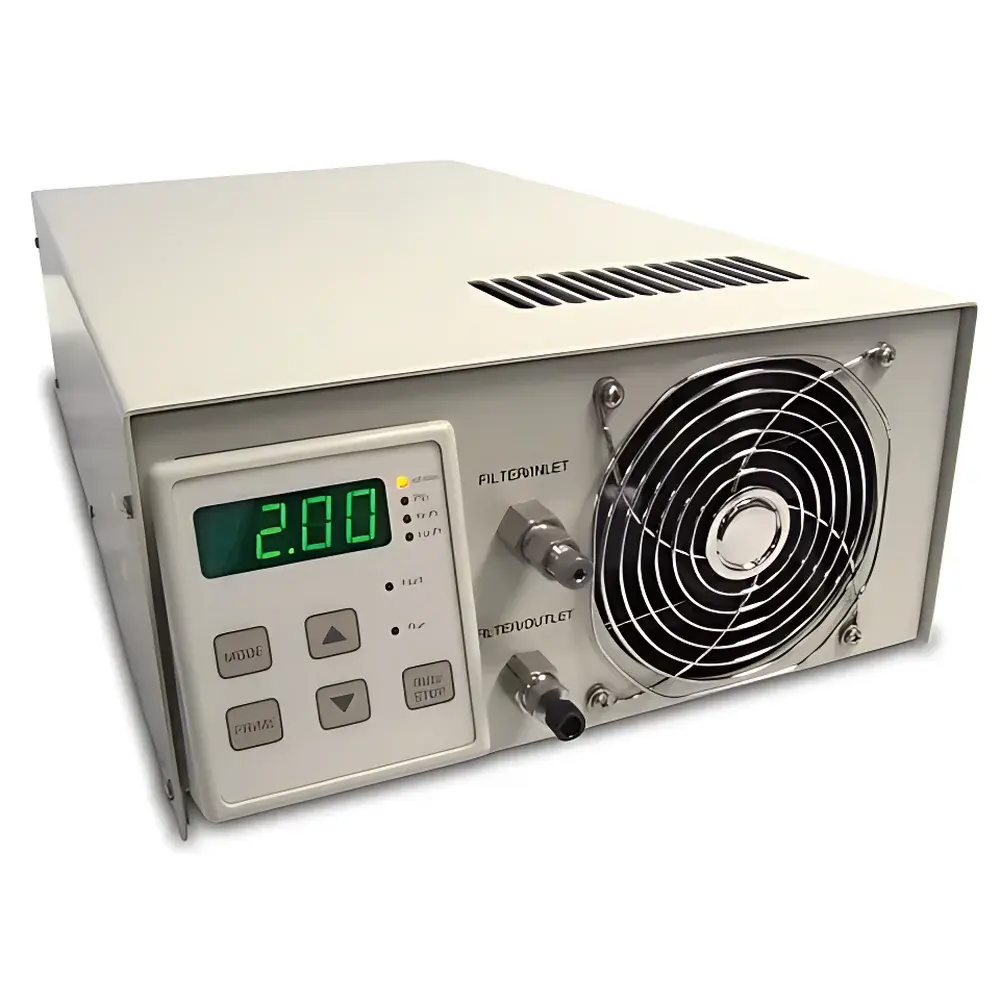
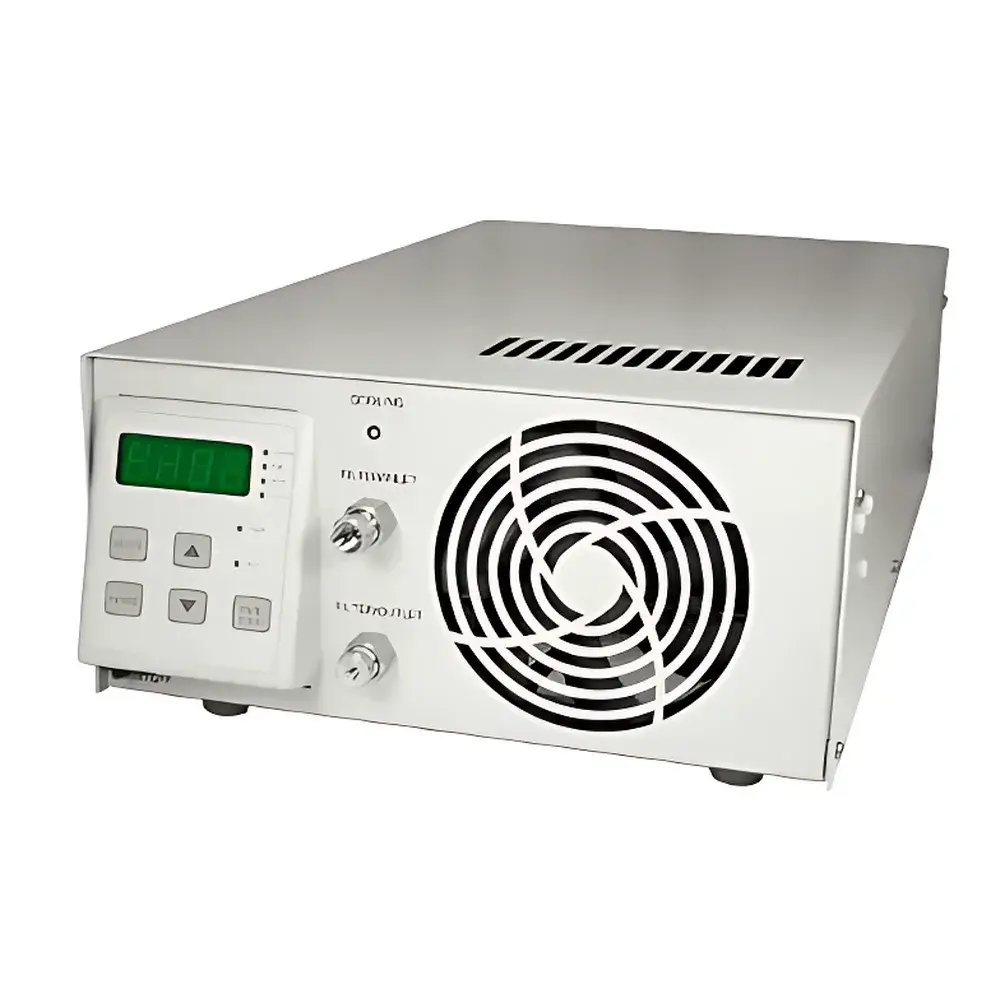
SSI SFC-24 Supercritical Fluid CO₂ Delivery Pump
| Brand | SSI |
|---|---|
| Origin | Imported |
| Model | SFC-24 |
| Maximum Flow Rate | 0.01–24.0 mL/min |
| Maximum Pressure | 10,000 psi |
| Pressure Accuracy | ±2% of full scale |
| Flow Accuracy | ±5% (gas-volume-based liquid flow calculation) |
| Cooling System | Integrated Peltier thermoelectric module |
| Pump Head Material | Aluminum |
| Fluid Path | Stainless steel |
| Pressure Sensing | Built-in electronic transducer |
| Control Interface | Front-panel keypad with LED display |
| Communication | RS-232 |
| Dimensions (H×W×D) | 146 × 283 × 537 mm |
| Weight | 16 kg |
Overview
The SSI SFC-24 Supercritical Fluid CO₂ Delivery Pump is a precision-engineered constant-flow, high-pressure pumping system specifically designed for supercritical fluid chromatography (SFC), extraction (SFE), and reaction applications requiring stable, metered delivery of carbon dioxide in its supercritical state. Operating on positive displacement principle with dual-piston reciprocating architecture, the pump maintains consistent volumetric output across wide pressure ranges—critical for maintaining CO₂ density and solvation power during method development and preparative-scale separations. Its ability to sustain pressures up to 10,000 psi (689 bar) enables operation well beyond the critical point of CO₂ (31.1 °C, 1070 psi), supporting both analytical and process-oriented workflows where thermal stability, phase consistency, and solvent compressibility must be tightly controlled.
Key Features
- Integrated Peltier thermoelectric cooling module — fully embedded within the pump housing to stabilize CO₂ temperature without external chillers, refrigerant lines, or cryogenic fluids; eliminates condensation risks and improves density control.
- Aluminum pump head with stainless-steel fluid path — corrosion-resistant, low-outgassing construction compatible with anhydrous CO₂ and co-solvent blends (e.g., methanol, ethanol, isopropanol).
- Built-in high-stability electronic pressure transducer — provides real-time feedback for closed-loop pressure regulation and enables seamless transition between constant-flow and constant-pressure modes.
- Front-panel keypad interface with LED display — supports intuitive local configuration of flow rate, pressure setpoint, purge cycles, and diagnostic status without external software dependency.
- RS-232 serial communication port — facilitates integration into automated SFC systems, LIMS environments, or custom control platforms compliant with IEEE 488 or SCPI command syntax.
- Motor fault detection and outlet particulate filter — enhances operational safety and protects downstream instrumentation (e.g., columns, detectors, back-pressure regulators) from mechanical anomalies and particulate contamination.
Sample Compatibility & Compliance
The SFC-24 is validated for use with pure CO₂ and CO₂–organic modifier mixtures at temperatures ranging from ambient to 60 °C and pressures up to 10,000 psi. It meets material compatibility requirements defined in ASTM D7091 (Standard Practice for Supercritical Fluid Chromatography) and aligns with ISO 13877:2017 (Supercritical fluid extraction — General principles and terminology). The pump’s pressure accuracy (±2% FS) and flow reproducibility support method transfer under ICH Q2(R2) guidelines. When operated within validated parameters and coupled with appropriate back-pressure regulation, it satisfies GLP and GMP data integrity expectations when used in conjunction with audit-trail-enabled software systems compliant with FDA 21 CFR Part 11.
Software & Data Management
While the SFC-24 operates autonomously via its front-panel interface, its RS-232 port allows bidirectional communication with host systems running vendor-neutral control software or custom LabVIEW/Python-based automation scripts. Pressure and flow setpoints, actual values, error codes, and motor status are transmitted as ASCII-encoded telemetry. For regulated environments, integration with chromatography data systems (CDS) such as Waters Empower or Thermo Chromeleon enables time-stamped event logging, electronic signatures, and full audit trail generation — fulfilling ALCOA+ (Attributable, Legible, Contemporaneous, Original, Accurate, Complete, Consistent, Enduring, Available) data governance criteria.
Applications
- Analytical and preparative supercritical fluid chromatography (SFC) for chiral separations, lipid profiling, and polymer analysis.
- Supercritical fluid extraction (SFE) of botanicals, food matrices, and environmental samples targeting thermolabile compounds (e.g., cannabinoids, carotenoids, essential oils).
- Reaction media delivery in supercritical CO₂-mediated hydrogenation, oxidation, and enzymatic catalysis studies.
- Material processing applications including aerogel synthesis, particle formation (RESS, SAS), and impregnation of pharmaceutical excipients.
- Method development and validation in pharmaceutical QC labs where solvent reduction, green chemistry metrics, and rapid cycle times are prioritized.
FAQ
Does the SFC-24 support both constant-flow and constant-pressure operation modes?
Yes — users may select either mode via the front-panel interface. In constant-pressure mode, the pump dynamically adjusts piston stroke frequency to maintain the user-defined pressure setpoint, compensating for changes in CO₂ compressibility and system resistance.
Is external cooling required for CO₂ liquefaction or subcooling?
No — the integrated Peltier module provides active temperature stabilization down to ~5 °C below ambient, sufficient to maintain CO₂ in liquid or dense-phase condition upstream of the pump inlet without auxiliary chillers.
What maintenance intervals are recommended for long-term reliability?
Pump seals should be inspected every 500 hours of operation; inlet/outlet filters require replacement every 200 hours when handling non-ultrapure CO₂; Peltier module performance should be verified annually using calibrated pressure and temperature references.
Can the SFC-24 be used with solvents other than CO₂?
It is engineered exclusively for supercritical and liquid CO₂ service. Use with other fluids (e.g., N₂O, ethane, or organic solvents) is not supported due to material compatibility, seal design, and thermal management constraints.
How is flow accuracy determined given CO₂’s compressibility?
Flow accuracy (±5%) is specified relative to gas-volume-equivalent calibration — i.e., volumetric flow measured at standard temperature and pressure (STP), then converted to mass-based liquid delivery using real-gas equations of state (NIST REFPROP v10+). This reflects industry-standard practice for supercritical fluid pumping metrology.



