
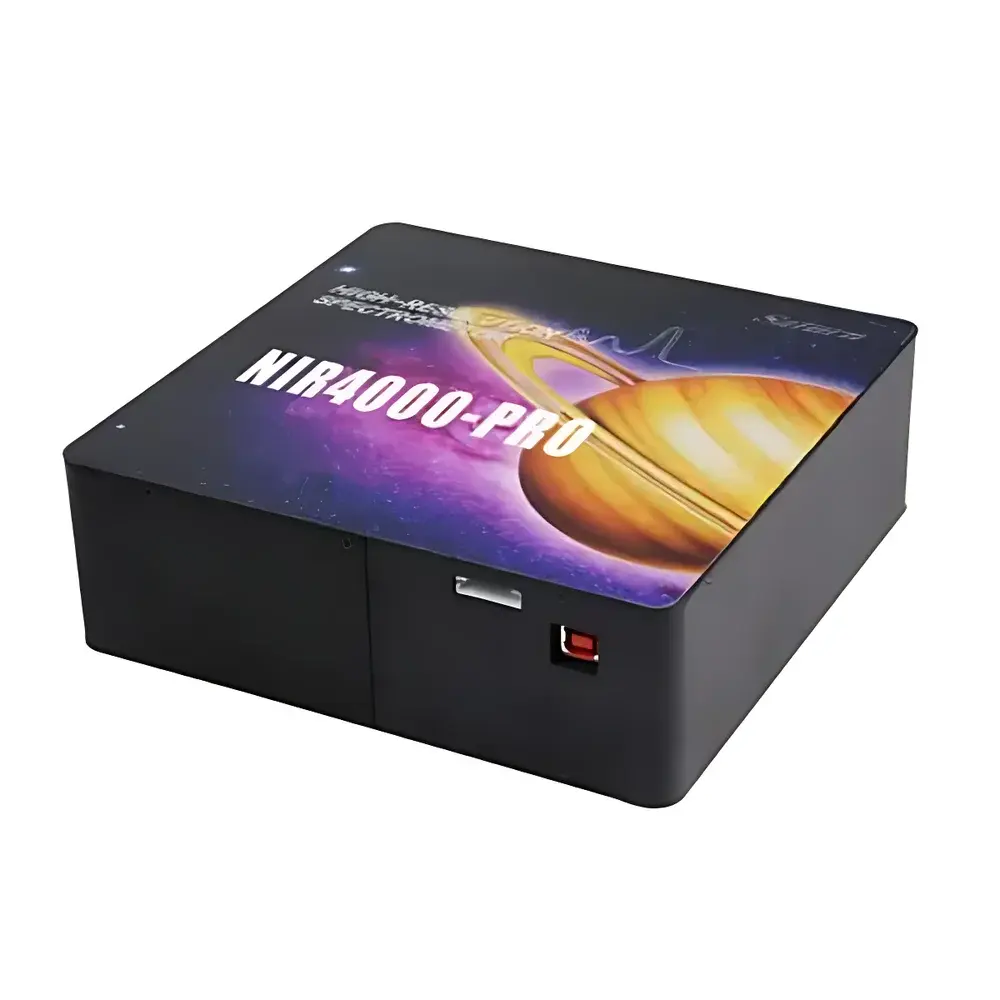
Auniontech NIR4000-PRO-AUT High-Resolution Communication-Band Near-Infrared Spectrometer
| Brand | Auniontech |
|---|---|
| Origin | Shanghai, China |
| Manufacturer Type | Authorized Distributor |
| Product Category | Domestic |
| Model | NIR4000-PRO-AUT |
| Instrument Type | Portable |
| Optical Platform | Czerny-Turner (f = 85–101.5 mm) |
| Numerical Aperture (NA) | 0.1 |
| Spectral Range | 900–1700 nm (tunable) |
| Optical Resolution (FWHM) | <0.2 nm (1522–1578 nm), <0.3 nm (1500–1600 nm) |
| Detector | Hamamatsu G11620-512DA |
| SNR (High Gain) | 2500:1 |
| Dynamic Range | 4700:1 (HG), 6500:1 (LN) |
| Dark Noise (RMS) | 14 counts (HG), 10 counts (LN) |
| ADC | 16-bit, 15 MHz |
| Integration Time | 0.1–24 s (both HG & LN modes) |
| Interface | USB 2.0 + 8-pin GPIO |
| Power | 5 VDC ±0.25 V, 300 mA |
| Operating Temperature | 0–50 °C |
| Dimensions | 180 × 175 × 59.5 mm |
| Weight | Not specified |
Overview
The Auniontech NIR4000-PRO-AUT is a high-resolution, portable near-infrared spectrometer engineered for precision spectral characterization of laser sources in the telecommunications band (900–1700 nm). Based on a robust Czerny-Turner optical architecture with an adjustable focal length (85–101.5 mm) and NA 0.1 input optics, it delivers sub-0.2 nm optical resolution at key C- and L-band wavelengths—enabling accurate determination of peak wavelength, centroid position, spectral intensity distribution, full width at half maximum (FWHM), and multi-peak decomposition. Its design prioritizes signal fidelity over compactness: the extended focal length enhances stray-light rejection and improves spectral contrast, resulting in higher signal-to-noise ratio (SNR up to 2500:1 in high-gain mode) and superior long-term stability—critical for monitoring wavelength drift in tunable lasers, DFB/DBR diodes, and broadband ASE sources under operational conditions.
Key Features
- Sub-0.2 nm optical resolution (FWHM) optimized for 1522–1578 nm, meeting stringent requirements for DWDM channel verification and laser linewidth assessment
- Compact, field-deployable form factor (180 × 175 × 59.5 mm) with USB 2.0 plug-and-play connectivity and integrated 8-pin GPIO for external trigger synchronization
- Hamamatsu G11620-512DA InGaAs linear array detector with thermoelectrically stabilized operation (no active cooling required), ensuring low dark noise (10–14 counts RMS) across gain modes
- Dual-gain acquisition architecture supporting both high-sensitivity (HS) and low-noise (LN) measurement regimes, with dynamic range up to 6500:1
- Flexible integration time control (0.1–24 s) enabling adaptive exposure for both CW and pulsed laser measurements
- Full software development kit (SDK) support for C/C++, Python, MATLAB, and LabVIEW—facilitating OEM integration, automated test systems, and custom spectral analysis workflows
Sample Compatibility & Compliance
The NIR4000-PRO-AUT is designed for direct optical coupling via SMA905 fiber interface or optional cosine corrector/integrating sphere accessories—ensuring compliant, repeatable irradiance measurements per ISO 13406-2 and IEC 62471. It supports both continuous-wave (CW) and pulsed laser characterization: for high-repetition-rate pulses (>100 Hz), standard acquisition suffices; for low-repetition or single-shot pulses, the onboard GPIO trigger input enables precise synchronization with external TTL signals (e.g., laser Q-switch or pulse generator outputs). While not certified to FDA 21 CFR Part 11 out-of-the-box, its data logging architecture—including timestamped spectral metadata, user-defined annotation fields, and binary raw-data export—supports audit-ready documentation in GLP/GMP environments when deployed with validated third-party software.
Software & Data Management
The instrument ships with a native Windows-based spectral acquisition suite featuring real-time display, baseline correction, peak search with FWHM fitting, and multi-curve overlay. All spectral data are saved in HDF5 format—preserving detector calibration coefficients, integration parameters, and hardware configuration state—ensuring traceability and reproducibility. The SDK provides low-level register access and asynchronous acquisition control, allowing developers to embed spectral acquisition into larger test platforms (e.g., automated laser wafer sorters or fiber Bragg grating interrogation systems). Export options include CSV, ASCII, and XML, compatible with industry-standard analysis tools such as OriginPro, JMP, and Python’s SciPy ecosystem.
Applications
- Wavelength validation and drift monitoring of telecom-grade lasers (DFB, EML, VCSELs) across O-, E-, S-, C-, and L-bands
- Characterization of amplified spontaneous emission (ASE) spectra from EDFA and Raman amplifiers
- Real-time spectral feedback in tunable laser control loops and wavelength locker systems
- Fiber-optic sensor demodulation, including FBG, LPG, and interferometric sensor arrays
- Material absorption spectroscopy for polymer, semiconductor, and biological sample analysis in the first and second NIR windows
- Calibration transfer between benchtop and portable platforms in manufacturing QA/QC labs
FAQ
Is the NIR4000-PRO-AUT suitable for measuring pulsed lasers with repetition rates below 10 Hz?
Yes—when configured with external optical triggering via the 8-pin GPIO port, the spectrometer achieves sub-microsecond timing jitter, enabling reliable single-pulse spectral capture synchronized to laser output.
Does the system support NIST-traceable wavelength calibration?
The factory calibration uses multiple certified rare-earth oxide emission lines (e.g., Holmium Oxide, Didymium) traceable to NIST SRM 2035; users may perform field recalibration using optional calibration sources.
Can the spectrometer operate without a PC connection?
No—it requires continuous USB 2.0 host communication for power delivery, command execution, and data streaming; embedded standalone operation is not supported.
What is the typical measurement uncertainty for peak wavelength determination?
Under controlled lab conditions (stable temperature, calibrated source), peak wavelength repeatability is ±0.015 nm (1σ) over 1-hour sessions, consistent with ISO 17025-compliant uncertainty budgets for optical metrology.
Is firmware upgrade capability available?
Yes—firmware updates are delivered via the vendor’s secure portal and applied through the host software; version history and release notes are publicly documented for audit compliance.




