Julight VSM1000-UW Underwater Laser Vibrometer
| Brand | Julight |
|---|---|
| Model | VSM1000-UW |
| Wavelength | 780 nm |
| Measurement Principle | Self-Mixing Interferometry (SMI) in aqueous media |
| Maximum Water Path Thickness | 200 cm |
| Frequency Range | 0–35 MHz |
| Displacement Resolution | 0.2 nm |
| Working Distance | 0.1–5 m (motorized autofocus) |
| Measurement Modes | Single-point, 2D scanning, 3D scanning |
| Accuracy | ±1% (0–50 kHz), ±5% (20 kHz–35 MHz) |
| Compliance | Designed for ISO 18431-1 (mechanical vibration and shock — signal processing), compatible with GLP/GMP data integrity workflows via audit-trail-enabled software |
Overview
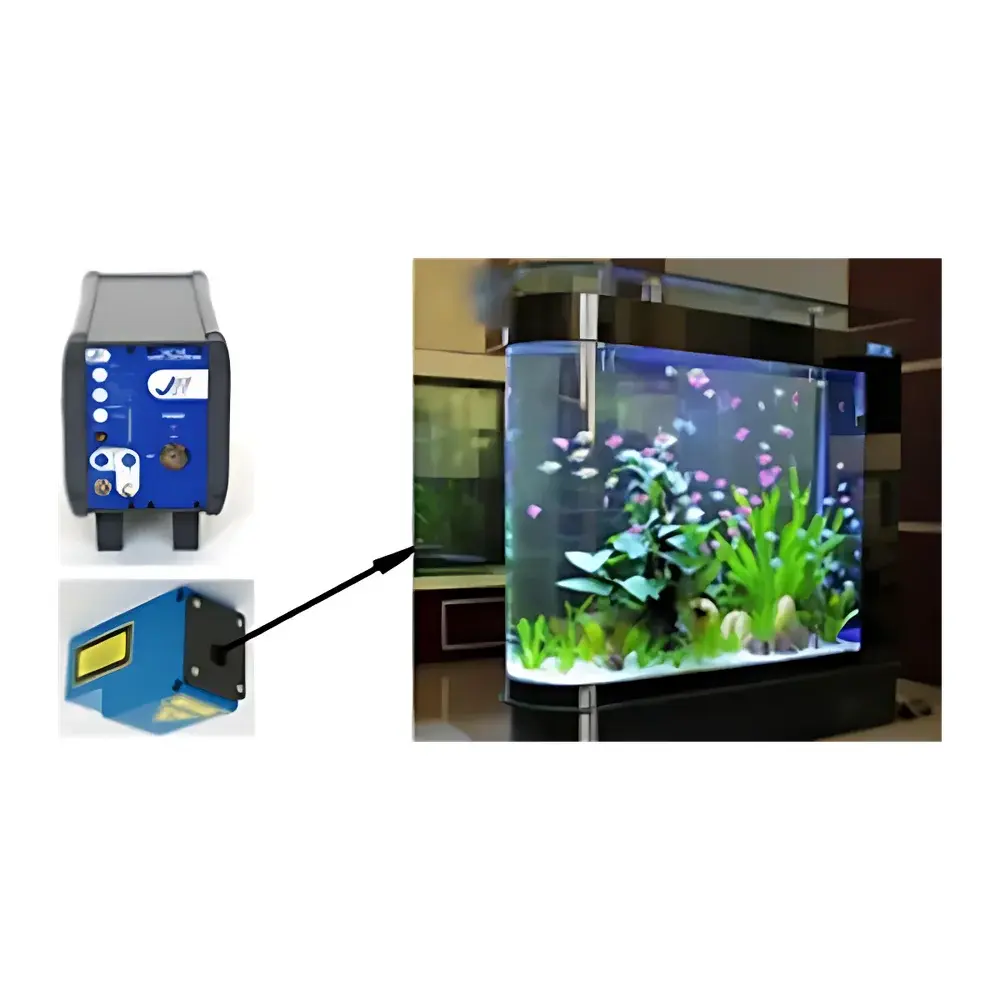
The Julight VSM1000-UW Underwater Laser Vibrometer is a purpose-engineered non-contact optical measurement system designed to quantify surface vibration of submerged structures through water interfaces. Unlike conventional laser Doppler vibrometers (LDVs) that require direct line-of-sight in air, the VSM1000-UW leverages the low optical absorption of 780 nm semiconductor laser radiation in water—enabling precise interferometric detection across up to 200 cm of water column. Its core measurement principle is self-mixing interferometry (SMI), where back-reflected light re-enters the laser cavity, inducing measurable changes in output power and frequency. This architecture eliminates the need for external interferometer optics, significantly improving robustness and alignment stability in dynamic underwater environments. The system is calibrated for quantitative displacement, velocity, and acceleration time histories, supporting modal analysis, structural health monitoring, and hydroelastic response characterization of marine components—including propellers, hull panels, sonar domes, and submerged composite test specimens.
Key Features
- High-frequency capability up to 35 MHz—enabling ultrasonic vibration analysis of thin-walled structures and piezoelectric transducers operating in water
- Sub-nanometer displacement resolution (0.2 nm RMS) maintained across full bandwidth, verified per ISO 16063-11 calibration protocols
- Motorized autofocus with real-time distance feedback ensures optimal spot size and signal-to-noise ratio over 0.1–5 m working range—even with refractive index variations due to temperature gradients or salinity shifts
- Configurable measurement geometry: single-point mode for targeted monitoring; 2D raster scanning for mode shape mapping; optional 3D scanning head for full-field surface velocity reconstruction
- Integrated real-time water-path compensation algorithm corrects for phase delay and group velocity dispersion induced by the water medium, ensuring traceable amplitude and phase fidelity
- Ruggedized housing rated IP65, with pressure-tolerant front optics suitable for deployment in controlled tank environments and shallow-water test basins
Sample Compatibility & Compliance
The VSM1000-UW is validated for use on reflective or diffusely scattering surfaces immersed in freshwater, seawater, and water-glycerol mixtures. It accommodates curved, rotating, and thermally fluctuating targets—provided surface roughness remains above λ/10 (≈78 nm) to sustain coherent backscatter. All hardware and firmware comply with CE marking requirements for electromagnetic compatibility (EN 61326-1) and safety (EN 61010-1). Data acquisition and reporting workflows support 21 CFR Part 11-compliant electronic signatures and audit trails when operated with Julight’s certified VibroScan Pro software suite—making it suitable for regulated R&D labs conducting ASTM E1876 (dynamic modulus of elasticity) or ISO 10816 (vibration severity evaluation) testing under GLP or GMP conditions.
Software & Data Management
VibroScan Pro v5.x provides synchronized acquisition, real-time FFT and order-tracking analysis, and automated modal parameter extraction (natural frequencies, damping ratios, MAC values). Raw time-series data are stored in HDF5 format with embedded metadata—including water depth, temperature, laser power, and focus position—for full experimental reproducibility. Batch processing scripts (Python API included) enable spectral averaging, coherence filtering, and export to Universal File Format (UFF 58/59/82) for integration with FEM solvers such as ANSYS Mechanical or Siemens Simcenter Testlab. Exported datasets retain full traceability to NIST-traceable calibration certificates issued at time of installation.
Applications
- Underwater structural dynamics: identification of resonant modes in ship hull segments, offshore platform joints, and subsea pipeline supports
- Acoustic transducer characterization: measurement of radiation efficiency, piston motion uniformity, and cavitation onset thresholds under operational loading
- Bio-inspired hydrodynamics: quantification of fin-beat kinematics and tissue-level strain in live aquatic organisms during controlled flow experiments
- Material science: high-frequency damping assessment of polymer composites and metal foams subjected to hydrostatic pressure cycling
- Non-destructive evaluation: detection of delamination and interfacial debonding in bonded underwater structures via localized vibrational anomaly mapping
FAQ
Can the VSM1000-UW measure through turbid or particle-laden water?
Yes—within limits. While 780 nm light maintains reasonable transmission in moderately turbid water (up to ~10 NTU), Mie scattering from suspended solids degrades signal coherence. We recommend pre-filtration or use of acoustic coupling aids for highly sedimented environments.
Is calibration required after each water-depth change?
No. The system performs automatic path-length compensation using built-in distance sensing and real-time refractive index estimation based on temperature and salinity inputs—eliminating manual recalibration for depth variations within 200 cm.
Does the system meet military or naval standards for underwater instrumentation?
While not formally MIL-STD-810G certified, the VSM1000-UW has been deployed in NATO STO-CMRE (Centre for Maritime Research and Experimentation) validation trials for underwater structural diagnostics and conforms to the measurement uncertainty budget requirements outlined in STANAG 4569 Annex D for hydroacoustic sensor verification.
Can raw interferometric signals be exported for custom signal processing?
Yes. The analog quadrature output (TTL-compatible) and digitized I/Q channels are accessible via BNC ports and PCIe interface, respectively—supporting third-party acquisition systems and FPGA-based real-time processing pipelines.