
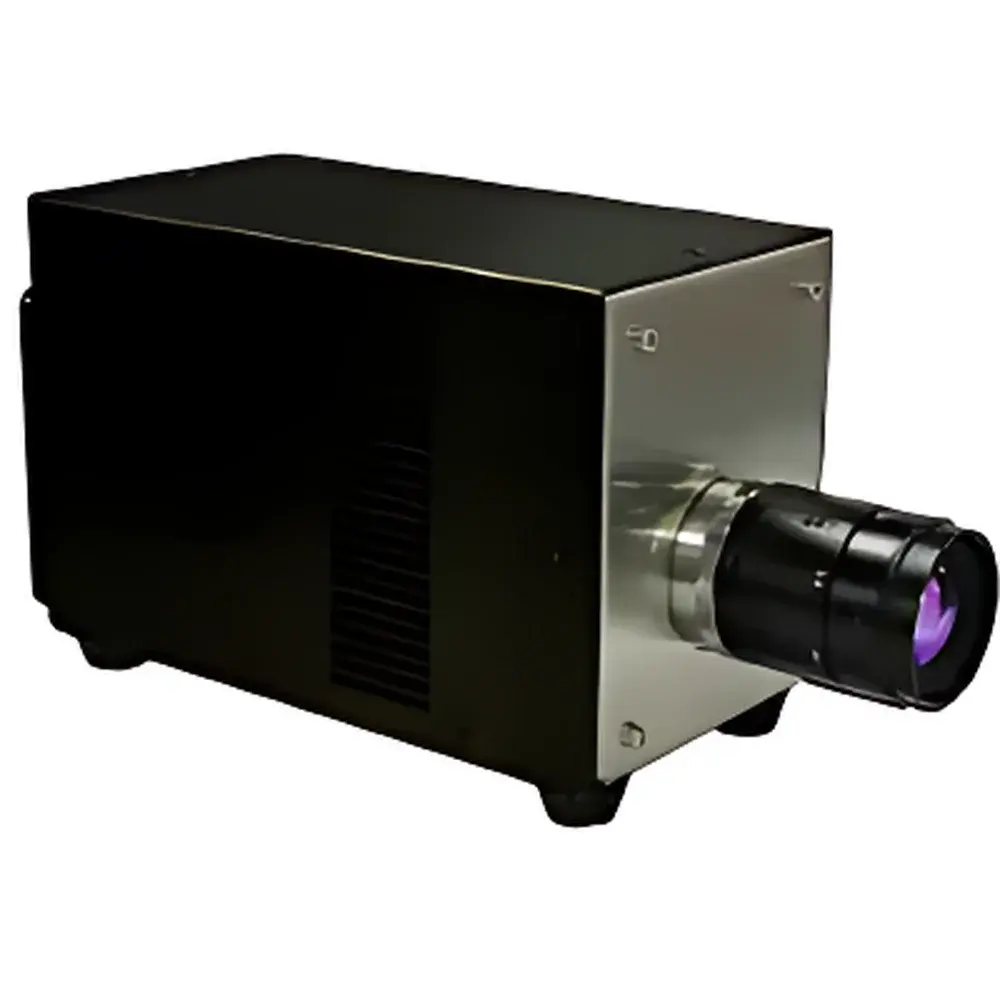
ARTRAY ARTCAM-2350SWIR / ARTCAM-2500SWIR InGaAs/GaAsSb Short-Wave Infrared (SWIR) Camera
| Brand | ARTRAY |
|---|---|
| Detector Material | InGaAs or GaAsSb |
| Spectral Range | 1000–2350 nm (ARTCAM-2350SWIR) / 1000–2500 nm (ARTCAM-2500SWIR) |
| Resolution | 320 × 256 pixels |
| Cooling | Thermoelectric (TE) |
| Frame Rate | Up to 320 fps (at minimum exposure of 1 ms) |
| Exposure Modes | Configurable from 1 ms to 9 ms across multiple frame rates |
| Bit Depth | 16-bit |
| Operating Temperature | 0–35 °C |
| Pixel Defect Rate | <1% |
| Lens Mount | C-mount |
| Compliance | RoHS-compliant design, compatible with industrial imaging standards (e.g., GenICam protocol support) |
Overview
The ARTRAY ARTCAM-2350SWIR and ARTCAM-2500SWIR are high-performance short-wave infrared (SWIR) cameras engineered for scientific, industrial, and defense applications requiring spectral sensitivity beyond the visible and near-infrared (NIR) bands. These cameras utilize lattice-matched InGaAs or extended-range GaAsSb photodiode arrays to deliver photon detection in the critical 1000–2350 nm and 1000–2500 nm spectral windows—regions where silicon-based sensors exhibit negligible quantum efficiency. Unlike thermal imaging systems operating in mid- or long-wave IR, SWIR imaging relies on reflected or transmitted photons, enabling high-resolution, diffraction-limited imaging with contrast mechanisms rooted in material-specific absorption, scattering, and reflectance properties. The cameras employ thermoelectric (Peltier) cooling to stabilize detector temperature, significantly reducing dark current and enabling low-noise operation essential for quantitative radiometric analysis and time-resolved measurements.
Key Features
- Two spectral variants: ARTCAM-2350SWIR (1000–2350 nm) and ARTCAM-2500SWIR (1000–2500 nm), optimized for extended cutoff performance with GaAsSb detector option
- 320 × 256 pixel InGaAs/GaAsSb focal plane array with <1% defective pixel rate and factory-mapped correction tables
- 16-bit digitization with linear response across full dynamic range; supports both global and rolling shutter modes
- High-speed acquisition: up to 320 fps at 1 ms exposure, with granular exposure control (1–9 ms) selectable per frame rate tier
- Integrated thermoelectric cooler maintaining detector stability within ±0.1 °C under ambient conditions (0–35 °C)
- C-mount lens interface compatible with standard SWIR achromats, telecentric lenses, and custom optical assemblies
- GenICam-compliant firmware enabling seamless integration into HALCON, OpenCV, MATLAB Image Acquisition Toolbox, and LabVIEW environments
Sample Compatibility & Compliance
These SWIR cameras are designed for non-contact, label-free inspection of optically opaque or semi-transparent materials. Their spectral response aligns with key molecular vibrational overtones (e.g., C–H, O–H, N–H bonds), making them suitable for compositional analysis without sample preparation. The system meets RoHS Directive 2011/65/EU requirements and conforms to CE marking standards for electromagnetic compatibility (EN 61326-1) and safety (EN 61010-1). While not certified for medical device use per ISO 13485, the camera’s deterministic timing, stable gain calibration, and reproducible linearity support GLP-compliant documentation workflows when deployed with traceable NIST-traceable reference sources. Data integrity is preserved via hardware timestamping and metadata embedding (exposure, gain, temperature, frame ID) in each image header.
Software & Data Management
ARTRAY provides a native SDK (Windows/Linux/macOS) supporting C/C++, Python, and .NET bindings. All captured frames include embedded EXIF-style metadata compliant with IEEE 1789-2021 for scientific imaging. Time-synchronized multi-camera operation is supported via TTL trigger input/output and programmable strobe output. Optional software modules include real-time spectral ratio mapping (e.g., 1550 nm / 1310 nm band ratio for moisture discrimination), FFT-based speckle contrast analysis for laser beam profiling, and batch-mode defect classification using user-defined intensity-threshold and morphology filters. Raw data export supports HDF5, TIFF (BigTIFF), and FITS formats—ensuring compatibility with MATLAB, Python (Astropy, scikit-image), and commercial metrology platforms such as ZEISS INSPECT or Keyence IM Series.
Applications
- Laser diagnostics: Real-time monitoring of 1550 nm telecom lasers, high-power fiber laser spots, and ultrafast amplifier outputs
- Industrial inspection: Detection of micro-cracks in silicon wafers, delamination in PV modules, and solder joint integrity in PCB assemblies
- Agricultural sorting: Discrimination of foreign materials (plastics, stones) and internal defects in fruits, grains, and nuts based on SWIR spectral signatures
- Fluorescence lifetime imaging (FLIM): Time-gated capture of NIR-II fluorophores (e.g., IR-26, CH1055) with sub-millisecond temporal resolution
- Combustion analysis: Flame front tracking, soot concentration mapping, and thermal signature separation in gas turbine and engine test cells
- Security & surveillance: Covert active illumination imaging through fog, smoke, or silicon-based barriers (e.g., solar cell encapsulation layers)
- Pharmaceutical QA: Tablet coating uniformity assessment and counterfeit drug identification via spectral fingerprinting
FAQ
What is the primary difference between InGaAs and GaAsSb detector options?
InGaAs detectors offer superior quantum efficiency (>70%) and lower dark current in the 1000–1700 nm range, while GaAsSb extends responsivity to 2500 nm with moderate QE degradation beyond 2200 nm—ideal for applications requiring full-band coverage.
Is external cooling required for stable operation?
No. Integrated thermoelectric cooling maintains optimal detector temperature without liquid nitrogen or chiller systems, enabling portable and OEM-integrated deployments.
Can the camera be synchronized with pulsed laser sources?
Yes. Hardware-triggered acquisition supports jitter <100 ns, with programmable delay (0–100 ms) and exposure window width down to 1 µs (via external gating mode).
Does the system support radiometric calibration?
Yes. Factory-calibrated radiometric response curves (W/cm²/nm per DN) are provided with NIST-traceable blackbody source validation reports; optional in-field recalibration kits available.
What lens options are recommended for macro-scale defect inspection?
Schneider-Kreuznach Xenoplan 1.4/23 SWIR or Edmund Optics #67-727 telecentric lenses are validated for ≤5 µm resolution at working distances of 100–300 mm.




