
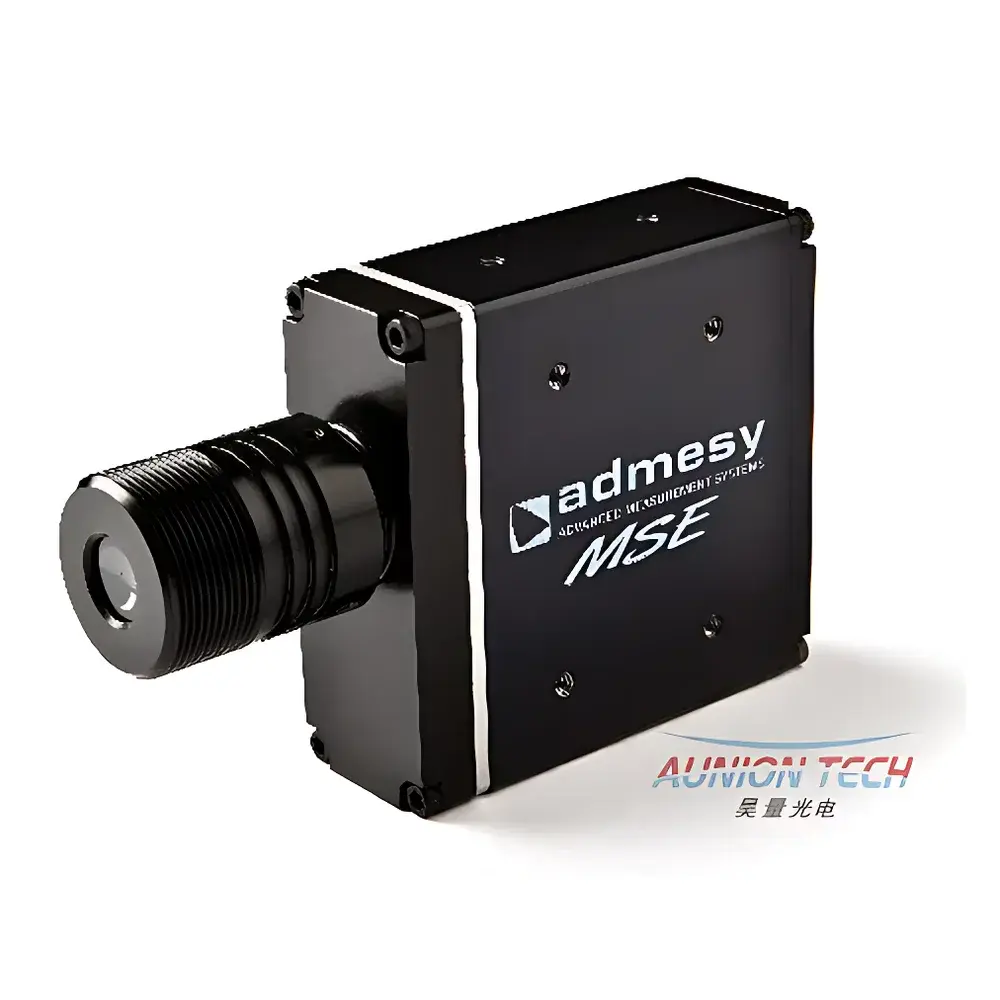
Admesy MSE Series Online Colorimeter
| Brand | Admesy |
|---|---|
| Origin | Netherlands |
| Model | MSE_colorimeters |
| Optical Spot Size | 10 mm (standard), 20 mm (MSE+ variant) |
| Spectral Response | CIE 1931 XYZ-matched via interference-filtered Si photodiodes |
| Measurement Speed | Up to 200 color measurements/sec @ 200 cd/m² |
| Luminance | 22,000 samples/sec |
| Dynamic Range | 0.05–3000 cd/cm² (MSE), 0.05–15,000 cd/cm² (MSE+) |
| Accuracy | Luminance Y ±0.06% (≥150 cd/m²), Chromaticity x,y ±0.0002 (≥150 cd/m², calibrated) |
| Repeatability | Y ±0.15% @ 1 cd/m² |
| Resolution | 15-bit for X,Y,Z channels |
| Integration Time | 1 ms – 5 s |
| Interface | USB 2.0, RS-232, TTL Trigger In/Out |
| Mechanical Shutter | >1 million cycles, 70–120 ms actuation |
| Operating Temperature | 10–35 °C |
| Dimensions (w/o lens) | 63 × 24 × 65 mm |
| Weight | 250 g |
| Mounting | 12× M3 threaded holes |
| Compliance | Designed for GLP/GMP-aligned manufacturing environments |
Overview
The Admesy MSE Series Online Colorimeter is an industrial-grade, compact photometric sensor engineered for real-time, high-speed chromaticity and luminance monitoring in automated production and R&D environments. Based on tristimulus XYZ detection using precision interference filters aligned to the CIE 1931 color matching functions, the MSE delivers traceable, spectrally accurate colorimetric data without requiring spectral decomposition. Its solid-state architecture—featuring three silicon photodiodes with individually optimized optical bandpass filters—ensures stable, drift-resistant performance across extended operational cycles. Unlike filter-wheel or scanning spectrometer-based systems, the MSE employs simultaneous analog signal acquisition, enabling true parallel measurement of X, Y, and Z tristimulus values. This architecture underpins its exceptional temporal resolution: up to 200 full-color (XYZ/Yxy) measurements per second at moderate luminance levels (200 cd/m²), and luminance-only sampling at 22,000 Hz. The built-in mechanical shutter enables precise dark-reference acquisition, critical for maintaining long-term calibration integrity in unattended 24/7 inline applications such as display panel manufacturing, LED binning, and backlight uniformity verification.
Key Features
- Simultaneous XYZ tristimulus acquisition with CIE 1931-compliant spectral responsivity
- Two optical configurations: standard 10 mm spot size (MSE) and extended-dynamic-range 10/20 mm options (MSE+)
- Integrated electromechanical shutter (>1 million actuation cycles) for automated dark compensation
- Dual-mode triggering: hardware TTL input/output for synchronization with conveyor motion, camera exposure, or pulse-width-modulated light sources
- Multi-parameter output: XYZ, Yxy, Yu’v’, CCT (Correlated Color Temperature), DWL (Dominant Wavelength), flicker (JEITA & contrast methods), and response time estimation
- Ruggedized aluminum housing (63 × 24 × 65 mm, 250 g) with 12× M3 mounting points for OEM integration into cleanroom-compatible fixtures
- USB 2.0 and RS-232 interfaces supporting both streaming and command-response protocols; no external power supply required (bus-powered)
Sample Compatibility & Compliance
The MSE Series is optimized for non-contact reflectance and transmittance measurements of flat, diffuse, or semi-diffuse surfaces—including LCD, OLED, microLED, and Mini-LED displays—as well as illuminated panels, automotive lighting modules, and architectural lighting fixtures. Its 5° field-of-view (±2.5° half-angle) ensures consistent spatial sampling across varying working distances (e.g., 10 mm spot at 50 mm WD; 12 mm at 100 mm). The device meets fundamental metrological requirements for ISO/CIE-compliant colorimetry and is routinely deployed in quality control workflows aligned with IEC 62341-6-3 (OLED displays), VESA DisplayHDR, and JEDEC JESD85 (flicker testing). When used with Admesy’s Quantum software suite and configured for secure user authentication, audit trails, and electronic signatures, the system supports compliance with FDA 21 CFR Part 11, EU Annex 11, and GLP/GMP documentation standards for regulated manufacturing environments.
Software & Data Management
Admesy provides native support through its Quantum software platform—a modular, Windows-based application enabling real-time visualization, statistical process control (SPC), pass/fail thresholding, and automated report generation. Raw data streams are timestamped and structured in CSV/JSON formats compatible with MES, SCADA, and LabVIEW systems. The SDK (C++, .NET, Python) exposes low-level register access and asynchronous callback functions for custom integration into PLC-controlled inspection stations or AI-driven defect classification pipelines. All measurement metadata—including integration time, gain setting, shutter state, and calibration certificate ID—is embedded in each data packet. Optional cloud gateway modules enable encrypted MQTT publishing to AWS IoT Core or Azure IoT Hub for centralized fleet monitoring and predictive maintenance analytics.
Applications
- Inline white point calibration and uniformity mapping during TFT-LCD/OLED module assembly
- Automated MURA defect screening via spatial chromaticity deviation analysis
- LED backlight binning based on CCT and chromaticity shift over drive current/temperature
- Flicker quantification per JEITA CP-1501 and IEEE 1789 standards for consumer electronics certification
- Response time estimation via luminance transient capture at ≥10 kHz sampling rate
- Color stability validation of automotive interior lighting under thermal soak conditions
- Quality gate verification for AR/VR microdisplay modules prior to wafer-level packaging
FAQ
What is the minimum measurable luminance level, and how does accuracy scale with brightness?
The MSE achieves reliable measurements down to 0.05 cd/cm². Luminance accuracy improves with increasing signal level: ±0.3% at 0.1 cd/m², tightening to ±0.06% at ≥150 cd/m². Chromaticity repeatability follows a similar trend—x,y uncertainty decreases from ±0.003 at 0.1 cd/m² to ±0.0002 at 150 cd/m².
Can the MSE be used for pulsed or PWM-driven light sources?
Yes. The device supports external trigger synchronization and offers programmable integration windows (1 ms – 5 s), enabling precise phase-locked capture of transient emissions. Its 22,000 Hz luminance sampling rate resolves individual PWM cycles up to ~10 kHz.
Is factory recalibration required, and what is the recommended interval?
Admesy recommends annual traceable recalibration against NIST-traceable standards. Field verification using certified reference tiles (e.g., BCRA Series II) is supported via built-in calibration routines.
Does the MSE support third-party software integration beyond Quantum?
Yes. Full API documentation, DLLs, and example code for LabVIEW, MATLAB, Python (PyAdmesy), and C# are provided. No licensing fees apply for OEM redistribution.
How is thermal drift managed during extended operation?
The MSE incorporates temperature-compensated analog front-end circuitry and internal thermal monitoring. Stability testing shows <0.0005 Δu’v’ drift over 8 hours at 25 °C ambient, with active thermal management advised above 35 °C.




