
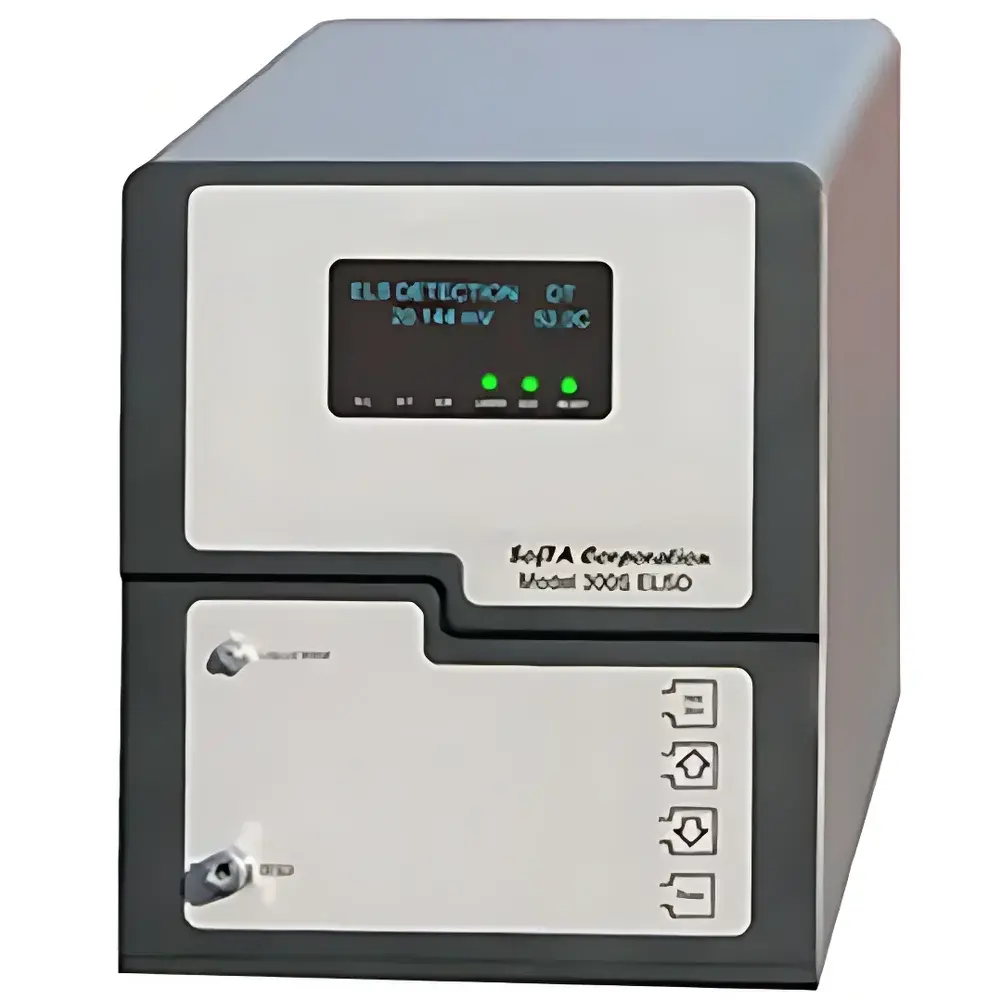
SofTA M300s Evaporative Light Scattering Detector (ELSD)
| Brand | SofTA |
|---|---|
| Origin | Imported |
| Manufacturer Type | Authorized Distributor |
| Model | M300s |
| Compatible Instrument | HPLC Systems |
| Detector Type | Evaporative Light Scattering Detector (ELSD) |
| Wavelength Range | 200 nm (UV-Vis spectral cutoff, not tunable source) |
| Detection Mode | Dual-Beam |
| Light Source | Deuterium Lamp (for baseline stability reference), 650 nm Near-Infrared Laser (primary scattering source) |
| Nebulizer | PTFE (Teflon®) Capillary |
| Drift Tube Temperature Range | Ambient to 120 °C |
| Nebulization Zone Temperature Range | 10–70 °C |
| Sensitivity | 100 pg glucopyranoside (micro-HPLC, 2 µL direct injection, 3 s peak width at 10% height) |
| Dynamic Range | 3 decades (standard gain), up to 4.5 decades (extended range mode) |
| Mobile Phase Flow Rate | Up to 5 mL/min |
| Gas Requirement | N₂ or inert gas, 50 psi supply pressure |
| Gas Consumption | ≤2.5 L/min |
| Power | 120/240 V, 50/60 Hz, 600 W |
| Dimensions | 25 W × 45 D × 29 H cm |
| Weight | 15 kg |
Overview
The SofTA M300s Evaporative Light Scattering Detector (ELSD) is a precision-engineered, thermally controlled detection system designed for universal, non-destructive quantification of non-volatile and semi-volatile analytes in liquid chromatography. Unlike UV-absorbing detectors, the M300s operates on the principle of nebulization, solvent evaporation, and light scattering—making it especially suitable for compounds lacking chromophores, such as carbohydrates, lipids, surfactants, polymers, and natural product glycosides. Its dual-beam optical architecture—comprising a deuterium lamp for real-time baseline correction and a Class 1, 650 nm near-infrared laser (<5 mW) compliant with FCC eye-safety standards—ensures high signal stability and low noise across variable mobile phase compositions. The detector integrates SofTA’s proprietary thermal分流 (thermal split) technology, enabling precise control over aerosol generation and particle size distribution within the nebulization zone—a critical factor governing detection sensitivity and reproducibility in gradient elution and high-boiling-point solvent applications.
Key Features
- PTFE (Teflon®)-lined nebulizer capillary—chemically inert, abrasion-resistant, and clog-resistant across aqueous, organic, and mixed-phase mobile phases.
- Independent temperature control of both nebulization zone (10–70 °C) and drift tube (ambient to 120 °C), allowing method-specific optimization for volatile vs. non-volatile solvents—including acetonitrile, methanol, THF, and aqueous buffers with salts.
- Cryogenic-capable operation: refrigerated nebulization enables stable ELSD response with highly volatile or heat-labile mobile phases without condensation artifacts.
- Vacuum fluorescent display (VFD) with intuitive menu navigation and real-time monitoring of temperature, pressure, gain, filter constant, and self-diagnostic status.
- Onboard storage for up to 10 user-defined methods—including temperature profiles, gain settings, and filtering parameters—enabling rapid method recall and instrument reconfiguration.
- Integrated gas management system featuring automatic inlet valve timing, built-in pressure regulation, overpressure shutoff, and fail-safe gas cutoff to prevent unintended cylinder depletion.
- Full-sealed, high-gain silicon photodiode detector with analog signal output (fixed 10 mV or 5 V; selectable 0–5 V) and RS232 serial interface for integration with third-party chromatography data systems (CDS).
Sample Compatibility & Compliance
The M300s supports broad sample compatibility across pharmaceutical, nutraceutical, food, and polymer analysis workflows. It is routinely employed for USP , EP 2.2.46, and ChP (Chinese Pharmacopoeia) HPLC-ELSD methods—particularly for assay of polysaccharides, saponins, fatty acids, and excipients where UV detection is impractical. All wetted materials—PTFE, 316 stainless steel, alumina, and borosilicate glass optics—are compliant with GLP/GMP environments and compatible with cleaning protocols per FDA 21 CFR Part 11 requirements when paired with validated CDS software. The detector’s fixed optical path and sealed optical chamber ensure long-term alignment stability and resistance to ambient humidity or particulate contamination.
Software & Data Management
While the M300s operates autonomously via front-panel controls, its RS232 interface permits bidirectional communication with industry-standard chromatography data systems (e.g., Waters Empower, Thermo Chromeleon, Agilent OpenLab). Users may configure acquisition parameters—including gain, filter time constant, zero calibration, and alarm thresholds—remotely. Audit-trail capable CDS implementations can record all detector parameter changes, calibration events, and error logs, satisfying ALCOA+ data integrity principles. Firmware updates are performed via serial upload, and all configuration data—including stored methods—is retained during power cycling.
Applications
- Quantitative analysis of non-UV-absorbing pharmaceutical actives and impurities (e.g., heparin, dextrans, cyclodextrins).
- Stability-indicating assays for lipid-based drug products and emulsions under ICH Q5C guidelines.
- Method transfer from preparative to analytical HPLC using micro- and narrow-bore columns (down to 1 mm ID), leveraging its 100 pg sensitivity and 3-second peak width capability.
- Quality control of herbal extracts, sweeteners, and prebiotic oligosaccharides per AOAC and ISO 17025-accredited laboratories.
- Process analytical technology (PAT) support for continuous chromatography systems requiring robust, non-destructive endpoint detection.
FAQ
Is the M300s compatible with UHPLC systems?
Yes—the detector accepts flow rates up to 5 mL/min and features low internal volume design, making it suitable for conventional HPLC and select UHPLC applications when operated with appropriate post-column flow splitting or low-dead-volume interfaces.
Does the M300s require daily calibration with standards?
No—ELSDs are inherently relative detectors; quantitative accuracy relies on consistent nebulization and evaporation conditions rather than absolute photometric calibration. However, routine system suitability testing using glucopyranoside or similar reference standards is recommended per pharmacopeial guidelines.
Can the M300s be used with corrosive mobile phases such as TFA or HFBA?
Yes—its PTFE nebulizer and stainless-steel fluid path provide excellent resistance to low-concentration ion-pairing reagents; however, prolonged exposure to >0.1% TFA or hydrofluoric acid derivatives is not advised without validation.
What is the role of the deuterium lamp in a primarily laser-based ELSD?
The deuterium lamp serves as a reference beam in the dual-beam optical circuit, compensating for lamp intensity drift and solvent vapor density fluctuations—enhancing baseline stability during gradient runs.
How does the thermal split function improve method robustness?
By modulating nebulization zone temperature, the thermal split dynamically adjusts droplet size distribution prior to solvent evaporation—optimizing particle nucleation for consistent light scattering response across diverse solvent strengths and analyte volatilities.





