
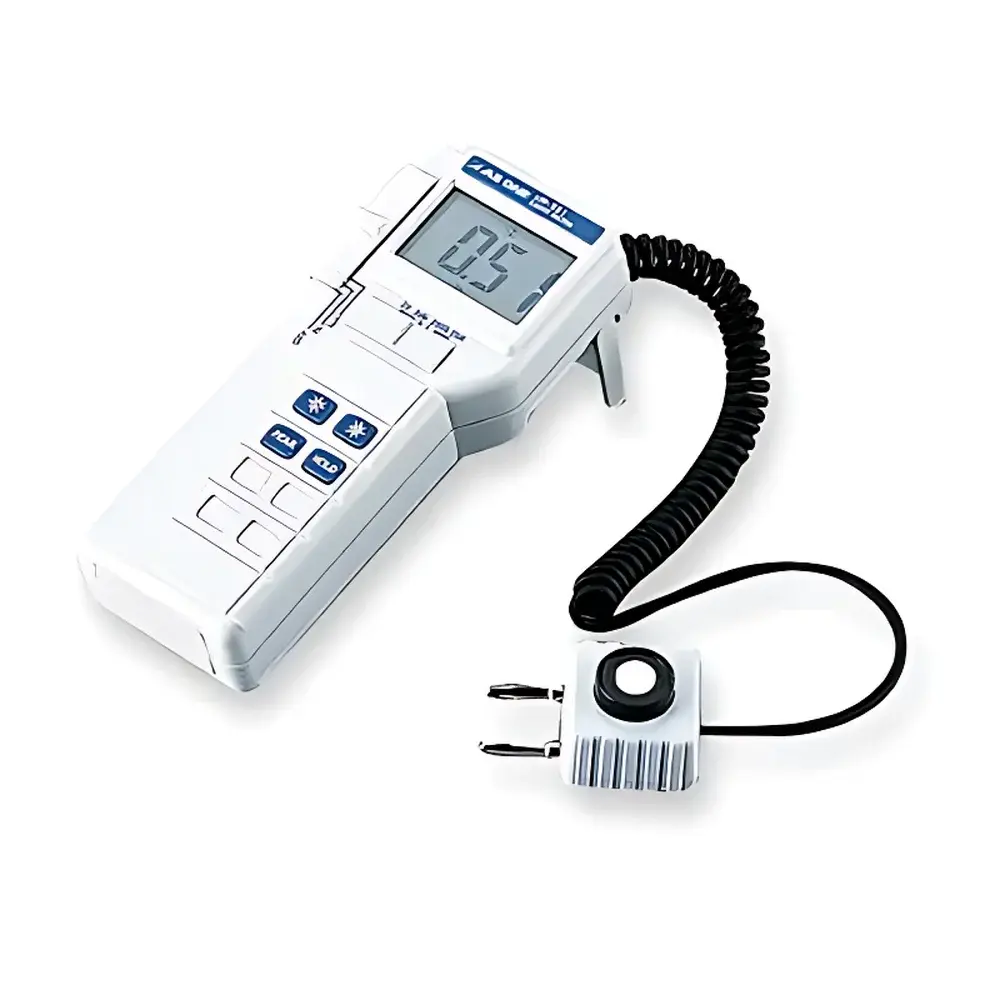
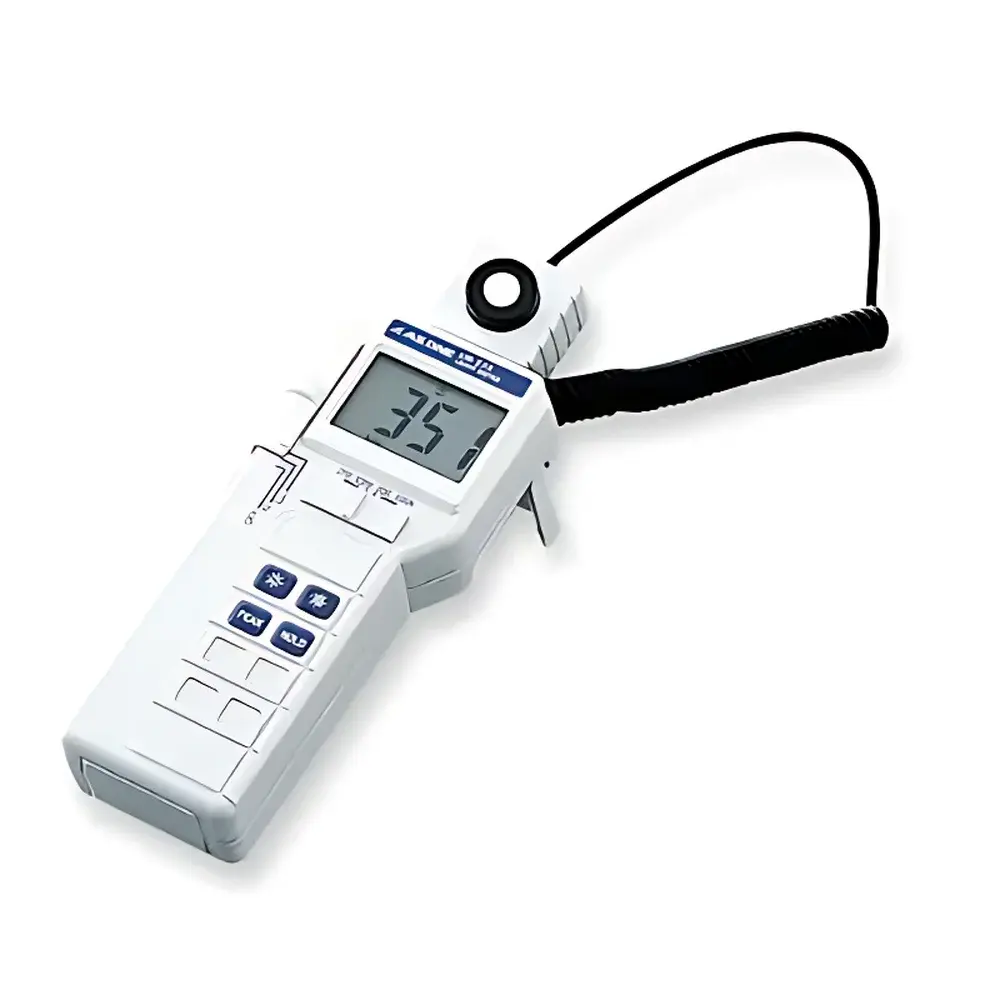
AS ONE LM-331 Illuminance Meter
| Brand | AS ONE |
|---|---|
| Origin | Taiwan |
| Manufacturer Type | Manufacturer |
| Country of Origin | China (Domestic) |
| Model No. | 1-5818-01 |
| Sensor Type | Silicon Photodiode |
| Display | 3.5-digit LCD with backlight |
| Accuracy | ±(5% rdg + 10 digits) |
| Sampling Rate | 2.5 samples/sec |
| Units | Lux (lx) and Foot-candles (fc), switchable via single button |
| Data Hold Function | Yes |
| Peak Hold Function | Yes |
| Sensor Mounting | Integrated fixing pin for secure sensor-to-body attachment |
| Power Supply | Not specified in source data |
Overview
The AS ONE LM-331 Illuminance Meter is a handheld, precision optical measurement instrument engineered for reliable quantification of visible light intensity incident on a surface—commonly referred to as illuminance. Operating on the fundamental photometric principle of spectral responsivity matched to the CIE standard luminosity function (V(λ)), the LM-331 employs a calibrated silicon photodiode sensor whose output current is linearly proportional to incident illuminance across the 400–700 nm visible spectrum. Designed for routine use in quality control laboratories, facility maintenance teams, lighting design validation, and occupational health & safety assessments, this meter delivers traceable, repeatable measurements compliant with international photometric practice. Its compact form factor, intuitive interface, and dual-unit capability (lux and foot-candles) support both SI and imperial reporting requirements without recalibration.
Key Features
- Integrated data hold function: Freezes the current reading on the LCD display for stable recording or remote observation.
- Peak hold mode: Captures and retains the maximum illuminance value detected during continuous sampling—critical for transient light source evaluation (e.g., strobes, pulsed LEDs, or flash units).
- One-touch unit switching: Enables instantaneous toggling between lux (lx) and foot-candles (fc) without menu navigation, reducing operational latency in multi-standard environments.
- Dedicated sensor mounting pin: Ensures mechanical stability and consistent angular alignment between sensor head and main unit—minimizing cosine error and improving measurement reproducibility under off-axis illumination conditions.
- Backlit 3.5-digit LCD: Provides high-contrast readability in low-light workspaces while maintaining low power consumption.
- Silicon photodiode sensor: Offers robust linearity, low temperature drift, and long-term stability—suitable for extended field deployment and periodic verification against NIST-traceable reference standards.
Sample Compatibility & Compliance
The LM-331 is optimized for measuring broadband white-light sources including incandescent, fluorescent, LED, and OLED fixtures under steady-state or quasi-steady conditions. It is not intended for narrowband UV/IR radiation, laser beams, or high-intensity pulsed sources exceeding 100,000 lx without neutral density filtering. The device complies with JIS C 1609-1:2019 (Illuminance Meters – Part 1: General Requirements) and aligns with the photopic response curve defined in CIE Publication No. 15:2018. While not certified to ISO/IEC 17025, its accuracy specification (±5% rdg + 10 digits) meets typical acceptance criteria for Class L2 illuminance meters per IEC 60825-1 Annex D and ASTM E1335-22 for general-purpose photometric surveys.
Software & Data Management
The LM-331 operates as a standalone, battery-powered instrument with no built-in memory or digital communication interface (e.g., USB, Bluetooth, or RS-232). All measurement data must be manually recorded or transcribed. For regulated environments requiring audit trails—such as GLP-compliant lighting validation in pharmaceutical cleanrooms or ISO 9001-certified manufacturing facilities—users are advised to pair the meter with external logging systems or validated spreadsheet templates that include operator ID, timestamp, location tag, and calibration certificate reference. Though the device itself does not support FDA 21 CFR Part 11 electronic signature functionality, its documented calibration history and controlled usage protocols can be integrated into broader quality management documentation frameworks.
Applications
- Workplace lighting assessment per OSHA 1910.303 and EN 12464-1 for office, industrial, and healthcare settings.
- Verification of lighting uniformity and compliance in museum galleries, archival storage, and color-matching booths.
- Commissioning and maintenance of architectural LED installations, including façade and interior ambient lighting.
- Photobiological safety pre-screening (IEC 62471) for general lighting equipment prior to formal radiometric testing.
- Educational laboratory experiments in photometry, human factors engineering, and environmental health sciences.
FAQ
What is the spectral response range of the LM-331 sensor?
The silicon photodiode is filtered to approximate the CIE V(λ) photopic luminosity function, with effective responsivity spanning 400–700 nm.
Does the LM-331 require periodic recalibration?
Yes—recommended annually or after physical shock, exposure to extreme temperatures (>50°C), or prolonged operation beyond manufacturer-specified duty cycles.
Can the LM-331 measure pulsed light sources accurately?
It captures peak values in Peak Hold mode but lacks high-speed sampling (≥1 kHz); therefore, it is unsuitable for characterizing microsecond-duration pulses or high-frequency PWM dimming.
Is the sensor cosine-corrected?
The sensor housing includes a diffuser optimized for Lambertian response; however, users should verify angular acceptance via independent cosine error testing at ±60° incidence angles per CIE TN 007:2021.
What battery type powers the LM-331?
The original equipment uses a standard 9 V alkaline battery (not included); runtime exceeds 200 hours under typical intermittent-use conditions.




