
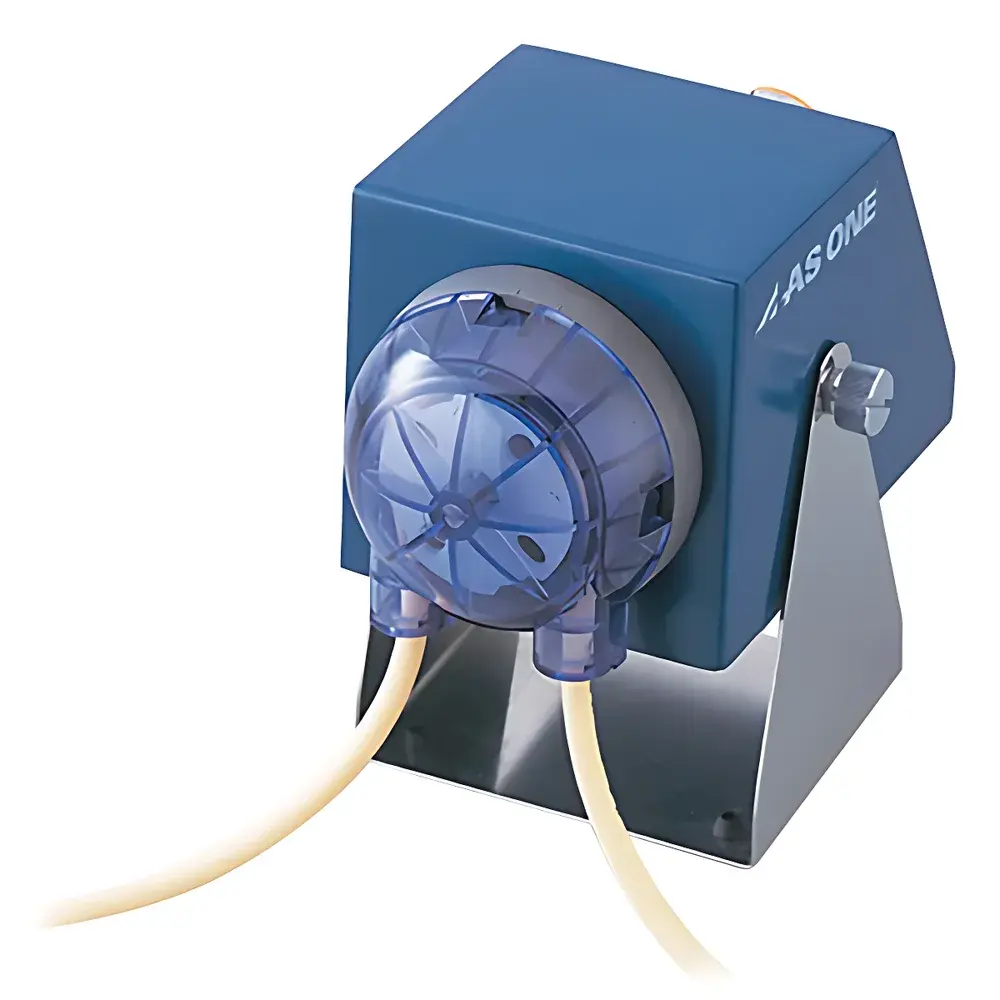
AS ONE MP-1983E Torque-Indicating Peristaltic Pump
| Brand | AS ONE (AS ONE Corporation) |
|---|---|
| Origin | Japan |
| Manufacturer | AS ONE Corporation |
| Product Type | Imported |
| Model No. | 1-9028-11 |
| Drive Method | Electric |
| Flow Rate Range | 30–280 mL/min |
| Compliance | RoHS 2 Directive (EU) 2015/863 |
| Dimensions (W×D×H) | 115 × 170 × 150 mm |
| Enclosure Design | Front-access tube replacement |
| Control System | Microprocessor-based speed regulation |
| Torque Monitoring | Real-time LED load indicator |
Overview
The AS ONE MP-1983E is a precision-engineered, electrically driven peristaltic pump designed for reliable, contamination-free fluid transfer in analytical, quality control, and research laboratory environments. Operating on the principle of positive displacement via roller compression of flexible tubing, it delivers consistent volumetric flow without internal wetted parts—eliminating risk of cross-contamination or chemical incompatibility with pump internals. Its self-priming capability removes the need for manual pre-filling or venting, enabling immediate operation upon startup. The integrated microprocessor controller ensures stable rotational speed across the full 30–280 mL/min range, supporting repeatable dosing and continuous delivery protocols. Unlike fixed-speed alternatives, the MP-1983E maintains high reproducibility even at low flow rates—critical for applications requiring precise reagent addition, sample dilution, or buffer exchange in HPLC, ICP-MS sample introduction, or cell culture media handling.
Key Features
- Real-time torque monitoring via front-panel LED indicator—provides immediate visual feedback on motor load, aiding early detection of tubing fatigue, occlusion, or excessive backpressure.
- Front-access design allows rapid, tool-free tubing replacement—reducing downtime during routine maintenance or method changeovers.
- Microprocessor-controlled brushless DC motor ensures smooth acceleration, minimal speed drift, and extended service life under variable load conditions.
- RoHS 2-compliant construction (Directive 2015/863/EU) confirms absence of restricted hazardous substances, supporting environmental compliance and safe disposal protocols.
- Compact footprint (115 × 170 × 150 mm) optimizes bench space in crowded analytical workstations or modular lab setups.
- No lubricants or seals in the fluid path—eliminates maintenance-related contamination risks and simplifies validation documentation for GLP/GMP-regulated workflows.
Sample Compatibility & Compliance
The MP-1983E is compatible with standard silicone, Viton®, and Tygon® peristaltic tubing (inner diameters 1.6–4.8 mm), permitting adaptation to diverse chemical compatibility requirements—from aqueous buffers and organic solvents to mildly corrosive acids and bases. As a Class II laboratory device, it meets essential safety and electromagnetic compatibility requirements per IEC 61010-1:2010 for electrical equipment used in measurement, control, and laboratory use. While not certified for intrinsically safe or explosion-proof environments, its non-sparking motor and low-energy drive architecture make it suitable for general-purpose use in ISO 17025-accredited testing labs. Documentation supports traceability to manufacturer’s QC records and conforms to common audit expectations for instrument qualification (IQ/OQ/PQ) under FDA 21 CFR Part 11–aligned data integrity frameworks.
Software & Data Management
The MP-1983E operates as a standalone analog-controlled unit and does not feature digital connectivity (e.g., RS-232, USB, or Ethernet). Flow rate is adjusted manually via calibrated potentiometer, with no onboard memory or data logging. However, its stable output and torque-indication function support integration into externally monitored systems: the LED torque signal can be interfaced with external PLCs or data acquisition modules via simple voltage-level sensing for process trend logging. For laboratories requiring electronic recordkeeping, pairing with a validated flow meter (e.g., Coriolis or thermal mass flow sensor) upstream or downstream enables full traceability of delivered volumes in accordance with ALCOA+ principles (Attributable, Legible, Contemporaneous, Original, Accurate, Complete, Consistent, Enduring, Available).
Applications
- Automated sample preparation for atomic absorption spectroscopy (AAS) and inductively coupled plasma (ICP) analysis.
- Controlled reagent delivery in titration systems and automated wet chemistry analyzers.
- Media perfusion in bioreactor seeding and stem cell expansion workflows.
- Low-shear transfer of shear-sensitive biological suspensions—including bacterial cultures, yeast slurries, and microencapsulated particles.
- Calibration standard delivery in gravimetric or volumetric verification procedures compliant with ISO/IEC 17025 Clause 6.4.10.
- Continuous eluent supply in preparative chromatography and solid-phase extraction (SPE) manifolds.
FAQ
Does the MP-1983E support programmable flow profiles or remote control?
No. It is a manually operated, analog-peristaltic pump with no digital interface, timer, or programmable ramp functionality.
What tubing sizes are recommended for optimal performance at minimum flow (30 mL/min)?
For stable low-flow operation, use 1.6 mm ID silicone tubing with appropriate wall thickness (e.g., 0.8 mm); higher elasticity improves occlusion consistency at reduced RPM.
Is the torque indicator calibrated to quantitative torque units (e.g., mN·m)?
No—the LED display provides relative load indication only (low/medium/high segments), intended for operational diagnostics rather than metrological measurement.
Can this pump be used for sterile filtration or aseptic transfer?
Yes, provided single-use, gamma-irradiated tubing sets are employed and the pump housing is maintained per ISO 14644-1 Class 5 cleanroom protocols; however, sterility assurance requires validation per ISO 13408-1.
How often should tubing be replaced to maintain accuracy and prevent failure?
Under continuous operation at mid-range flow (150 mL/min), replace tubing every 200–300 hours; frequency increases with abrasive or high-viscosity fluids and must be verified via flow calibration per ASTM D3418.



