
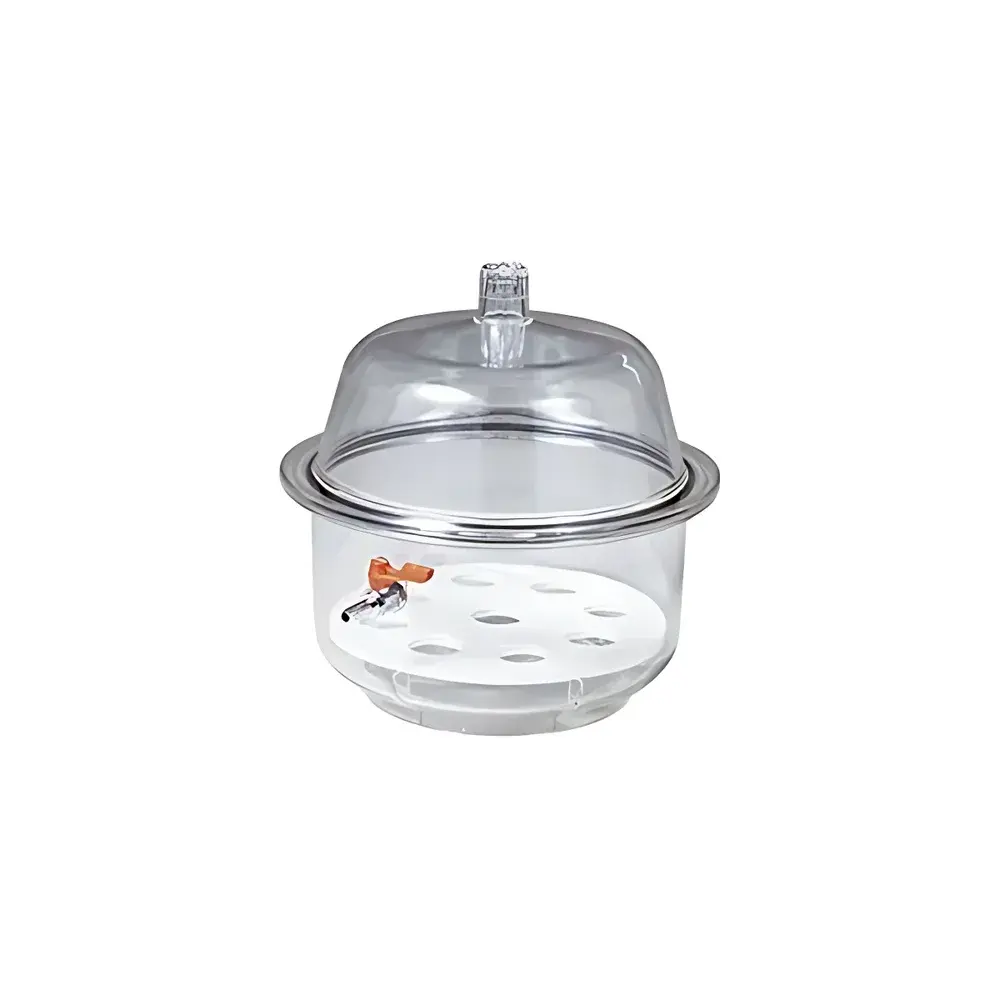
AS ONE 1-066-32 Vacuum Desiccator Cabinet (300-Type)
| Brand | AS ONE |
|---|---|
| Origin | Japan |
| Manufacturer | AS ONE Co., Ltd. |
| Type | Vacuum Desiccator Cabinet |
| Model | 1-066-32 |
| Chamber Internal Diameter | Φ306 mm |
| Chamber Height (excl. vacuum gauge) | 368 mm |
| Internal Volume | ~19 L |
| Maximum Operating Vacuum | ≈133 Pa (1 mmHg) |
| Construction Material | Polycarbonate (PC) body, NBR O-rings |
| Included Accessory | 1 x Alumina Ceramic Plate |
| Vacuum Port | Integrated quick-release valve with Φ9 mm metal stem |
Overview
The AS ONE 1-066-32 Vacuum Desiccator Cabinet (300-Type) is a precision-engineered, benchtop vacuum storage and drying system designed for long-term moisture-sensitive sample preservation, solvent-free drying of hygroscopic materials, and inert-atmosphere conditioning in analytical, pharmaceutical, and materials science laboratories. Unlike conventional forced-air ovens or static desiccators, this unit operates on a true vacuum principle—removing ambient air and water vapor via mechanical evacuation to achieve and maintain a low-humidity environment (<0.1% RH at 133 Pa). Its monolithic polycarbonate (PC) chamber construction provides exceptional impact resistance, optical clarity for visual monitoring, and chemical inertness against common solvents and reagents. The vacuum-tight seal is achieved through high-precision molded flange geometry and dual-lip NBR (nitrile butadiene rubber) O-rings—eliminating the need for lubricants that could outgas or contaminate sensitive samples. This design supports ISO/IEC 17025-compliant storage protocols where trace moisture interference must be excluded from calibration standards, reference materials, or pre-weighed analytical samples.
Key Features
- Monolithic polycarbonate chamber: Lightweight (≈4.2 kg), shatter-resistant, and transparent for real-time observation without breaking vacuum
- Lubricant-free vacuum sealing: Precision-machined mating surfaces and compression-formed NBR O-rings ensure repeatable leak rates <1×10⁻³ Pa·m³/s under continuous operation
- Integrated ceramic plate support: One alumina ceramic plate (≥99.5% Al₂O₃) included—chemically inert, non-porous, and thermally stable up to 1200°C; suitable for direct placement of crucibles, weighing boats, or reaction vessels
- Dual-port vacuum interface: Standard Φ9 mm stainless steel stem with integrated quick-release valve enables connection to rotary vane pumps (e.g., KNF NRP series) or dry scroll pumps (e.g., Agilent IDP-10); optional vacuum gauge mounting port available on G-series variants
- Optimized chamber geometry: Cylindrical Φ306 mm × 368 mm internal dimensions yield ~19 L usable volume—sufficient for multiple 100 mL glass desiccators, stacked Petri dishes, or standard ASTM E1228 test specimens
- G2-series configuration: Dual vacuum ports allow simultaneous evacuation and inert gas backfilling (e.g., N₂ or Ar) for controlled atmosphere processing per USP and JP 17 guidelines
Sample Compatibility & Compliance
The 1-066-32 accommodates a broad range of sample formats including glass vials (up to 50 mL), aluminum weighing pans, silica gel desiccant trays, polymer film substrates, lithium battery electrode coatings, and pre-dried pharmaceutical excipients. Its PC construction complies with JIS K 6720 for polycarbonate physical properties and meets RoHS Directive 2011/65/EU restrictions on hazardous substances. For regulated environments, the unit supports GLP documentation workflows: vacuum hold time, final pressure, and operator ID can be logged externally via connected digital vacuum gauges (e.g., MKS Baratron 627B) compliant with FDA 21 CFR Part 11 audit trail requirements. It is routinely deployed in QC labs performing moisture content validation per ASTM D6980 and ISO 15512 for packaging materials and active pharmaceutical ingredients.
Software & Data Management
As a standalone passive vacuum system, the 1-066-32 does not include embedded firmware or proprietary software. However, it is fully compatible with third-party vacuum monitoring solutions. When paired with a calibrated capacitance manometer and data acquisition module (e.g., LabVIEW-compatible USB DAQ or Modbus-enabled PLC), users can record time-stamped pressure decay curves, generate hold-time certificates, and export CSV-formatted logs for inclusion in electronic lab notebooks (ELN) such as LabArchives or Benchling. All mechanical interfaces conform to ISO-KF16 and NW16 vacuum standards, ensuring seamless integration into automated drying workflows governed by SOPs aligned with ISO 9001:2015 clause 7.1.5.
Applications
- Precision weighing preparation: Stabilizing hygroscopic reference standards (e.g., potassium hydrogen phthalate, sodium chloride) prior to gravimetric analysis
- Electronics component storage: Protecting moisture-sensitive SMD components (MSL 2a–5a per JEDEC J-STD-020) during humidity-controlled assembly staging
- Materials research: Conditioning MOFs, perovskites, and solid electrolytes under defined low-pH₂O partial pressures for structural stability studies
- Pharmaceutical stability testing: Supporting ICH Q1A(R2) long-term storage conditions where residual moisture must remain below specification limits (e.g., ≤0.5% w/w for amorphous APIs)
- Microscopy sample prep: Drying TEM grids and SEM stubs without thermal stress or carbon contamination associated with heated ovens
FAQ
What vacuum pump is recommended for optimal performance with the 1-066-32?
A two-stage rotary vane pump with ultimate vacuum ≤5 Pa (e.g., Welch 1402 or Edwards RV8) is recommended. For oil-free operation in GMP environments, a dry scroll pump rated to ≤1 Pa (e.g., Agilent IDP-10) achieves full 133 Pa capability within ≤4 minutes.
Can the ceramic plate be replaced with custom-sized inserts?
Yes—the Φ306 mm internal diameter allows user-fabricated alumina, quartz, or borosilicate glass inserts up to 6 mm thickness; maximum load capacity is 5 kg distributed evenly.
Is the polycarbonate chamber resistant to acetone or chloroform exposure?
Polycarbonate exhibits limited resistance to chlorinated solvents; prolonged contact with acetone or chloroform may cause stress cracking. For aggressive solvent applications, AS ONE recommends the optional stainless steel liner kit (Part No. C1-671-06DA-20D).
Does the unit meet UL or CE safety certification?
The 1-066-32 is a non-powered passive device and therefore exempt from UL/CE electrical safety directives. It carries JIS-compliant material certifications and is supplied with Japanese Industrial Standard test reports upon request.
How frequently should the NBR O-rings be replaced under daily use?
Under typical laboratory use (1–3 evacuations/day), NBR O-rings maintain integrity for ≥24 months. Visual inspection for compression set (>15% thickness loss) or surface crazing is advised quarterly per ISO/IEC 17025 Clause 6.4.6 maintenance protocols.



