
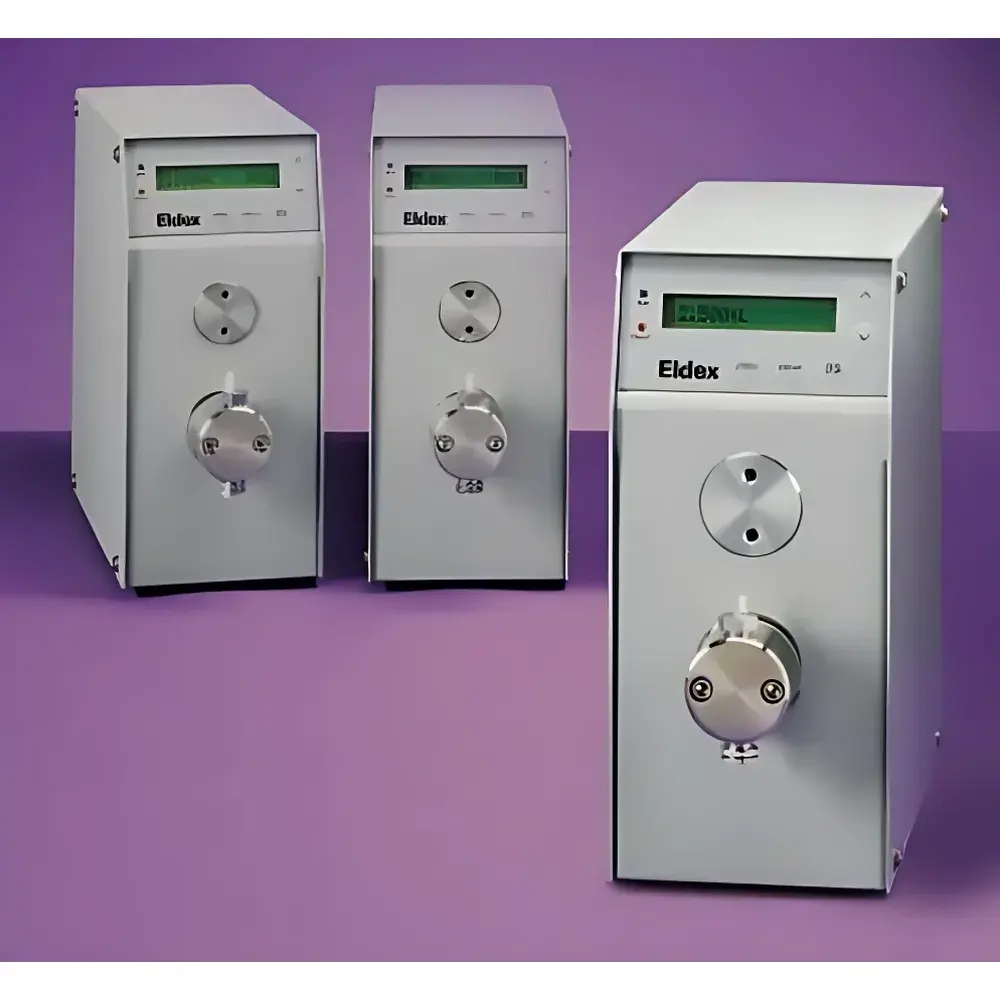
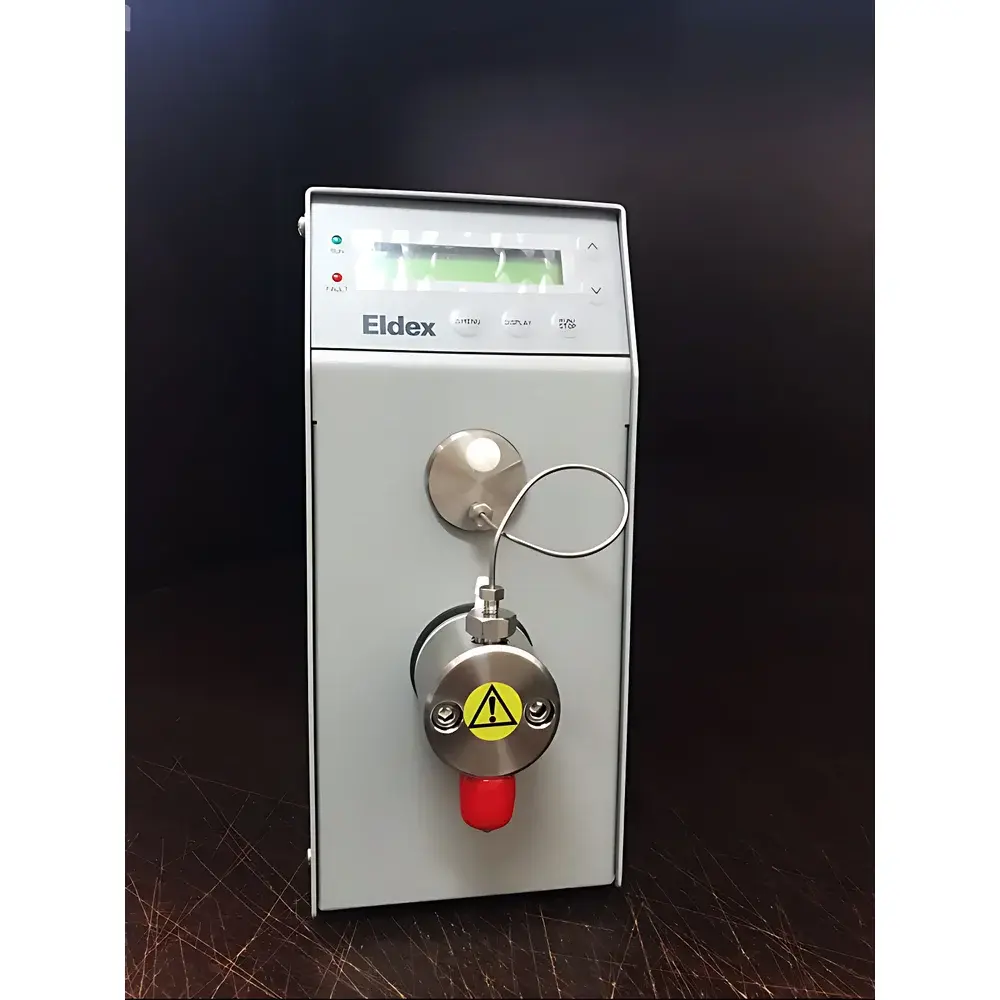
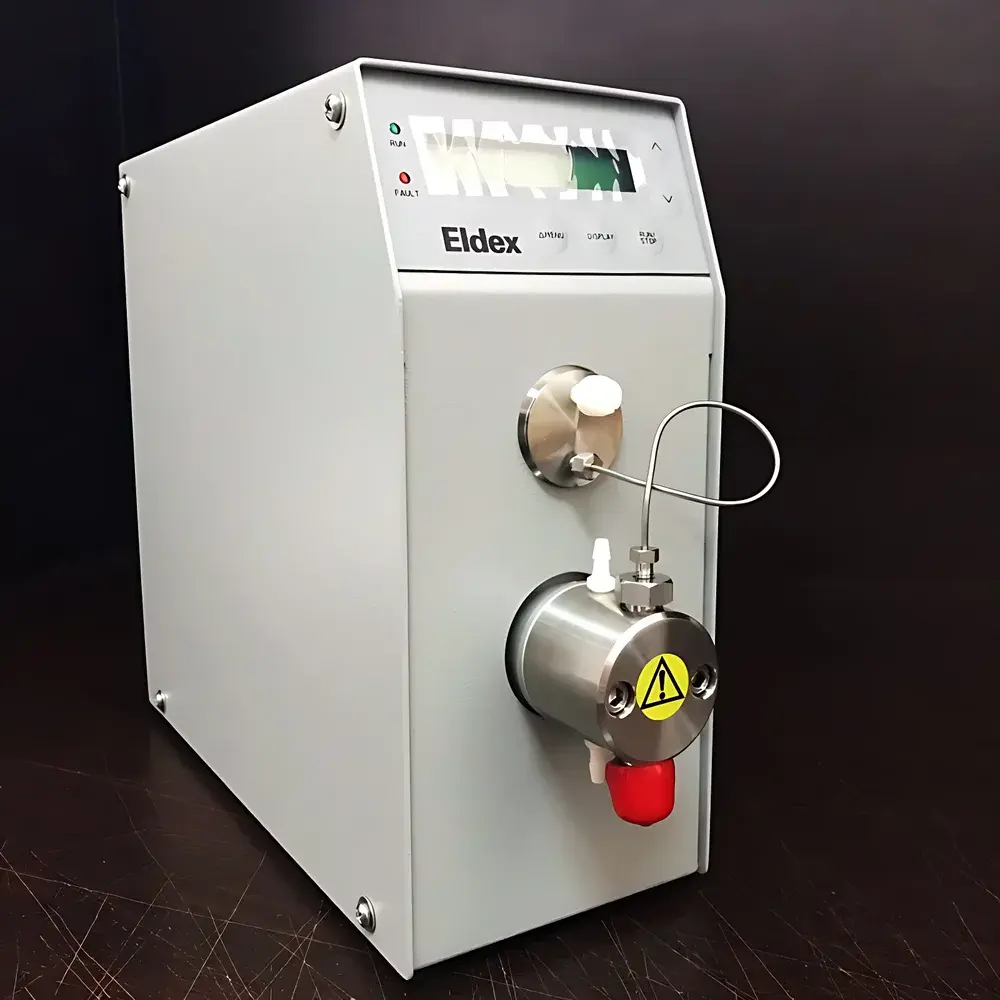
Eldex Optos Series Precision Piston Pump Model 1LM1HM
| Brand | Eldex |
|---|---|
| Model | Optos 1LM1HM |
| Flow Rate | 0.002–2.5 mL/min |
| Maximum Pressure | 6000 psi (414 bar) |
| Fluid Viscosity Range | up to 500 cP |
| Temperature Range | up to 120 °C |
| Flow Repeatability | ±0.3% |
| Inlet/Outlet | 1/8" Swagelok fittings |
| Power Supply | 100–230 VAC, 50/60 Hz, 80 W |
| Dimensions (W×H×D) | 10 × 23 × 24 cm |
| Weight | 5.3 kg (standard), 6.4 kg (pulse-damped version) |
| Construction | 316 stainless steel housing, PEEK or polyethylene piston, sapphire-tipped plunger sensor |
| Control Interface | Analog (0–5 V, 4–20 mA), RS232 serial command protocol |
| Integrated Piston Flush System | compatible with 20% deionized water in methanol |
Overview
The Eldex Optos Series Precision Piston Pump Model 1LM1HM is a high-accuracy, programmable constant-flow infusion pump engineered for demanding analytical and preparative applications in chromatography, microfluidics, chemical synthesis, and pharmaceutical process development. Based on positive displacement via a precision-machined reciprocating piston mechanism, the 1LM1HM delivers stable, pulse-minimized flow across its full operational range (0.002–2.5 mL/min) under pressures up to 6000 psi (414 bar). Its design adheres to fundamental principles of volumetric displacement metrology—leveraging high-resolution stepper motor actuation, sapphire-tipped plunger position sensing, and real-time pressure feedback—to ensure traceable, repeatable fluid delivery. Unlike peristaltic or diaphragm-based alternatives, the Optos architecture eliminates elastomer degradation pathways and provides inherent compatibility with aggressive solvents, high-viscosity fluids (up to 500 cP), and elevated temperatures (up to 120 °C), making it suitable for HPLC, SFC, and continuous-flow reaction systems requiring long-term stability and low carryover.
Key Features
- 316 stainless steel main housing with corrosion-resistant wetted path components (PEEK or polyethylene piston, sapphire plunger tip)
- High-resolution stepper motor drive system minimizing flow pulsation and enabling sub-microliter dispensing accuracy
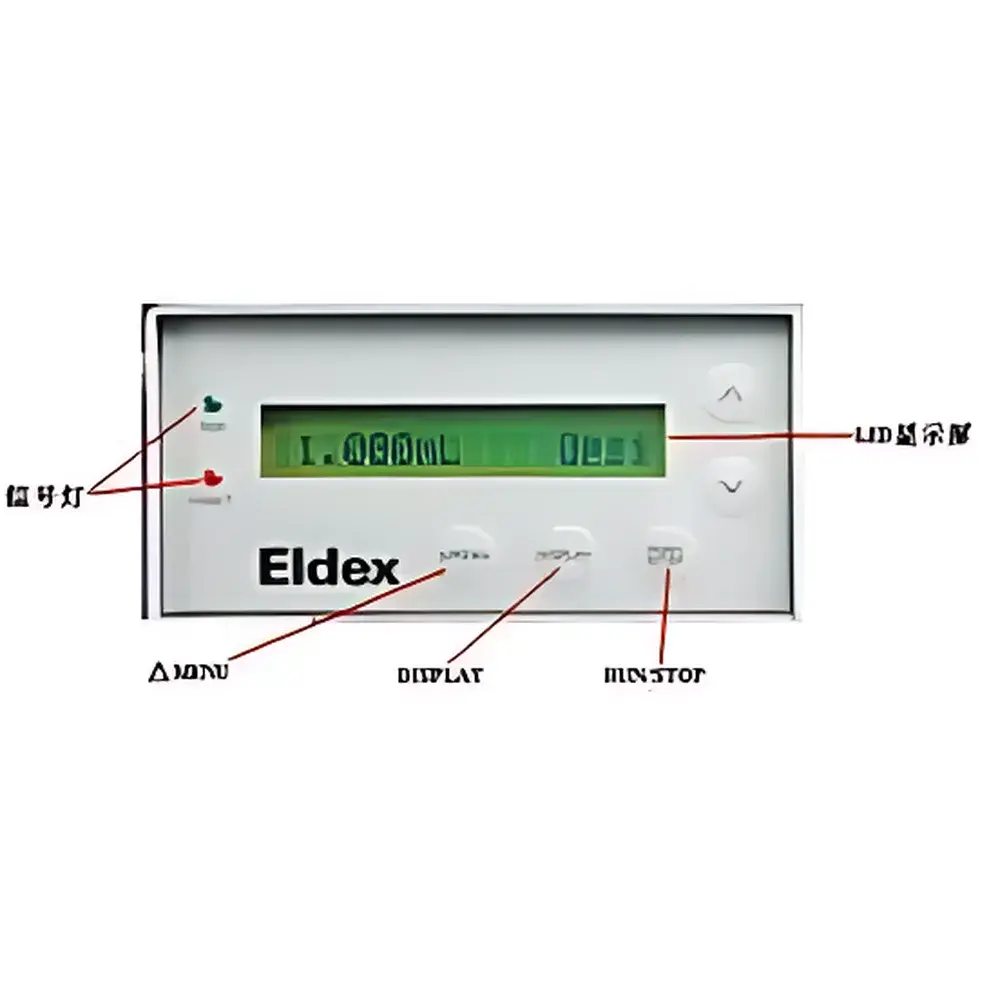
- Integrated real-time flow and pressure monitoring via backlit LCD display; intuitive front-panel control (SET, RUN/STOP)
- Full analog (0–5 V DC, 4–20 mA) and digital (RS232) remote command capability for seamless integration into automated lab platforms
- Dedicated piston flush subsystem—programmable, solvent-compatible (e.g., 20% deionized water in methanol)—to dissolve crystalline deposits and prevent seal wear
- Thermally stable fluid path rated for continuous operation at 120 °C, supporting high-boiling-point solvents and heated reaction streams
- Compact footprint (10 × 23 × 24 cm) and lightweight construction (5.3 kg standard, 6.4 kg pulse-damped variant) optimized for benchtop and rack-mount deployment
Sample Compatibility & Compliance
The 1LM1HM accommodates a broad spectrum of chemically aggressive and viscous media—including acetonitrile, THF, DMSO, glycerol/water mixtures, and polymer solutions—without compromising seal integrity or dimensional stability. Its wetted materials comply with USP Class VI biocompatibility standards and exhibit low extractables per ASTM D4292. The pump meets CE marking requirements for electromagnetic compatibility (EN 61326-1) and safety (EN 61010-1). While not inherently 21 CFR Part 11 compliant, its RS232 interface supports audit-trail-capable host software for GLP/GMP environments when integrated with validated data acquisition systems. All models are supplied with Swagelok 1/8″ inlet/outlet ports (1HM configuration), ensuring leak-tight connections in high-pressure fluidic assemblies.
Software & Data Management
The Optos 1LM1HM operates as a stand-alone instrument or as a networked node within larger automation frameworks. Its RS232 command set follows ASCII-based SCPI-like syntax (e.g., “FLOW 1.25”, “PRESSURE?”, “FLUSH ON”) and supports bidirectional status reporting. When interfaced with third-party LabVIEW, Python (PySerial), or MATLAB environments, users can implement closed-loop flow regulation using external pressure or UV signal feedback. Internal memory retains user-defined flow/pressure profiles and flush schedules. For regulated laboratories, raw command logs and timestamped operational events (start/stop, error codes, flush cycles) may be captured externally to satisfy ALCOA+ data integrity criteria when paired with appropriate electronic record systems.
Applications
- HPLC and UHPLC gradient elution where precise, low-pulsation solvent delivery is critical to baseline stability and peak resolution
- Supercritical fluid chromatography (SFC) using CO₂–co-solvent mixtures requiring accurate co-solvent metering at elevated pressures
- Microreactor feeding in continuous-flow synthesis, especially with heterogeneous catalyst slurries or viscous intermediates
- Calibration fluid delivery for flowmeter validation per ISO 4064-2 and ASTM D1941
- Long-duration permeability testing in geoscience and membrane research, leveraging thermal stability and chemical resistance
- Automated sample introduction in ICP-MS and LC-MS workflows requiring reproducible nanoliter-to-microliter dosing
FAQ
What is the maximum allowable viscosity for continuous operation?
The 1LM1HM is rated for fluids up to 500 cP at operating temperatures ≤120 °C. Viscosity limits assume laminar flow conditions and proper pre-filtration (≤0.45 µm) to prevent particulate-induced plunger binding.
Can the pump handle corrosive solvents such as concentrated acids or halogenated compounds?
Wetted materials include 316 SS, PEEK, and polyethylene—providing robust resistance to most organic solvents and mild aqueous acids/bases. Hydrofluoric acid, hot concentrated sulfuric acid, and chlorine gas are not recommended. Consult the Eldex Chemical Compatibility Guide prior to use.
Is pulse dampening hardware included with the 1LM1HM model?
The base 1LM1HM configuration does not include mechanical pulse dampeners. A dedicated pulse-damped variant (1LMP) is available separately, adding 1.1 kg mass and reducing flow ripple to <±0.15% RMS.
How frequently should the piston flush cycle be performed?
Flush frequency depends on solvent volatility and salt concentration. For typical reversed-phase HPLC buffers, daily flushing is advised; for high-salt mobile phases (e.g., phosphate buffers), flushing after each run is recommended to prevent crystallization.
Does the pump support flow calibration traceable to NIST standards?
While the 1LM1HM does not ship with factory-issued NIST-traceable calibration certificates, its flow repeatability (±0.3%) enables user-performed gravimetric calibration per ISO 4064-4 using certified balance and temperature-controlled collection vessels.
Related Products



