
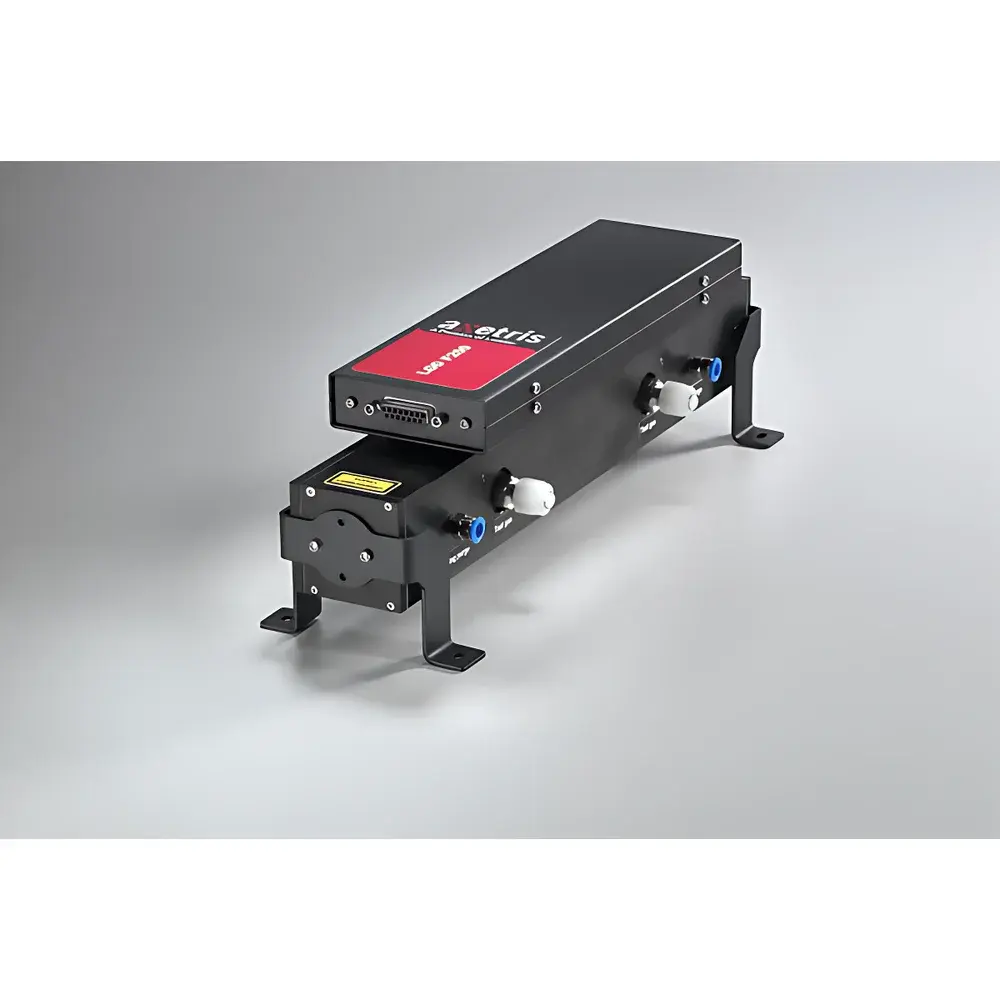
Axetris LGD Series Tunable Diode Laser Gas Detection Module
| Brand | Axetris |
|---|---|
| Origin | Switzerland |
| Model | LGD Series |
| Detection Principle | Tunable Diode Laser Absorption Spectroscopy (TDLAS) |
| Target Gases | NH₃, CH₄, H₂O, CO₂, HCl, HF, O₂, and trace impurities in high-purity gases (He, H₂, N₂, CO₂) |
| Measurement Mode | Non-contact, in-situ or extractive |
| Response Time | <1 s (typ.) |
| Operating Temperature Range | –20 °C to +60 °C (standard) |
| Calibration | Factory-calibrated |
| Compliance | Designed for integration into systems compliant with IEC 61508 (SIL2 capable), CE, RoHS, and EMC Directive 2014/30/EU |
| Enclosure Rating | IP65 (module housing) |
Overview
The Axetris LGD Series is a compact, OEM-optimized tunable diode laser gas detection module engineered for high-selectivity, real-time quantitative analysis of target gases in demanding industrial and environmental applications. Based on the physical principle of Tunable Diode Laser Absorption Spectroscopy (TDLAS), the module interrogates specific ro-vibrational absorption lines in the near-infrared (NIR) spectral region—typically between 760 nm and 2000 nm—with sub-picometer wavelength resolution. This enables species-specific detection without interference from overlapping spectral features of background gases—a critical advantage over electrochemical, catalytic bead, or NDIR sensors. Unlike conventional dual-beam or reference-cell-based optical analyzers, the LGD operates as a single-beam, self-referencing system: laser wavelength modulation and harmonic detection (e.g., 2f-wavelength modulation spectroscopy) provide inherent compensation for optical path fluctuations, dust accumulation, and source intensity drift. The result is a robust, maintenance-light solution suitable for continuous unattended operation in process ducts, stack monitors, cleanroom air handling units, and portable safety instruments.
Key Features
- Modular architecture optimized for seamless integration into third-party analyzers, control cabinets, and embedded monitoring platforms—no proprietary chassis or power supply required.
- True non-contact measurement: optical path lengths configurable from 10 cm to 5 m (via retroreflectors); no sampling lines, filters, or pumps needed for in-situ installation.
- High selectivity (>99.9% specificity for target gas) ensured by narrow-linewidth DFB lasers and precisely matched absorption line targeting—eliminating cross-sensitivity to common interferents (e.g., CO₂ in NH₃ measurement).
- Sub-second response time (t₉₀ < 1 s) enabled by high-frequency laser modulation and digital lock-in signal processing—critical for dynamic process control loops and leak localization.
- Extended temperature operation: standard version rated for –20 °C to +60 °C ambient; high-temperature variant supports probe head heating up to 190 °C for hot/wet gas streams (e.g., boiler flue gas, biogas desulfurization lines).
- Factory calibration traceable to NIST-standard gas mixtures; no field recalibration required under stable operating conditions—reducing lifecycle cost and downtime.
Sample Compatibility & Compliance
The LGD module supports both in-situ and extractive measurement configurations. For in-situ use, it interfaces directly with optical access ports in ducts or pipes (with optional heated purge air nozzles for particulate mitigation). In extractive mode, it couples with standardized 1/4″ Swagelok fittings and heated sample lines (up to 190 °C). It is compatible with corrosive, humid, and particulate-laden gas matrices when paired with appropriate conditioning—validated for long-term operation in landfill biogas (H₂S, CH₄, CO₂), SCR ammonia slip streams, and semiconductor-grade ultra-high-purity (UHP) bulk gases (He, H₂, N₂) where impurity detection limits reach sub-ppm levels. The module’s electromagnetic compatibility (EMC) and safety design align with IEC 61326-1 (industrial EMV), IEC 61000-6-2/6-3, and CE marking requirements. When integrated into larger systems, it supports functional safety architectures compliant with IEC 61508 SIL2 for emission monitoring and safety interlock applications.
Software & Data Management
The LGD communicates via RS-485 (Modbus RTU) or analog 4–20 mA outputs (configurable per gas channel), enabling plug-and-play integration with PLCs, DCS, and SCADA systems. Optional USB-C interface allows local configuration and diagnostics using Axetris’ LGD Configuration Tool—a Windows-based utility supporting firmware updates, spectral alignment verification, and alarm threshold setting. All operational parameters—including laser temperature, drive current, detector signal amplitude, and diagnostic flags—are accessible via Modbus registers. While the module itself does not store historical data, its deterministic output behavior and timestamp-ready analog signals ensure full compatibility with FDA 21 CFR Part 11-compliant data acquisition systems when deployed in regulated environments (e.g., pharmaceutical cleanroom air monitoring or GMP-compliant gas cabinet leak detection). Audit trails, user access logs, and electronic signatures are implemented at the host system level—not within the module—to maintain architectural simplicity and certification flexibility.
Applications
- Process Control: Ammonia slip monitoring in selective catalytic reduction (SCR) systems; combustion optimization via O₂ and CO feedback in industrial burners; methane concentration control in anaerobic digesters.
- Emission Monitoring: Continuous emissions monitoring systems (CEMS) for HCl and HF in waste incineration; CO₂ and CH₄ quantification in power plant stacks per EN 15267 and EPA Method 320.
- Environmental Monitoring: Fugitive emission surveys at landfills and livestock facilities; greenhouse gas flux studies using eddy covariance setups; ambient air quality networks measuring NH₃ and H₂O vapor.
- Safety & Leak Detection: Real-time refrigerant (R-134a, R-1234yf) leak monitoring in HVAC service bays; HCl/HF detection in semiconductor fab tool exhaust lines; toxic gas screening in confined-space entry protocols.
- High-Purity Gas Analysis: Residual moisture (H₂O), oxygen (O₂), and carbon dioxide (CO₂) verification in UHP helium, hydrogen, and nitrogen used in photolithography, CVD, and analytical instrument carrier gas supply.
FAQ
Does the LGD module require periodic recalibration?
No—factory calibration is stable over the module’s operational lifetime under nominal conditions. Zero and span adjustments are not required unless exposed to extreme mechanical shock or prolonged operation beyond specified temperature/humidity limits.
Can multiple gases be measured simultaneously with one LGD unit?
Each LGD module is configured for a single target gas. Multi-gas capability requires parallel modules or sequential wavelength scanning variants (e.g., LGD2 series with multi-line lasers), subject to optical path and timing constraints.
Is the module suitable for explosive atmospheres?
The base LGD module is not intrinsically safe certified. For Zone 1/21 deployment, it must be installed in an approved explosion-proof enclosure or used with a certified safety barrier in conjunction with a host system meeting ATEX/IECEx requirements.
What is the minimum detectable concentration for NH₃ in flue gas?
Detection limits depend on optical path length and gas matrix; typical values range from 0.2 ppm·m to 2 ppm·m (1σ, 1-s integration). With a 2-m path and signal averaging, sub-ppm NH₃ detection is achievable in low-dust SCR ducts.
How is condensation managed during H₂O vapor measurement?
For saturated or dew-point-critical applications, the high-temperature option (190 °C heated probe head) prevents condensation on optical windows. Alternatively, thermoelectrically cooled detectors with active humidity compensation algorithms are available in customized configurations.







