
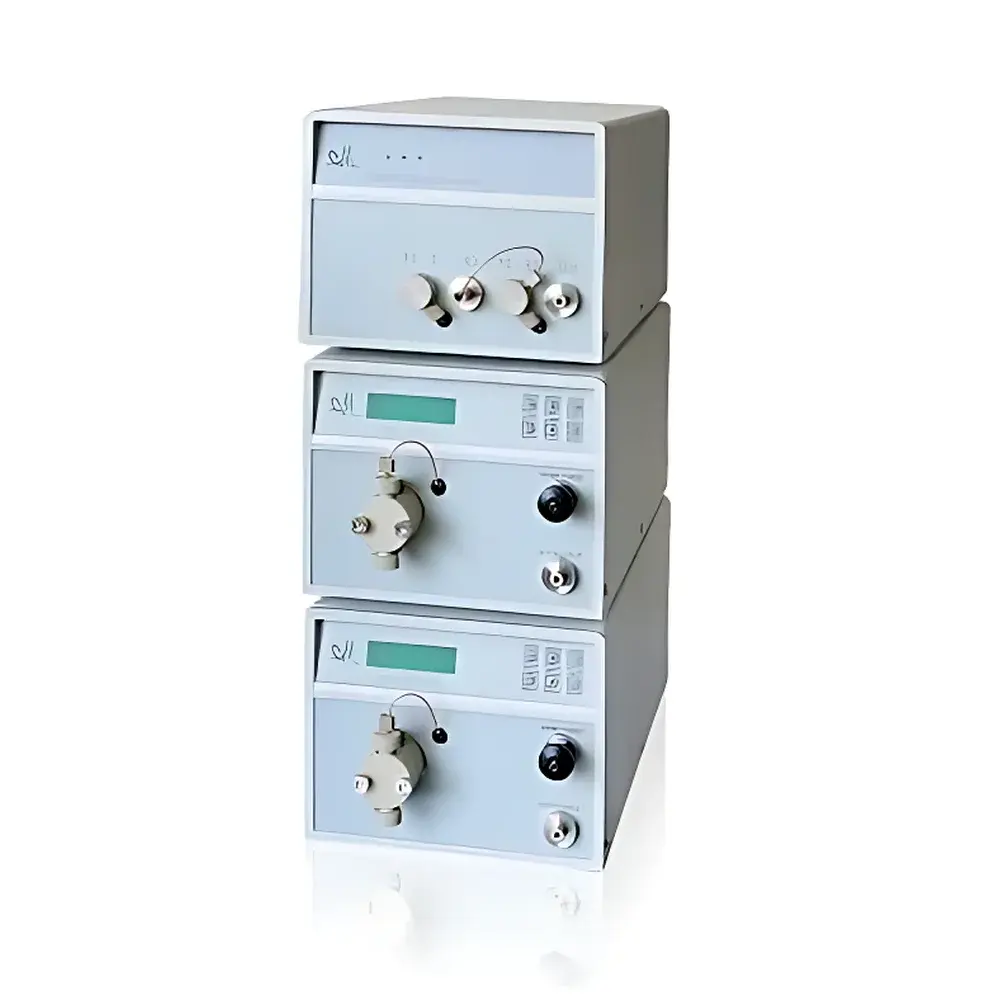
CoMetro 6000PCR Post-Column Derivatization System
| Brand | CoMetro |
|---|---|
| Origin | Imported |
| Manufacturer Type | Authorized Distributor |
| Model | 6000PCR |
| Temperature Range | 150 °C |
| Derivatization Reagent Flow Rate | 0.001–10 mL/min |
| Reaction Coil Material | PEEK |
| Reaction Volume Options | 0.15 / 0.5 / 1.5 mL |
| Temperature Accuracy | ±1 °C |
| Temperature Reproducibility | ±0.4 °C |
| Max Pressure | 4000 psi |
| Flow Accuracy | ±1% |
| Flow Precision | 0.2% RSD |
Overview
The CoMetro 6000PCR Post-Column Derivatization System is a precision-engineered, modular platform designed to enhance detection sensitivity and selectivity for analytes with poor native chromophoric or fluorophoric properties in high-performance liquid chromatography (HPLC) and ultra-high-performance liquid chromatography (UHPLC) workflows. Operating on the principle of post-column chemical derivatization—where analytes eluting from the separation column undergo controlled, time-resolved reaction with reagents prior to detection—the system enables quantitative analysis of low-abundance or non-UV-active compounds via fluorescence, UV-Vis, or electrochemical detection. Engineered for robustness and regulatory compliance, the 6000PCR integrates thermally stabilized reaction coils, PEEK-wetted fluidics, and digitally controlled reagent delivery to ensure high reproducibility across diverse analytical applications including amino acid profiling, pesticide residue quantification, mycotoxin screening, antibiotic assay, and clinical metabolic diagnostics.
Key Features
- Modular reactor architecture supporting single- or dual-core configurations for sequential or parallel derivatization (e.g., heating + ambient-step reactions)
- Front-panel digital interface with real-time display of coil temperature setpoint/actual value, reagent flow rate, line pressure, and pressure limits
- PEEK-only fluidic path—including reactor coils, fittings, and pump manifolds—to ensure chemical inertness, low metal leaching, and compatibility with aggressive reagents (e.g., o-phthalaldehyde, ninhydrin, ortho-dianisidine)
- Rapid reactor exchange mechanism requiring only two connections per coil; available coil volumes: 0.15 mL, 0.5 mL, and 1.5 mL (±5% volumetric accuracy)
- Thermostatic control range: ambient +10 °C to 150 °C (±1 °C accuracy, ±0.4 °C reproducibility); safety cutoff at 160 °C; thermal stabilization to 150 °C achieved within 30 minutes
- Derivatization pumps featuring step-motor-driven precision metering, integrated PEEK exhaust valves, automatic online seal cleaning, and built-in pressure transducers
- RS232 serial interface for remote instrument control, parameter logging, and integration into LIMS or chromatography data systems (CDS)
Sample Compatibility & Compliance
The 6000PCR supports derivatization of primary and secondary amines, aldehydes, thiols, and hydrazide-reactive functional groups—enabling reliable analysis of amino acids (e.g., taurine), carbamate pesticides (e.g., carbaryl), glyphosate and its metabolites, aflatoxins (B1, B2, G1, G2), deoxynivalenol (DON), erythromycin, voglibose, and biogenic amines. Its all-PEEK construction complies with USP , ASTM D8079 (for food testing), and ISO/IEC 17025 method validation requirements. The system’s pressure monitoring, temperature audit trail, and RS232 logging capability support alignment with FDA 21 CFR Part 11 for electronic records and signatures when deployed in GLP/GMP-regulated environments such as pharmaceutical QC labs and contract research organizations (CROs).
Software & Data Management
While the 6000PCR operates autonomously via front-panel controls, its RS232 interface enables bidirectional communication with third-party CDS platforms (e.g., Thermo Chromeleon, Waters Empower, Agilent OpenLab). Users may configure temperature ramps, flow gradients, and pressure thresholds programmatically; all operational parameters—including timestamped temperature deviations, pressure excursions, and flow calibration logs—are accessible via ASCII-based serial output. Optional integration with laboratory informatics systems allows for automated metadata tagging of derivatization conditions alongside chromatographic results, facilitating full traceability during method transfer, audit preparation, or regulatory submissions.
Applications
- Amino acid analysis in infant formula, dietary supplements, and clinical serum/plasma (per AOAC 999.12 and USP )
- Residue monitoring of glyphosate, paraquat, and diquat in environmental water and agricultural commodities (EPA Method 547.1, EN 15662)
- Mycotoxin quantification in cereals and feedstuffs using fluorescence detection after iodine oxidation (AOAC 2005.02)
- Antibiotic potency testing in veterinary formulations (aminoglycosides, polyethers) per EP 2.2.27
- Newborn screening for phenylketonuria (PKU) and maple syrup urine disease (MSUD) via tandem mass spectrometry–coupled derivatization
- Quantitation of bromate in drinking water (EPA Method 300.1) and Cr(VI) in industrial effluents using diphenylcarbazide derivatization
FAQ
What types of detectors are compatible with the 6000PCR system?
The system interfaces seamlessly with fluorescence detectors (FLD), UV-Vis absorbance detectors (including diode array), and electrochemical detectors (ECD); it is not designed for direct coupling to mass spectrometers due to solvent compatibility and backpressure constraints.
Can the 6000PCR perform two-step derivatization in a single run?
Yes—its dual-core module option permits independent temperature and flow control for sequential reactions, such as initial condensation followed by oxidative enhancement.
Is validation documentation provided for IQ/OQ/PQ protocols?
CoMetro supplies factory calibration certificates for temperature and flow modules; users are responsible for site-specific operational qualification per ISO/IEC 17025 or internal SOPs.
What maintenance intervals are recommended for the derivatization pumps?
Seal replacement is advised every 6–12 months depending on reagent aggressiveness and daily usage; the auto-cleaning function extends seal life significantly under standard OPA/ninhydrin conditions.
Does the system support gradient reagent delivery?
No—the 6000PCR delivers reagents at constant flow rates; gradient derivatization requires external binary pump integration via auxiliary valve switching.




