
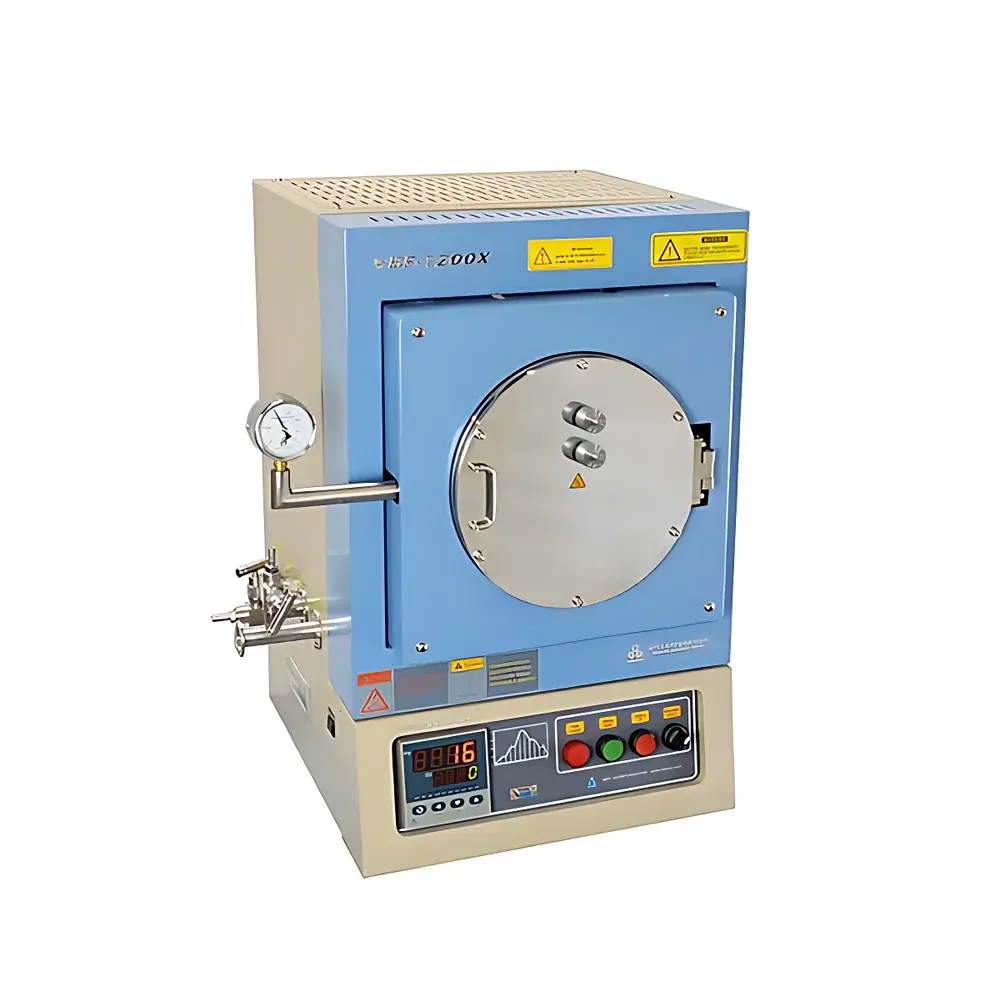
Kejing VBF-1200X-H8 High-Temperature Vacuum Tube Furnace
| Brand | Kejing |
|---|---|
| Origin | Anhui, China |
| Model | VBF-1200X-H8 |
| Maximum Temperature | 1200 °C |
| Continuous Operating Temperature | ≤1000 °C |
| Temperature Uniformity Zone | Φ100 × 89 mm (±5 °C at center) |
| Effective Heating Zone | Φ190 × 216 mm (7.6 L) |
| Chamber Dimensions | Φ200 × 340 mm (quartz tube) |
| Control Accuracy | ±2 °C |
| Power Rating | 3 kW (AC 208–240 V, 50 Hz) |
| Heating Element | Ni-Cr-Al resistance wire with ZrO₂ coating |
| Insulation | Imported 1750 °C alumina ceramic coating on inner chamber surface |
| Cooling | Integrated water-cooled stainless-steel flange with dual silicone O-rings |
| Vacuum Performance | 10⁻²–10⁻⁵ Torr (dependent on pump configuration) |
| Inlet/Outlet | KF-25 vacuum port, 1/4″ VCR gas inlet with precision needle valve |
| Compliance | CE certified |
Overview
The Kejing VBF-1200X-H8 is a horizontally oriented, high-temperature vacuum tube furnace engineered for precise thermal processing under controlled atmosphere or deep vacuum conditions. It employs resistive heating via Ni-Cr-Al alloy elements uniformly wound around a high-purity fused quartz tube (Φ200 × 340 mm), enabling stable operation up to 1200 °C—though continuous use is rated to 1000 °C for optimal quartz integrity and service life. The furnace’s thermal architecture integrates a proprietary 1750 °C alumina-based reflective coating on the inner chamber surface, enhancing radiant heat transfer efficiency and reducing thermal gradient across the effective heating zone (Φ190 × 216 mm). A precisely defined temperature uniformity zone (Φ100 × 89 mm, ±5 °C tolerance at center) ensures reproducible thermal profiles essential for materials synthesis, annealing, sintering, and reduction reactions. Its mechanical design features a water-cooled stainless-steel flange with dual compression silicone seals and integrated KF-25 vacuum interface—enabling compatibility with both rotary vane pumps (achieving ≤10⁻² Torr) and turbomolecular pumping systems (down to ≤10⁻⁵ Torr when paired with appropriate high-vacuum accessories). All electrical components exceeding 24 V meet UL, MET, and CSA safety standards, and the system carries full CE marking per EU Machinery Directive 2006/42/EC and Low Voltage Directive 2014/35/EU.
Key Features
- 30-segment programmable digital temperature controller enabling precise ramp/soak profiles, including user-defined heating rates, cooling rates, and dwell times
- Water-cooled dual-O-ring stainless-steel flange with integrated Φ12 mm PVC coolant ports—designed to maintain seal integrity during extended operation above 300 °C
- Quartz tube chamber with optional high-purity alumina-fiber insulated door plug (pre-baked at 900 °C), minimizing radial heat loss and protecting elastomeric seals
- KF-25 vacuum port (left-side outlet) and 1/4″ VCR gas inlet with calibrated needle valve for inert or reducing atmospheres (e.g., Ar, N₂, H₂—H₂ use requires external ventilation per safety guidelines)
- High-emissivity alumina ceramic coating applied to internal furnace walls improves thermal reflectivity and extends structural longevity
- ZrO₂-coated Ni-Cr-Al heating elements provide enhanced oxidation resistance and extended service life under cyclic thermal stress
- Compliance-ready architecture: supports optional data logging via RS485/USB interface; firmware compatible with third-party SCADA systems for GLP/GMP audit trail implementation
Sample Compatibility & Compliance
The VBF-1200X-H8 accommodates substrates and samples up to 6 inches (152 mm) in diameter placed horizontally within the quartz tube. It is routinely deployed for solid-state reaction studies, thin-film annealing, catalyst activation, and precursor decomposition under vacuum or low-pressure reactive gases. The furnace meets ISO/IEC 17025-relevant environmental control requirements when operated with traceable calibration hardware (e.g., armored Type S thermocouples). For regulated environments, optional validation packages—including IQ/OQ documentation templates and as-found/as-left calibration reports—are available upon request. While not intrinsically rated for Class I Division 1 hazardous locations, its design conforms to ASTM E1112 (Standard Guide for Safety in Laboratories Using High-Temperature Equipment) and supports integration into facilities operating under FDA 21 CFR Part 11-compliant data management frameworks when paired with validated software.
Software & Data Management
The standard 30-segment controller includes USB and RS485 communication interfaces. Optional Kejing Furnace Control Software (KFCS) enables real-time temperature monitoring, remote program editing, automated data export (CSV/TXT), and timestamped event logging—including power failure recovery and thermal deviation alerts. When installed pre-shipment, KFCS is configured for immediate deployment on Windows-based host systems. The software architecture supports CSV-based import/export of thermal profiles and generates audit-ready logs compliant with GLP principles—including operator ID tagging, parameter change history, and electronic signature fields (when integrated with institutional identity management systems). Raw thermocouple voltage outputs are accessible via analog output terminals for connection to independent DAQ systems meeting IEC 61000-4-3 immunity standards.
Applications
- Low-pressure chemical vapor deposition (CVD) precursor pyrolysis for graphene and transition metal dichalcogenide synthesis
- Controlled-atmosphere annealing of perovskite solar cell precursors (e.g., MAPbI₃) under N₂ glovebox-integrated workflows
- Vacuum degassing and outgassing studies of polymer composites and battery electrode materials
- Thermal stability evaluation of MOFs and COFs under inert sweep gas (Ar/N₂) at 400–800 °C
- Reductive sintering of Cu/ZnO catalysts under diluted H₂/N₂ mixtures (≤5% H₂, flow-limited to 200 sccm)
- Calibration reference furnaces for thermocouple verification per ASTM E230/E230M Annex A3
FAQ
What is the maximum recommended continuous operating temperature?
Continuous operation is rated to 1000 °C. Prolonged exposure above this temperature—particularly under vacuum—risks quartz tube deformation and reduced service life.
Can hydrogen be used safely with this furnace?
Hydrogen may be introduced only under strict engineering controls: flow must remain ≤200 sccm, system pressure maintained below 1.2 atm absolute, and furnace housed within a certified fume hood with continuous H₂ monitoring per IEC 60079-10-1.
Is the furnace suitable for GMP-regulated production?
As supplied, it meets foundational equipment qualification criteria. Full GMP compliance requires installation qualification (IQ), operational qualification (OQ), and integration with validated software supporting 21 CFR Part 11 audit trails—available as an add-on service.
What vacuum level can be achieved with a standard mechanical pump?
Using a dual-stage rotary vane pump and KF-25 fittings, base pressure reaches ≤10⁻² Torr within 30 minutes—improving to ≤6 × 10⁻² Torr when the optional alumina-fiber door plug is installed.
Does the furnace include temperature calibration certification?
A factory calibration report (as-found/as-left) is provided with each unit. NIST-traceable calibration using a secondary-standard platinum-rhodium thermocouple is available as a value-added service.
Related Products



