
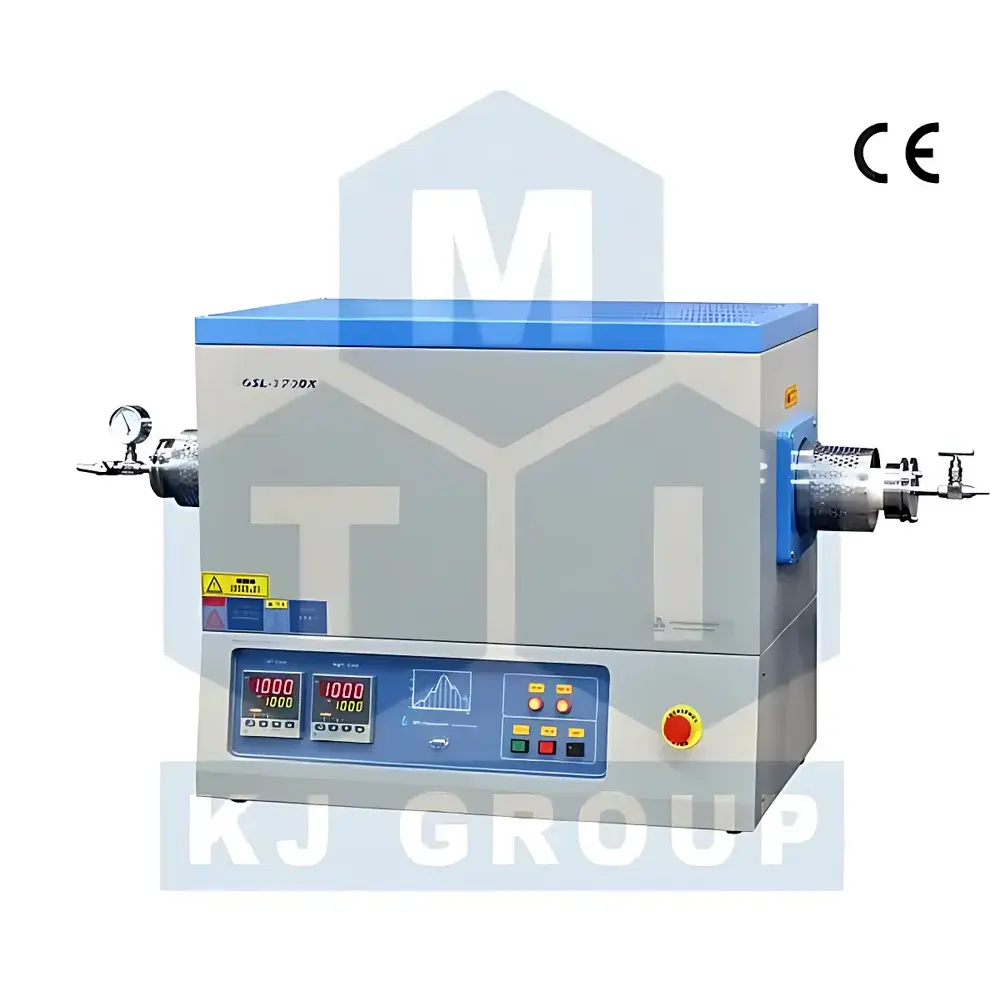
KEJING GSL-1700X-II Dual-Zone High-Temperature Tube Furnace (1700 °C)
| Brand | KEJING |
|---|---|
| Model | GSL-1700X-II |
| Max Temperature | 1700 °C (Zone 2), 1400 °C (Zone 1) |
| Heating Elements | U-shaped SiC rods (1500 °C grade) for Zone 1 |
| Control Precision | ±1 °C |
| Heating Zone Length | 300 mm per zone |
| Uniform Temperature Zone | 100 mm (±1 °C) per zone |
| Ramp Rate | 20 °C/min (Zone 1), 10 °C/min (Zone 2) |
| Power | 9 kW |
| Voltage | AC 380 V, 50 Hz |
| Chamber Material | 99.8% Al₂O₃ ceramic tube (60 mm OD × 54 mm ID × 1000 mm L) |
| Insulation | High-purity polycrystalline alumina fiber |
| External Surface Temp | <60 °C (with dual-shell + air-cooling) |
| Certification | CE |
| Weight | 150 kg |
| Dimensions (L×W×H) | 780 × 450 × 720 mm |
Overview
The KEJING GSL-1700X-II is a dual-zone high-temperature tube furnace engineered for precision thermal processing in advanced materials synthesis, thin-film deposition, and controlled-atmosphere heat treatment. It operates on the principle of resistive heating via high-stability ceramic-based heating elements—silicon carbide (SiC) rods in Zone 1 (800–1400 °C) and molybdenum disilicide (MoSi₂) rods in Zone 2 (800–1700 °C)—enabling independent thermal profiling across two spatially separated zones. This architecture supports the establishment of stable axial temperature gradients within the 1000 mm alumina tube, critical for chemical vapor deposition (CVD), physical vapor deposition (PVD), crystal growth, annealing, and sintering protocols requiring precise thermal zoning. The furnace complies with CE safety directives and integrates structural features—including a dual-layer steel shell with forced-air cooling, high-emissivity 1750 °C-rated alumina coating on the inner chamber surface, and polycrystalline alumina fiber insulation—to ensure thermal efficiency, operator safety, and long-term operational stability under repeated high-temperature cycling.
Key Features
- Dual independent PID-controlled zones, each supporting up to 30-segment programmable ramp-soak profiles with real-time deviation monitoring and automatic over-temperature/thermocouple-failure shutdown
- B-type thermocouples (2 pcs) mounted at center positions of each heating zone for direct, traceable temperature feedback
- High-purity 99.8% alumina tube (60 mm OD × 54 mm ID × 1000 mm L) with vacuum-tight stainless-steel KF-60 flanges, needle valve, and analog pressure gauge as standard configuration
- Optimized thermal uniformity: ±1 °C over 100 mm active zone length per heating section, verified under steady-state conditions
- Robust mechanical design featuring reinforced U-shaped heating elements (8 per zone), low-thermal-mass insulation, and surface temperature maintained below 60 °C during continuous operation at maximum rating
- Modular gas interface options: KF-25 adapters for high-conductance vacuum pumping; VCR double-ferrule fittings for inert/reducing gas lines (e.g., Ar, H₂, N₂); optional hinged flange and corrosion-resistant capacitance manometer available
Sample Compatibility & Compliance
The GSL-1700X-II accommodates standard and custom substrates—including silicon wafers, quartz slides, metal foils, and ceramic pellets—within its 54 mm internal diameter tube. Its ability to sustain controlled atmospheres (vacuum down to 10⁻³ mbar with optional pump; inert or reducing gases at regulated flow rates) makes it suitable for processes governed by ASTM C1171 (carbon-carbon composite heat treatment), ISO 8501-1 (surface cleanliness prior to coating), and USP environmental conditioning requirements. While not inherently GLP/GMP-certified, the furnace’s programmable controller logs setpoint history and includes hardware-level fault detection—features that support audit-ready documentation when integrated into validated laboratory workflows compliant with FDA 21 CFR Part 11 (with external data acquisition systems).
Software & Data Management
The integrated PID temperature controller provides local touchscreen operation and supports RS485 Modbus RTU communication for integration with SCADA or LabVIEW-based supervisory systems. Though no proprietary PC software is bundled, the controller outputs time-stamped temperature data via serial interface, enabling third-party logging tools to capture full thermal profiles—including ramp rate, dwell time, and deviation traces—for IQ/OQ documentation. All firmware updates and calibration procedures adhere to KEJING’s documented service protocols, and the unit ships with a factory calibration certificate referencing NIST-traceable B-type thermocouple standards.
Applications
- Growth of 1D and 2D nanomaterials (e.g., carbon nanotubes, MoS₂ monolayers) via atmospheric or low-pressure CVD
- Thermal annealing of perovskite solar cell precursors under nitrogen glovebox-coupled environments
- Sintering of solid-state electrolyte ceramics (e.g., LLZO, LATP) with gradient densification control
- Controlled oxidation/reduction of transition metal oxides for catalyst screening studies
- Preparation of doped phosphors and upconversion nanoparticles requiring precise multi-step thermal cycles
- Heat treatment of MEMS packaging substrates where thermal stress minimization depends on gradual axial gradients
FAQ
What is the maximum sustainable vacuum level achievable with the standard configuration?
The base system achieves ≤10⁻² mbar using a rotary vane pump connected via the included rubber hose and KF-60 flange; upgrading to a KF-25 adapter and turbomolecular pump enables ≤10⁻⁵ mbar operation.
Can both zones operate at their respective maximum temperatures simultaneously?
Yes—Zone 1 may be held at 1400 °C while Zone 2 reaches 1700 °C, provided total power draw remains within the 9 kW limit and cooling airflow is unobstructed.
Is the alumina tube resistant to HF or chlorine-containing precursors commonly used in CVD?
No—the 99.8% Al₂O₃ tube is incompatible with hydrofluoric acid vapors or Cl₂-rich chemistries above 800 °C; quartz or recrystallized alumina alternatives are recommended for such applications.
Does the furnace include validation documentation required for ISO/IEC 17025-accredited labs?
It ships with CE certification and a factory temperature uniformity report; full IQ/OQ/PQ documentation must be generated onsite using user-selected calibrated reference thermocouples and procedural checklists.
What maintenance intervals are recommended for heating elements and insulation?
SiC rods typically last >2000 hours at ≤1350 °C; MoSi₂ rods maintain integrity beyond 1500 hours at 1700 °C in clean air. Polycrystalline fiber insulation should be inspected annually for cracking or dusting—replacement advised if >10% volume loss is observed.
Related Products



