
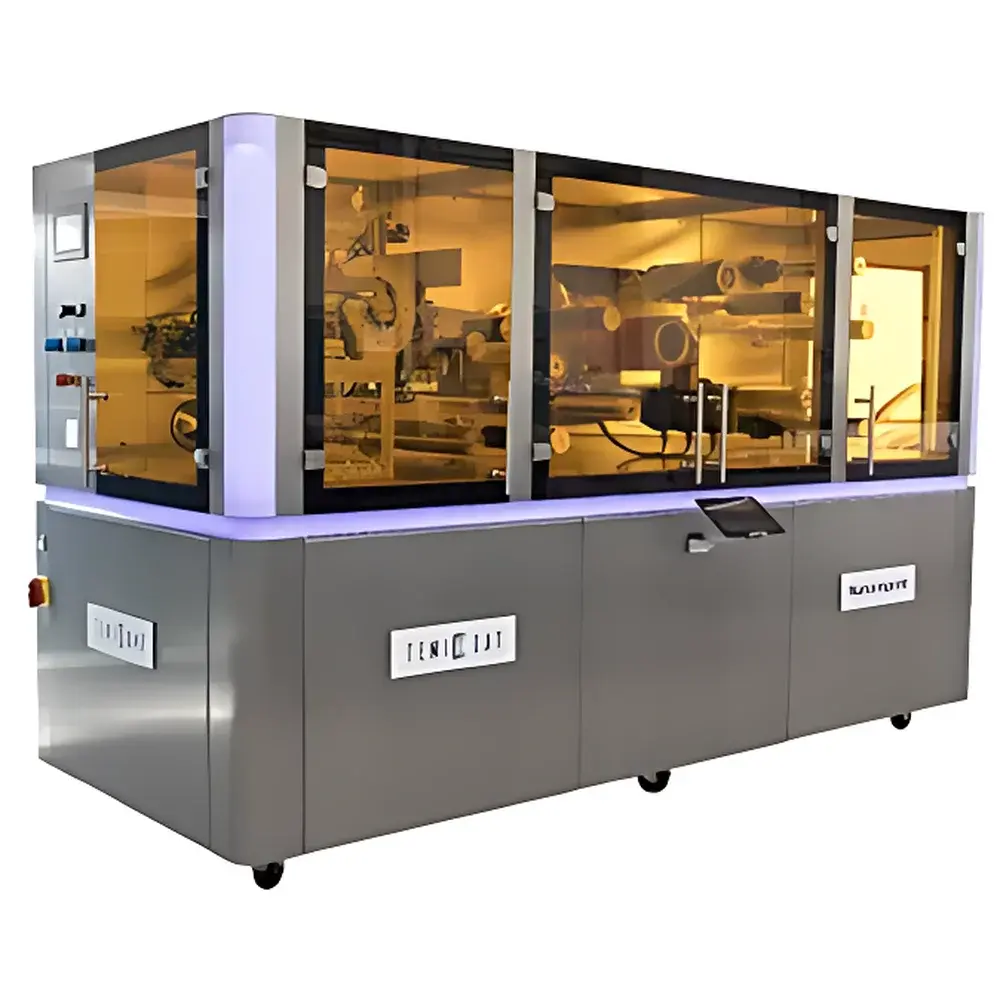
R2R-300mm Industrial Roll-to-Roll Nanoimprint Lithography System by Coatema
| Brand | Coatema |
|---|---|
| Origin | Germany |
| Model | R2R-300mm |
| Maximum Web Width | 300 mm |
| Configuration | Fully Integrated R2R Nanoimprint Platform for Continuous Patterning |
| Compliance | Designed for ISO Class 7 Cleanroom Integration |
| Drive Architecture | Servo-Motor Synchronized Dual-Web Tension Control |
| Thermal Management | Precision Zone-Controlled Heated Roll Stack (RT–180 °C) |
| Alignment Capability | In-Line Optical Registration with Sub-10 µm Overlay Accuracy |
| Tooling Interface | Quick-Change Magnetic Chuck for Master Stamp Mounting |
| Vacuum-Assisted Mold Separation | Programmable Negative Pressure Profile (−0.8 to −0.95 bar) |
Overview
The Coatema R2R-300mm Industrial Roll-to-Roll Nanoimprint Lithography System is a fully engineered platform for high-throughput, continuous nanostructure replication on flexible substrates. Based on thermal nanoimprint lithography (NIL) principles, the system applies controlled heat and mechanical pressure between a rigid master stamp and a thermoplastic polymer-coated web moving at synchronized linear velocity. Unlike batch-based spin-coating or UV-NIL processes, this R2R architecture enables deterministic pattern transfer across kilometer-length substrates—critical for scalable manufacturing of microfluidic devices, optical films, anti-counterfeiting surfaces, and biosensor arrays. The system operates within a modular cleanroom-compatible frame and integrates seamlessly into existing pilot-line or production environments requiring GMP-aligned process documentation and repeatable nanoscale fidelity.
Key Features
- Servo-synchronized dual-web tension control ensures <1% web speed deviation across 0.5–5 m/min operating range, minimizing shear-induced pattern distortion.
- Zone-controlled heated roll stack maintains ±0.5 °C thermal uniformity over 300 mm width, enabling consistent glass-transition-driven imprinting of PMMA, COP, and UV-curable resins.
- In-line optical registration system supports real-time overlay monitoring using fiducial markers; achieves ≤8 µm overlay accuracy between successive imprint zones under steady-state conditions.
- Magnetic quick-change chuck allows tooling exchange in <90 seconds without recalibration, supporting rapid prototyping across stamp geometries (e.g., 100 nm line/space, 500 nm pillar arrays).
- Vacuum-assisted demolding employs programmable negative pressure ramping to suppress residual layer fracture and edge delamination—particularly critical for high-aspect-ratio (>5:1) microfluidic channel replication.
- Modular design permits integration with upstream coating (slot-die, gravure) and downstream inspection (automated dark-field imaging, laser scatterometry) modules via standardized SECS/GEM interfaces.
Sample Compatibility & Compliance
The R2R-300mm system accommodates polymeric webs including PET (12–250 µm), PC, PEN, PI, and functionalized barrier films. Substrate surface energy is managed via integrated corona or atmospheric plasma pre-treatment stations (optional). All wet-process-compatible components meet FDA 21 CFR 175.300 and EU 10/2011 compliance for medical device substrate handling. Mechanical and thermal subsystems conform to CE Machinery Directive 2006/42/EC and EN 60204-1 safety standards. Process logs—including temperature profiles, web tension values, vacuum cycles, and stamp contact time—are timestamped and stored with SHA-256 hashing to support GLP/GMP audit readiness per ISO/IEC 17025 and ISO 13485 frameworks.
Software & Data Management
Coatema’s proprietary R2R-IMPRESS software provides centralized control via a 15″ touchscreen HMI with role-based access (Operator, Technician, Engineer). Real-time data acquisition records >200 parameters at 100 Hz, archived in HDF5 format with embedded metadata (stamp ID, lot number, environmental RH/T). The system supports 21 CFR Part 11-compliant electronic signatures, audit trails with immutable log entries, and automated report generation (PDF/CSV) compliant with ASTM E2500-13 for equipment qualification. OPC UA server enables bidirectional communication with MES platforms (Siemens Opcenter, Rockwell FactoryTalk) for traceability down to individual imprint cycle level.
Applications
- Mass production of disposable microfluidic cartridges for point-of-care diagnostics, featuring laminar flow channels (20–200 µm wide), mixing structures, and integrated capillary burst valves.
- Continuous fabrication of broadband antireflective moth-eye nanostructures on display cover glasses and AR/VR waveguide substrates.
- Replication of plasmonic grating arrays for surface-enhanced Raman spectroscopy (SERS) sensor strips with reproducible enhancement factors (EF > 10⁷).
- High-volume patterning of hydrophilic/hydrophobic contrast surfaces for digital microfluidics and cell-adhesion control in organ-on-chip platforms.
- Manufacturing of diffractive optical elements (DOEs) for structured light illumination in 3D sensing modules used in industrial automation.
FAQ
What substrate widths and thicknesses are supported?
The system handles web widths up to 300 mm and accommodates substrates from 12 µm (ultra-thin PET) to 250 µm (rigid polycarbonate), with automatic thickness compensation during nip engagement.
Is UV-NIL functionality available as an option?
Yes—UV-integrated configurations include mercury-xenon arc lamps (365 nm peak) with intensity feedback control and nitrogen purge manifolds to suppress oxygen inhibition during photopolymerization.
How is master stamp lifetime monitored?
Integrated force-sensing rolls detect progressive adhesion increase; software correlates cumulative imprint cycles with measured demolding force rise, triggering preventive maintenance alerts before feature degradation exceeds ISO 10110-7 specification limits.
Can the system be validated for ISO 13485-certified medical device manufacturing?
Yes—the platform includes IQ/OQ documentation templates, DQ risk assessment files, and full traceability of calibration certificates for all metrology subsystems (load cells, RTDs, encoders), meeting Annex I essential requirements for class IIa/IIb device production.
What level of cleanroom compatibility does the system provide?
Standard configuration meets ISO Class 7 (Class 10,000) particulate requirements; optional HEPA-filtered enclosure upgrades support ISO Class 6 operation with integrated particle counters and differential pressure monitoring.





