
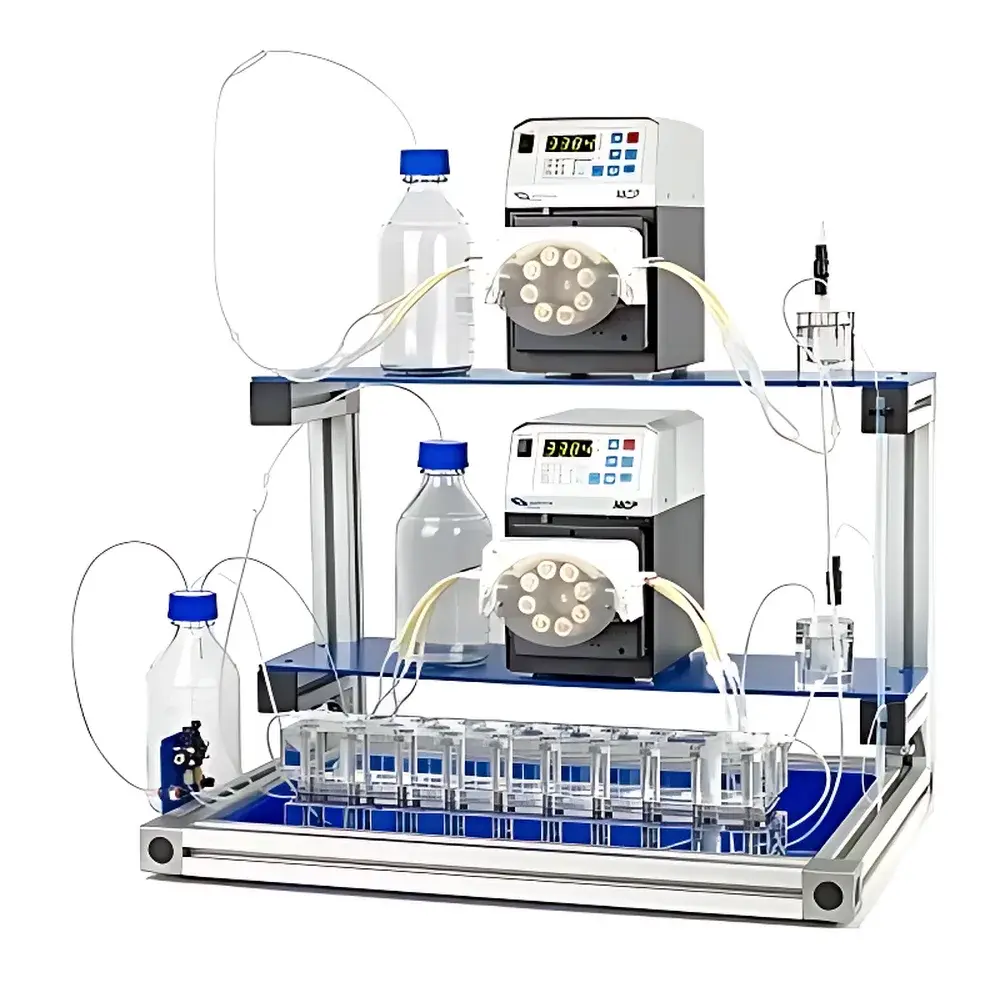
Postnova GF2000 GS Gravitational Sedimentation Field-Flow Fractionation (SdFFF) Instrument
| Brand | POSTNOVA |
|---|---|
| Origin | Germany |
| Model | GF2000 GS |
| Separation Mode | Gravitational Sedimentation FFF |
| Core Technology | SPLITT (Split Flow Thin Cell Fractionation) |
| Channel Configuration | Horizontal, Membrane-Free, Stationary-Phase-Free |
| Applicable Sample States | Aqueous or Low-Viscosity Suspensions |
| Typical Particle Size Range | 10 nm – 100 µm (dependent on density contrast and flow conditions) |
| Max. Sample Concentration | ≤ 5% w/v (varies by particle density and dispersibility) |
| Flow Rate Range | 0.1–5.0 mL/min (per inlet) |
| Compliance | Designed for GLP-compliant laboratories |
Overview
The Postnova GF2000 GS is a high-precision gravitational sedimentation field-flow fractionation (SdFFF) instrument engineered for the size-based separation of colloidal and particulate systems without chromatographic stationary phases or membranes. Unlike size-exclusion chromatography (SEC) or ultrafiltration, SdFFF leverages the natural sedimentation velocity of particles under Earth’s gravitational field within a thin, planar flow channel — a principle rooted in classical hydrodynamic theory and validated by ISO 13321 for particle size distribution analysis. The GF2000 GS implements the Split Flow Thin Cell (SPLITT) configuration: two parallel, horizontally oriented inlets deliver carrier liquid at precisely controlled, differential flow rates across the top and bottom surfaces of the separation channel. This generates a parabolic laminar flow profile, while gravity induces differential settling of particles according to their mass density, size, and shape. Particles with higher sedimentation velocities migrate toward the lower wall and are eluted via the bottom outlet; those with lower velocities remain suspended near the upper wall and exit via the top outlet. This orthogonal, non-interacting separation mechanism preserves sample integrity, eliminates surface adsorption artifacts, and enables true native-state characterization of fragile or interactive species.
Key Features
- Membrane-free and stationary-phase-free separation channel — eliminates irreversible binding, shear-induced aggregation, and membrane fouling
- SPLITT architecture with independent dual-inlet flow control for precise modulation of cross-flow velocity gradients and sedimentation equilibrium
- Horizontal channel orientation optimized for gravitational field alignment and reproducible sedimentation kinetics
- Integrated temperature-stabilized fluidic manifold (±0.2 °C) to maintain consistent viscosity and sedimentation behavior
- Modular detector interface supporting simultaneous multi-angle light scattering (MALS), dynamic light scattering (DLS), UV-Vis absorbance, and ICP-MS coupling
- Rugged stainless-steel and PEEK-wetted path construction compliant with low-metal-leaching requirements for environmental and biopharmaceutical applications
Sample Compatibility & Compliance
The GF2000 GS accommodates a broad spectrum of dispersed systems including environmental colloids (e.g., riverine sediments, clay aggregates, humic nanocolloids), biopharmaceutical entities (intact cells, extracellular vesicles, virus-like particles, protein aggregates), and industrial particulates (carbon black, silica nanoparticles, mineral powders). Its absence of solid-phase interaction ensures minimal perturbation of surface charge, hydration shell, or conformational stability. Method development aligns with ASTM E2490 (Standard Guide for Field-Flow Fractionation Methods) and supports regulatory documentation per FDA 21 CFR Part 11 when paired with validated Postnova FFFware™ software. System suitability testing, calibration traceability to NIST-traceable latex standards, and audit trail generation meet GLP/GMP data integrity requirements.
Software & Data Management
Controlled exclusively via Postnova FFFware™ v5.x, the GF2000 GS provides full method scripting, real-time flow/pressure monitoring, automated fraction collection triggering, and integrated peak deconvolution. All acquisition parameters — including split ratio, total flow, injection volume, and detector dwell times — are stored with electronic signatures and time-stamped metadata. Raw chromatograms export in ASTM E1946-compliant ASCII format; processed results support CSV, PDF, and XML for LIMS integration. Software validation packages (IQ/OQ/PQ documentation, UAT protocols) are available for regulated environments requiring formal system qualification.
Applications
- Environmental science: Quantitative sizing and compositional mapping of polydisperse sediment fractions from estuarine cores or wastewater effluents
- Biopharmaceutical development: Resolving subvisible particles in monoclonal antibody formulations without surfactant interference or column degradation
- Materials science: Characterizing agglomeration state and density heterogeneity in ceramic nanopowders and carbon nanotube dispersions
- Nanotoxicology: Isolating respirable fractions of engineered nanomaterials for subsequent cellular uptake assays
- Geoscience: Fractionating authigenic mineral colloids from groundwater samples for isotopic and trace-element analysis by MC-ICP-MS
FAQ
Does the GF2000 GS require calibration standards for routine operation?
Yes — NIST-traceable polystyrene or silica nanolatex standards (e.g., 20 nm, 100 nm, 500 nm) are recommended for initial system verification and periodic performance checks. Calibration is method-specific and must account for carrier fluid density and viscosity.
Can the instrument handle viscous or high-salt matrices?
Carrier fluids with viscosities up to 5 mPa·s and ionic strengths ≤ 0.5 M NaCl are supported; however, elevated salt concentrations may reduce resolution due to suppressed double-layer thickness and altered sedimentation velocity profiles.
Is on-line fraction collection available?
Yes — optional automated fraction collector (Postnova FC-2000) enables timed or peak-triggered collection across 96-well plates or vials, with programmable delay compensation for detector dead volume.
What maintenance intervals are recommended for the separation channel?
Channel cleaning is performed after each run using 10% nitric acid followed by ultrapure water flush; full disassembly and inspection are advised every 200 operational hours or upon observed pressure drift >15%.
Related Products






