
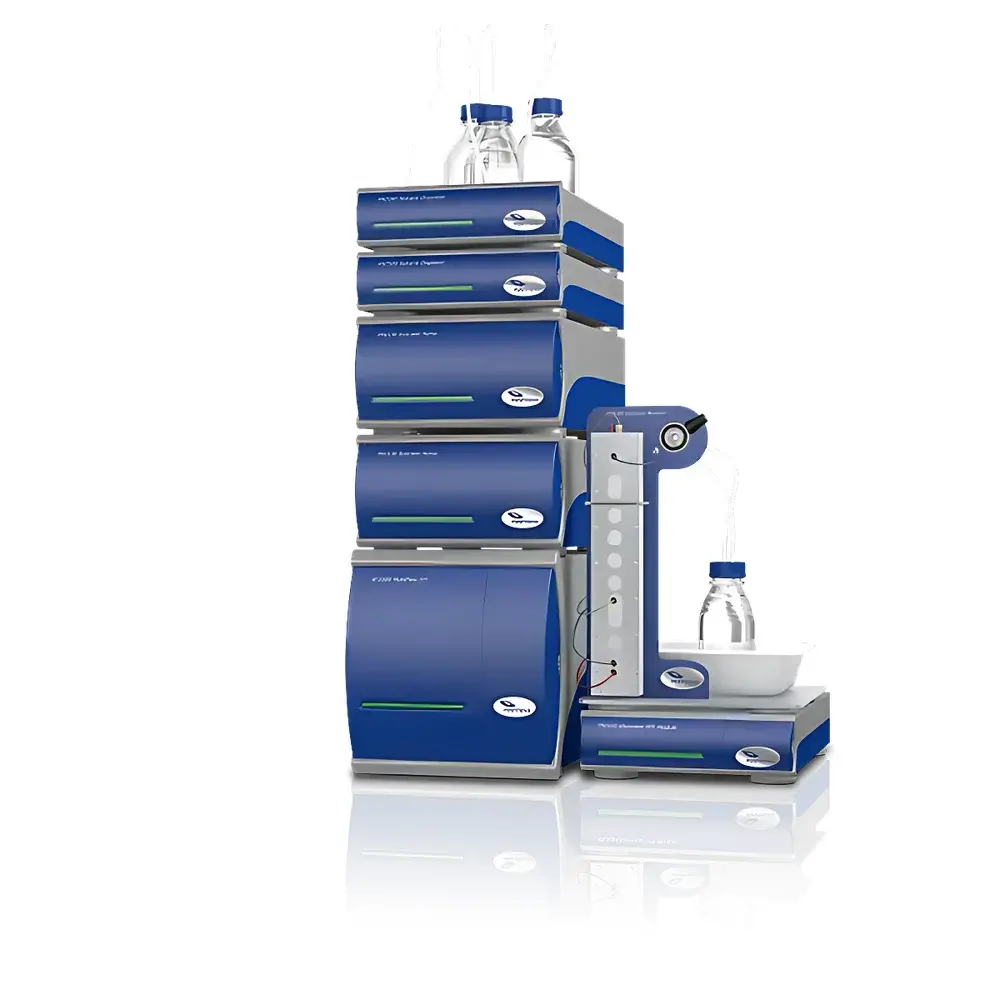
POSTNOVA EAF2000 Two-Dimensional Asymmetric Flow Field-Flow Fractionation (AF4) and Electric Field-Flow Fractionation (EF4) Instrument
| Brand | POSTNOVA |
|---|---|
| Origin | Germany |
| Model | EAF2000 |
| Instrument Type | Asymmetric Flow Field-Flow Fractionation (AF4) with Integrated Electric Field-Flow Fractionation (EF4) |
| Operating Solvent Compatibility | Aqueous only |
| Channel Configuration | Dual-field, orthogonal separation channel module |
| Regulatory Compliance | Designed for GLP/GMP environments |
Overview
The POSTNOVA EAF2000 is a high-precision, two-dimensional field-flow fractionation (2D-FFF) system engineered for orthogonal separation of complex macromolecular and nanoscale analytes in aqueous media. It integrates asymmetric flow field-flow fractionation (AF4) and electric field-flow fractionation (EF4) within a single, thermally stabilized separation channel module—enabling simultaneous application of hydrodynamic lift forces and electrophoretic migration forces along perpendicular axes. Unlike conventional one-dimensional FFF techniques, the EAF2000 exploits differential responses to flow-induced cross-stream diffusion and charge-dependent electromigration, thereby resolving species that co-elute under AF4 or EF4 alone—such as structurally similar protein isoforms, virus subpopulations, or polydisperse polyelectrolyte nanoparticles. The instrument operates on well-established FFF theory: analytes are introduced into a thin, ribbon-like channel bounded by an accumulation wall (porous frit or semi-permeable membrane) and a smooth top wall; separation arises from the balance between parabolic flow velocity profile and analyte-specific retention governed by diffusion coefficient, electrophoretic mobility, and hydrodynamic radius. This dual-field architecture delivers enhanced peak capacity, improved resolution of heterogeneous biocolloids, and quantitative recovery across a broad size range (1 nm – 1 µm).
Key Features
- Dual-field orthogonal separation: Independent, programmable control of asymmetric cross-flow (AF4) and vertical electric field polarity (EF4), allowing real-time switching between AF4-only, EF4-only, or combined 2D mode
- Reversible electrode configuration: Electrode polarity across the channel height is fully invertible—enabling both anodic and cathodic migration regimes without hardware reconfiguration
- Modular channel design: Standardized, disposable or reusable separation channels optimized for aqueous buffers; compatible with low-adsorption membranes (e.g., regenerated cellulose, polyethersulfone)
- Integrated thermal management: Precise Peltier-based temperature control (±0.1 °C) across the entire channel assembly to minimize thermal convection artifacts
- High-fidelity flow control: Dual syringe pumps with pressure monitoring ensure stable cross-flow and sample injection profiles; programmable gradient elution supported
- Full compatibility with standard FFF detectors: UV-Vis, MALS, DLS, ICP-MS, and fluorescence detectors via standardized fluidic interfaces and timing synchronization
Sample Compatibility & Compliance
The EAF2000 is validated for use with aqueous-based samples only—including physiological buffers (e.g., PBS, Tris-HCl), low-ionic-strength electrolytes, and mildly denaturing conditions. It supports analysis of proteins, monoclonal antibodies (mAbs), viral vectors (AAV, lentivirus), exosomes, synthetic polyelectrolytes (e.g., polyacrylamide, poly(sodium 4-styrenesulfonate)), humic substances, and engineered nanomaterials (e.g., silica, gold, polymer nanoparticles). All fluidic pathways employ biocompatible, low-binding materials (PEEK, fused silica, fluoropolymer seals) to minimize surface adsorption and preserve native conformation. The system meets design requirements for GLP-compliant laboratories and integrates seamlessly with audit-trail-capable chromatography data systems (CDS) compliant with FDA 21 CFR Part 11. While not certified to ISO/IEC 17025 out-of-the-box, its operational parameters align with ASTM D8296–22 (Standard Guide for Field-Flow Fractionation of Nanoparticles) and ISO 22412:2017 (Dynamic Light Scattering).
Software & Data Management
Operation and data acquisition are managed via POSTNOVA’s FFF Expert software—a Windows-based platform supporting method development, real-time channel diagnostics, automated calibration routines, and multi-detector correlation. The software implements rigorous peak deconvolution algorithms based on retention time–hydrodynamic radius relationships and incorporates electrophoretic mobility correction factors derived from applied field strength and buffer conductivity. All raw data (flow rates, voltage, detector signals, temperature logs) are stored in vendor-neutral HDF5 format with embedded metadata. Audit trails record user actions, parameter changes, and calibration events with timestamped digital signatures. Export options include CSV, ASCII, and mzML-compatible formats for downstream analysis in third-party tools (e.g., R, Python SciPy, UNICORN). Method templates conform to USP <729> and ICH Q5E guidance for characterization of biopharmaceutical aggregates and particles.
Applications
- Characterization of therapeutic protein aggregates and fragments in formulation development
- Size-and-charge-resolved profiling of adeno-associated virus (AAV) capsid variants and empty/full ratios
- Stability assessment of monoclonal antibody conjugates under stress conditions
- Quantitative analysis of natural organic matter (NOM) fractions—humic vs. fulvic acid subpopulations
- Charge heterogeneity mapping of polyelectrolyte-coated nanoparticles for drug delivery optimization
- Orthogonal release testing of nanocarriers in simulated biological fluids
FAQ
Can the EAF2000 operate with organic solvents such as THF or acetonitrile?
No. The EAF2000 is strictly designed for aqueous-phase operation. Its electrode materials, membrane chemistries, and fluidic seals are incompatible with organic solvents. For non-aqueous FFF, POSTNOVA offers dedicated thermal FFF (ThFFF) and sedimentation FFF (SdFFF) platforms.
Is online sample concentration supported?
Yes. The system supports large-volume injection (up to 1 mL) with on-channel focusing via programmed cross-flow ramping and optimized focusing flow protocols—enabling trace-level detection without pre-concentration steps.
How is calibration performed for dual-field mode?
Calibration uses NIST-traceable nanoparticle standards (e.g., polystyrene, silica) for hydrodynamic size, supplemented by mobility standards (e.g., carboxylated latex) for EF4 response. Software auto-generates dual-parameter calibration curves using retention time and migration shift relative to zero-field AF4 baselines.
Does the EAF2000 support regulatory submissions?
When deployed with validated CDS and documented SOPs, data generated on the EAF2000 meet evidentiary requirements for regulatory filings (e.g., FDA BLA, EMA marketing authorization), particularly for particle size distribution (PSD), charge heterogeneity, and aggregate quantification per ICH Q5A(R2) and Q5E.




