
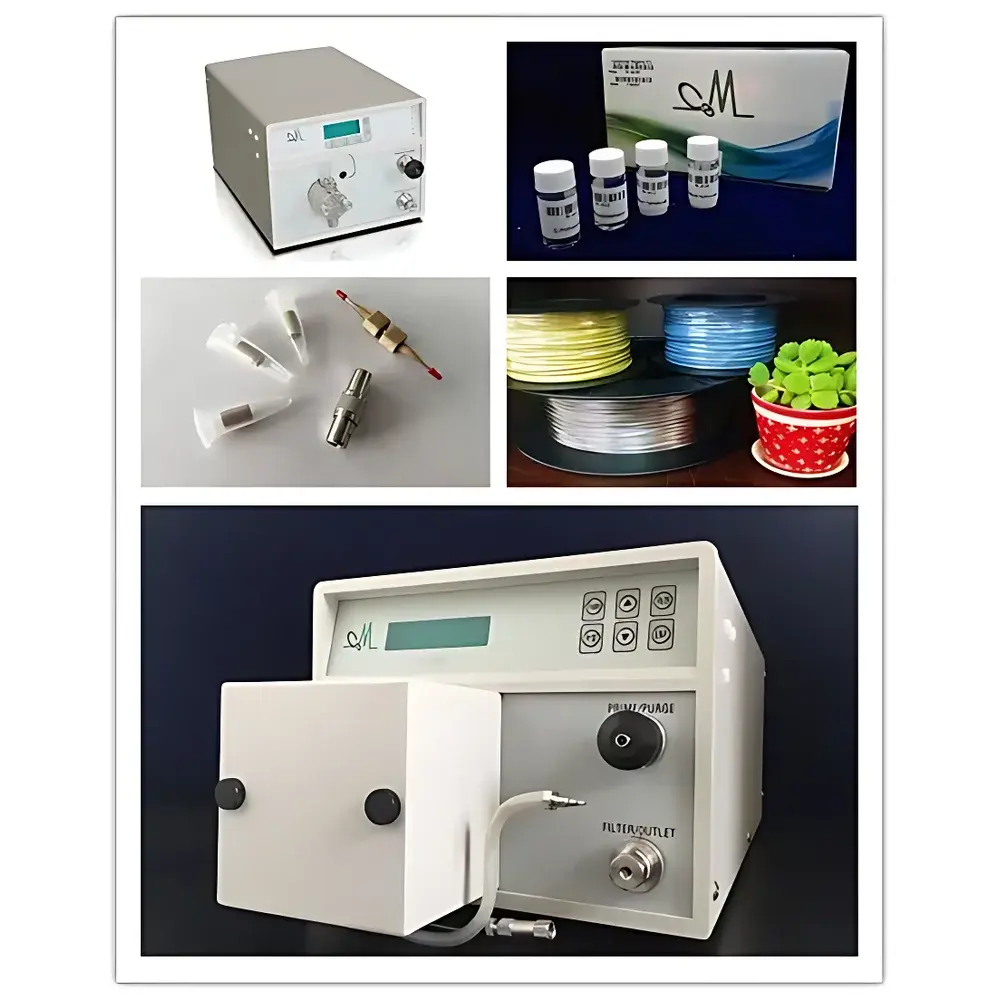
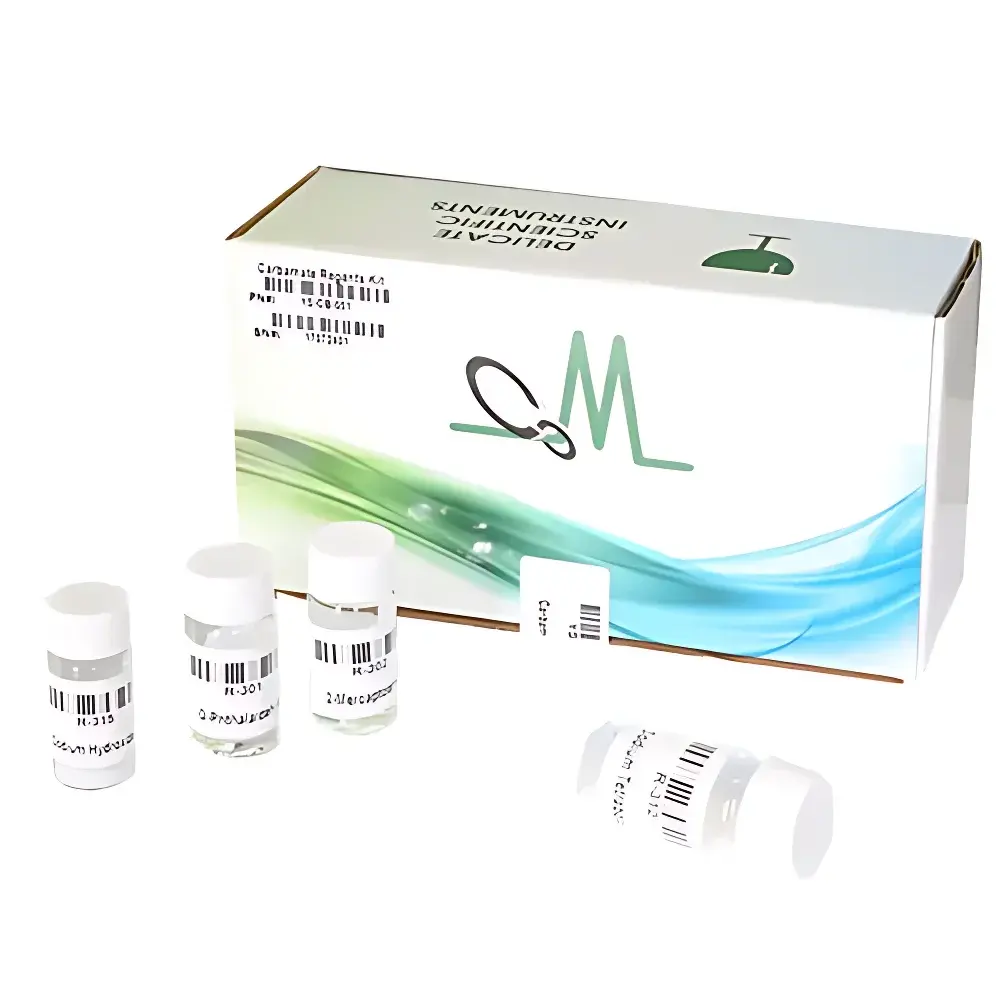
CoMetro YS-CB-001 OPA Post-Column Derivatization Kit for Carbamate Pesticide Residue Analysis
| Brand | CoMetro |
|---|---|
| Model | YS-CB-001 |
| Instrument Type | HPLC Post-Column Derivatization System |
| Application | Carbamate pesticide residue analysis |
| Derivatization Reagent Capacity | 1000 mL prepared solution |
| Reagent Components | R312 (OPA diluent powder), R315 (hydrolysis solid reagent), R301 (OPA stock solution), R302 (2-mercaptoethanol) |
| Compatible Column | Comatex C18-CB, 5 µm, 250 × 4.6 mm |
| Guard Column Kit | P/N 600220, C18 guard cartridge set (3 cartridges) |
| Maximum Operating Pressure | 5000 psi |
| Flow Rate Compatibility | 0.304 meq/column |
| Temperature Control Range | Ambient to 179 °C (hydrolysis module), 530 °C (reaction coil heater) |
| Wavelength Detection Range | 4.1 mm optical path length cell |
| Data Acquisition Frequency | 100 Å spectral resolution (UV-Vis detection compatible) |
Overview
The CoMetro YS-CB-001 OPA Post-Column Derivatization Kit is a purpose-engineered reagent and hardware integration system designed for the sensitive and selective quantification of carbamate pesticides in environmental, food, and agricultural samples via high-performance liquid chromatography (HPLC) with post-column derivatization. This kit implements ortho-phthalaldehyde (OPA)–thiol chemistry, wherein primary amine groups—liberated from carbamates during on-line alkaline hydrolysis—are rapidly condensed with OPA in the presence of 2-mercaptoethanol to form highly fluorescent isoindole derivatives. The reaction occurs under precisely controlled thermal and flow conditions within a dedicated post-column reactor, enabling detection at excitation/emission wavelengths of 330/455 nm. Engineered for compatibility with standard HPLC platforms, the YS-CB-001 supports trace-level analysis down to sub-ppb concentrations when coupled with fluorescence detection, meeting method requirements outlined in AOAC Official Method 992.11 and EPA Method 531.1.
Key Features
- Complete derivatization chemistry set: Includes all four critical reagents—R312 (OPA diluent powder), R315 (solid-phase hydrolysis reagent), R301 (pre-weighed OPA stock), and R302 (2-mercaptoethanol)—optimized for stoichiometric consistency and shelf-stable storage.
- Thermally stabilized reaction manifold: Integrated dual-zone heating modules maintain independent temperature control—179 °C for alkaline hydrolysis and 530 °C for rapid derivatization—ensuring complete cleavage and quantitative fluorophore formation.
- High-pressure compatible design: Rated for continuous operation up to 5000 psi, enabling seamless integration with UHPLC systems without flow restriction or backpressure instability.
- Precision flow management: Designed for nominal flow rates corresponding to 0.304 meq/column, ensuring consistent reagent stoichiometry and minimizing carryover between injections.
- Optimized optical interface: 4.1 mm path-length flow cell delivers high signal-to-noise ratio for fluorescence detection; compatible with standard HPLC fluorescence detectors calibrated to 100 Å spectral resolution.
Sample Compatibility & Compliance
The YS-CB-001 kit is validated for use with carbamate analytes including carbaryl, carbofuran, methomyl, aldicarb, and propoxur in complex matrices such as fruit extracts, soil leachates, and drinking water. Sample preparation follows QuEChERS-based extraction and dispersive SPE cleanup per EN 15662:2018. All reagents are supplied with CoMetro Certificate of Analysis (CoA), confirming purity ≥99.5% (HPLC-grade) and absence of interfering fluorescent impurities. The system supports GLP-compliant workflows: derivatization parameters (temperature, flow rate, reagent age) are logged in instrument audit trails, and column lot traceability (Comatex C18-CB, P/N C42545; guard column P/N 600220) aligns with FDA 21 CFR Part 11 data integrity expectations.
Software & Data Management
While the YS-CB-001 is a hardware/reagent kit—not a standalone instrument—it interfaces directly with vendor HPLC data systems (e.g., Waters Empower, Thermo Chromeleon, Agilent OpenLab). Method templates include predefined derivatization sequence steps: pre-hydrolysis equilibration, post-hydrolysis reagent mixing delay, and fluorescence acquisition windows synchronized to peak elution. All parameters—including pump flow profiles, reactor zone temperatures, and detector gain settings—are stored as version-controlled methods. Raw fluorescence chromatograms support peak integration using ISO 11843-2–compliant signal thresholding and baseline correction algorithms.
Applications
- Regulatory monitoring of carbamate residues in fruits, vegetables, and cereals per EU MRL regulations (EC No. 396/2005).
- Environmental fate studies assessing carbamate degradation products in surface and groundwater.
- Method development laboratories validating multi-residue LC-FLD protocols for pesticide screening programs.
- Reference material certification labs performing value assignment of carbamate CRM batches (e.g., NIST SRM 3149).
- Contract testing facilities requiring AOAC- or SANTE/11312/2021–aligned analytical workflows.
FAQ
What is the shelf life of the prepared OPA derivatization solution?
When prepared under nitrogen and refrigerated (2–8 °C), the final derivatization reagent remains stable for up to 48 hours. R312 and R315 solids retain full activity for 24 months when stored desiccated at room temperature.
Can the YS-CB-001 be used with reversed-phase C8 columns?
No. The kit is validated exclusively with Comatex C18-CB (5 µm, 250 × 4.6 mm), a sterically hindered C18 phase optimized for carbamate retention and hydrolysis compatibility. Substitution with generic C8 columns compromises resolution and hydrolysis efficiency.
Is the guard column included in the kit reusable?
Yes—the P/N 600220 guard cartridge set includes three replaceable C18 guard column cores. Each core supports ≥200 injections under typical food matrix loads before replacement is recommended.
Does this kit comply with USP chromatographic system suitability criteria?
When operated per CoMetro’s validated method SOP, the system meets USP requirements for tailing factor (≤2.0), resolution (≥2.0 for carbaryl/carbofuran), and %RSD of peak area (≤5.0% for six replicate injections).
How is reagent blank interference minimized?
R301 and R312 undergo triple recrystallization and UV-transparent solvent purification to eliminate native fluorescence. Blank response is routinely verified to be <0.5% of the LOQ signal across 200–500 nm.





