
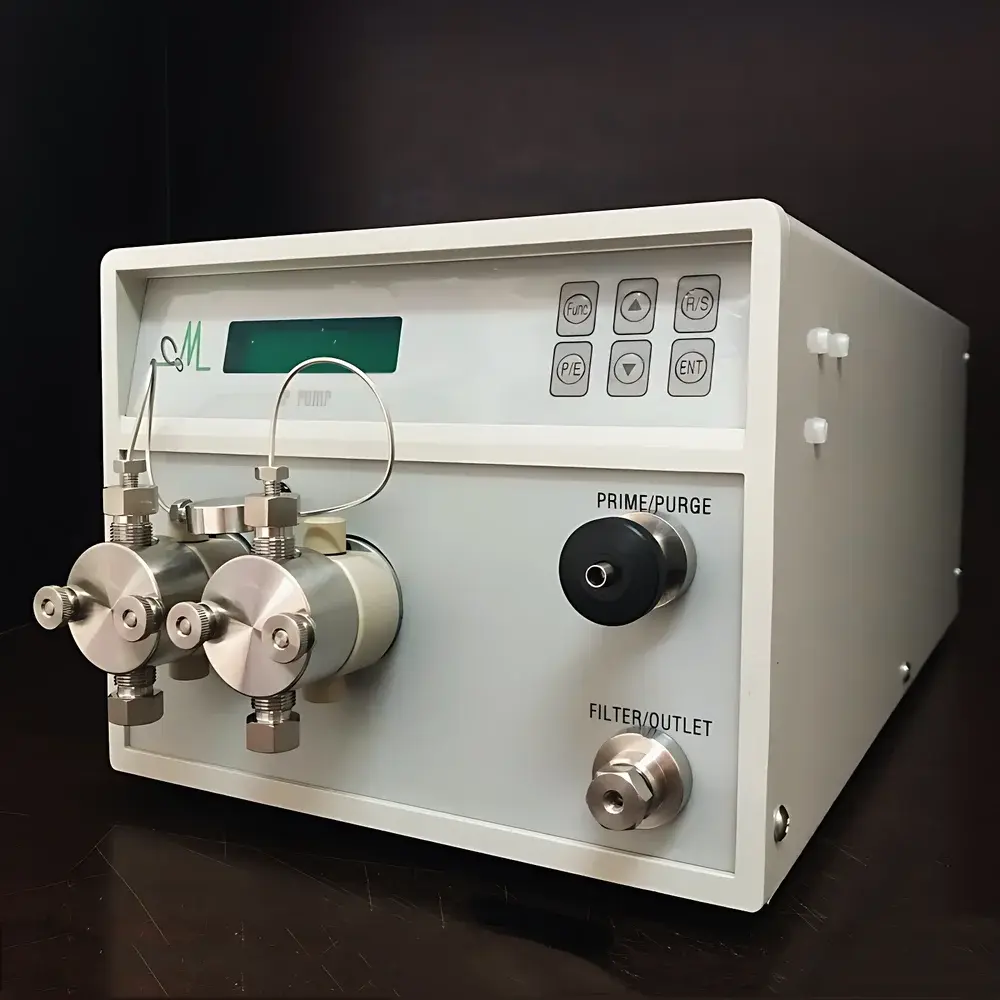
CoMetro CP-LDI High-Pressure Constant Flow Pump for Hydrogenation Catalyst Evaluation Systems
| Brand | CoMetro |
|---|---|
| Model | CP-LDI |
| Flow Rate | 10 mL/min (standard configuration) |
| Maximum Pressure | 600 psi |
| Pump Head Configuration | Parallel Dual Plunger Heads |
| Flow Accuracy | ±1% |
| Flow Precision | ≤0.1% RSD |
| Pressure Units | PSI, MPa, bar (user-selectable) |
| Control Modes | Front-panel keypad, RS-232/USB PC interface, analog input (0–5 V / 4–20 mA) |
| Compressibility Compensation | Adjustable |
| Auto-purge & Solvent Flush Function | Supported |
| Self-cleaning Mode for Salt-Containing Buffers | Available |
Overview
The CoMetro CP-LDI High-Pressure Constant Flow Pump is an engineered solution for precise, stable, and reproducible liquid delivery in catalytic reaction evaluation—particularly in fixed-bed or trickle-bed hydrogenation catalyst testing systems operating under elevated pressure and temperature conditions. Designed around a dual-plunger, parallel-flow architecture, the CP-LDI employs a closed-loop electronic control system integrating brushless DC motor drive, real-time pressure transduction, and adaptive compressibility compensation to maintain volumetric flow integrity across variable backpressures up to 600 psi (41.4 bar). Its robust mechanical design—including suspended pump head assembly, sapphire-hardened check valves, and chemically resistant fluidic pathways—ensures long-term stability in continuous operation with organic solvents, aqueous buffers, and corrosive reagent mixtures common in hydrotreating, hydrodesulfurization (HDS), and hydrogenolysis studies.
Key Features
- Dual parallel plunger heads enabling true constant-flow delivery with minimized pulsation (<±0.1% RSD) and high-pressure resilience (rated to 600 psi, with optional configurations up to 6000 psi)
- Intelligent electronic control core featuring real-time pressure monitoring, programmable high/low pressure limits, and dynamic compressibility correction for accurate flow under compressible mobile phases
- User-configurable pressure units (PSI, MPa, bar) and flexible control interfaces: local keypad, PC-based software via RS-232/USB, or external analog signal (0–5 V / 4–20 mA)
- Integrated solvent purge and automated column wash routines—especially critical when using phosphate or ammonium-based buffers to prevent crystallization and seal degradation
- Modular scalability: multiple CP-LDI units (2–4) can be synchronized for binary or quaternary gradient elution in multi-feed catalytic screening or kinetic mapping experiments
- High-brightness LED display with remote-readable contrast, supporting simultaneous monitoring of flow rate (0.001–12 mL/min standard range), actual system pressure, and operational status flags
Sample Compatibility & Compliance
The CP-LDI is compatible with a broad spectrum of process liquids used in heterogeneous catalysis evaluation—including aliphatic/aromatic hydrocarbons, alcohols, water–organic mixtures, and low-concentration acidic or basic aqueous solutions. All wetted parts are constructed from 316 stainless steel, sapphire, and PEEK, ensuring resistance to chloride-induced stress corrosion cracking and compatibility with ASTM D6300-compliant fuel simulants. The pump meets general laboratory safety standards per IEC 61010-1 and supports GLP-compliant operation through audit-trail-enabled software logging (when paired with CoMetro’s optional ChromaControl Suite). While not intrinsically rated for Class I Div 1 hazardous areas, it is routinely deployed in ventilated fume hoods or gas-tight reactor enclosures compliant with NFPA 55 and OSHA 1910.119 process safety management requirements.
Software & Data Management
When operated via PC interface, the CP-LDI integrates with CoMetro’s ChromaControl Suite—a validated, Windows-based platform supporting method storage, time-programmed flow/pressure profiles, event-triggered data capture, and CSV-exportable logs with timestamps traceable to system clock (NIST-synchronized). The software complies with FDA 21 CFR Part 11 requirements for electronic records and signatures when configured with user-role permissions, audit trail activation, and digital signature enforcement. Raw pressure and flow telemetry are sampled at ≥10 Hz and buffered onboard during communication latency, ensuring no loss of transient response data during catalyst breakthrough or pressure surge events.
Applications
- Fixed-bed hydrogenation catalyst activity and deactivation profiling under industrially relevant LHSV (liquid hourly space velocity) and H2:feed ratios
- Trickle-bed reactor hydroprocessing studies requiring precise co-feeding of liquid feedstock and high-purity H2 carrier streams
- In situ FTIR or online GC-MS coupling where pulse-free, low-drift flow is essential for quantitative analyte transport
- Kinetic parameter estimation (e.g., TOF, apparent activation energy) via controlled step-change experiments in flow-through reactors
- Multi-variable screening of bimetallic or support-modified catalysts using programmable gradient feed composition
- Long-duration stability tests (>500 h) with automated buffer flush cycles to mitigate salt fouling in Ni/Mo–Al2O3 or CoMo/zeolite systems
FAQ
What is the maximum recommended operating pressure for the standard CP-LDI configuration?
The standard CP-LDI unit is rated for continuous operation up to 600 psi (41.4 bar); higher-pressure variants (1500 psi, 3000 psi, and 6000 psi) are available with modified plunger seals and reinforced housing.
Can the CP-LDI be used with aggressive solvents such as concentrated HCl or HF-containing media?
No—wetted materials are not resistant to hydrofluoric acid or hot concentrated mineral acids. For such applications, Hastelloy C-276 or titanium pump heads must be specified separately.
Does the pump support automatic calibration verification per ISO 8981 or USP <621>?
While the CP-LDI itself does not perform gravimetric calibration, its flow accuracy (±1%) and precision (≤0.1% RSD) meet the performance thresholds required for method validation under USP <621> and ISO 8981 Annex B when verified externally using certified flow meters.
Is remote start/stop and fault reporting possible via PLC integration?
Yes—the analog I/O port supports 4–20 mA pressure feedback and discrete TTL-level signals for run/stop/alarms, enabling seamless integration into Siemens S7, Allen-Bradley CompactLogix, or Beckhoff CX-series control systems.
How often should the pump seals be replaced during continuous catalyst testing?
Under typical hydrotreating conditions (e.g., 300°C, 50 bar, diesel-range feed), sapphire/PEEK check valves and fluoropolymer-coated plungers demonstrate >6 months service life; replacement intervals are logged automatically in ChromaControl Suite based on cumulative stroke count and pressure history.



