
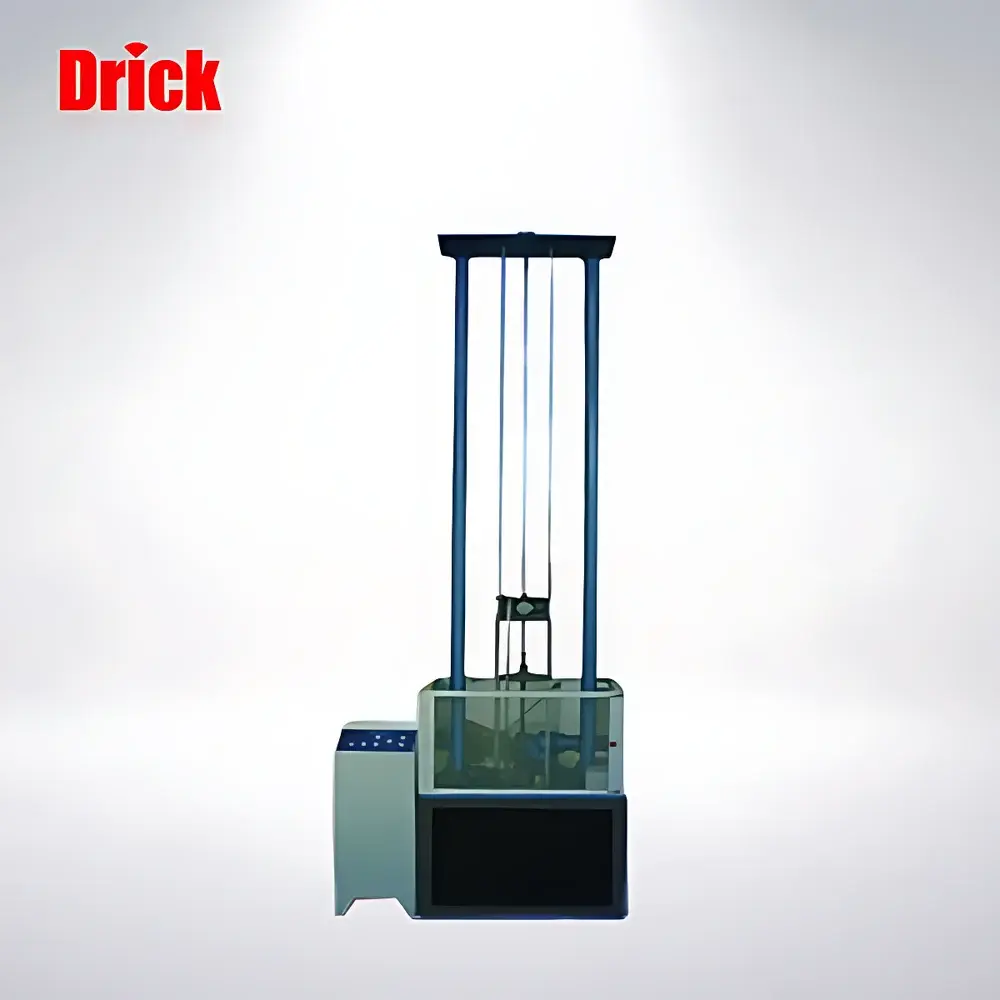
Drick LC-300B Plastic Pipe Drop Weight Impact Tester
| Brand | Drick |
|---|---|
| Origin | Shandong, China |
| Manufacturer Type | Direct Manufacturer |
| Product Origin | Domestic (China) |
| Model | DRK-LC-300B |
| Instrument Category | Non-Metallic Impact Testing Machine |
| Hammer Mass Range | 0.25–16.0 kg |
| Hammer Tip Radii | R5, R10, R25, R30, R50 mm (customizable) |
| Specimen Support Travel | 0–400 mm |
| Specimen Diameter Capacity | 10–600 mm |
| Maximum Drop Height | 2000 mm |
| Impact Center Alignment Tolerance | ≤2 mm |
| Anvil Configuration | 120° V-type, supported, or flat fixture anvil |
| Power Supply | AC 220 V, 50 Hz |
| Dimensions (W×D×H) | 750 × 550 × 3500 mm |
| Net Weight | 280 kg |
Overview
The Drick LC-300B Plastic Pipe Drop Weight Impact Tester is a precision-engineered mechanical impact testing system designed for evaluating the dynamic impact resistance of thermoplastic and thermoset piping systems, rigid sheets, profiles, and brittle non-metallic materials such as glass and ceramics. It operates on the fundamental principle of gravitational energy conversion: a calibrated hammer mass is elevated to a defined height and released under free-fall conditions to strike a standardized specimen clamped in a fixed anvil configuration. The resulting fracture behavior—whether pass/fail at specified energy levels or quantified via threshold energy determination—is assessed in accordance with internationally recognized static and dynamic impact test methodologies. This instrument is not a pendulum-based or instrumented Charpy system; rather, it implements a controlled drop-weight methodology optimized for large-diameter tubular geometries and heterogeneous cross-sections where localized stress concentration and crack propagation kinetics are critical performance indicators.
Key Features
- High-reliability electromagnetic braking system prevents secondary impact events, ensuring single-event energy delivery and eliminating rebound-induced measurement artifacts.
- Calibrated vertical guidance column with precision linear bearing assembly guarantees consistent hammer trajectory and minimizes lateral deviation (<2 mm offset between impact center and fixture center).
- Modular anvil system supports interchangeable configurations: 120° V-type cradles for round pipes, flat support plates for flat specimens, and custom-supported fixtures for irregular profiles—each compliant with ISO 179-1, ASTM D746, and GB/T 14152 requirements.
- Digital height scale with vernier-assisted readout enables repeatable, traceable drop-height setting from 0 to 2000 mm in 1-mm increments, directly correlating to impact energy (E = m·g·h).
- Hammer mass selection covers 0.25 kg to 16.0 kg in discrete increments, with interchangeable hammer heads featuring standardized radii (R5, R10, R25, R30, R50 mm) per ISO 6603-2 and GB/T 1043.1 specifications.
- Structural frame fabricated from high-tensile steel with vibration-damping base mount ensures operational stability during high-energy impact cycles and long-term dimensional integrity.
Sample Compatibility & Compliance
The LC-300B accommodates specimens ranging from small-diameter tubing (10 mm OD) to large structural conduits (600 mm OD), including PVC-U, PE, PP-R, ABS, CPVC, and fiber-reinforced composites. Its adjustable support travel (0–400 mm) permits axial positioning of weld seams, extrusion lines, or marked test zones within the impact zone. The system fully complies with Chinese national standards GB/T 14152 (Toughness test for thermoplastic pipes), GB/T 14153 (Impact resistance of plastic pipe fittings), GB/T 10002.1/10002.3 (PVC pressure pipes), GB/T 13664 (Irrigation pipes), GB/T 5836.1 (PVC drainage pipes), GB/T 18477 (Corrugated pipes), GB/T 16800 (Double-wall corrugated pipes), and GB/T 8814 (UPVC window profiles). It also satisfies essential technical clauses of ISO 3127 (Plastic pipes — Determination of resistance to external blows), ASTM D2444 (Impact resistance of thermoplastic pipe), and EN ISO 179-1 (Plastics — Determination of Charpy impact properties), supporting audit-ready documentation for GLP-compliant laboratories.
Software & Data Management
While the LC-300B is primarily a manually operated, mechanically verified impact tester, optional digital upgrade kits provide RS-232 or USB connectivity for integration with laboratory information management systems (LIMS). These modules log timestamped test records—including hammer mass, drop height, specimen ID, anvil type, pass/fail outcome, and operator credentials—enabling full traceability in accordance with FDA 21 CFR Part 11 requirements when paired with validated electronic signature protocols. All calibration certificates, maintenance logs, and verification reports adhere to ISO/IEC 17025:2017 documentation frameworks, facilitating internal QA audits and third-party accreditation assessments.
Applications
- Quality control of extruded plastic pipe batches prior to hydrostatic pressure certification.
- Evaluation of low-temperature impact brittleness in municipal water supply systems (e.g., PE100 pipes at −20 °C).
- Comparative assessment of notch sensitivity across polymer grades and recycled content formulations.
- Validation of fusion joint integrity in HDPE butt-welded pipeline segments per ASTM F2620.
- R&D screening of novel polymer blends intended for underground conduit applications subject to backfill loading.
- Third-party certification testing for CCC, CE, and WRAS regulatory submissions requiring documented impact energy thresholds.
FAQ
What standards does the LC-300B explicitly support?
It meets all mandatory clauses of GB/T 14152, GB/T 14153, GB/T 10002.1, GB/T 10002.3, GB/T 13664, GB/T 5836.1, GB/T 18477, GB/T 16800, and GB/T 8814, with technical alignment to ISO 3127, ASTM D2444, and EN ISO 179-1.
Can the system be used for testing pipe fittings or only straight pipe sections?
Yes—it supports both straight pipe segments and molded fittings (elbows, tees, couplings) using custom anvil adapters and support fixtures validated per GB/T 14153.
Is calibration traceable to national metrology institutes?
All hammer mass sets are supplied with NIM-traceable calibration certificates (CNAS-accredited), and height scales are verified using Class II optical leveling instruments per JJG 707-2014.
Does the equipment require compressed air or hydraulic power?
No—the LC-300B is purely electromechanical: lifting is motor-driven, braking is electromagnetic, and release is solenoid-actuated. Only AC 220 V / 50 Hz mains power is required.
What maintenance intervals are recommended for long-term reliability?
Lubrication of guide columns every 500 tests, electromagnetic brake coil resistance verification quarterly, and annual full mechanical alignment check using laser collimation tools per manufacturer’s service manual DRK-LC300B-SM-Rev.3.



