
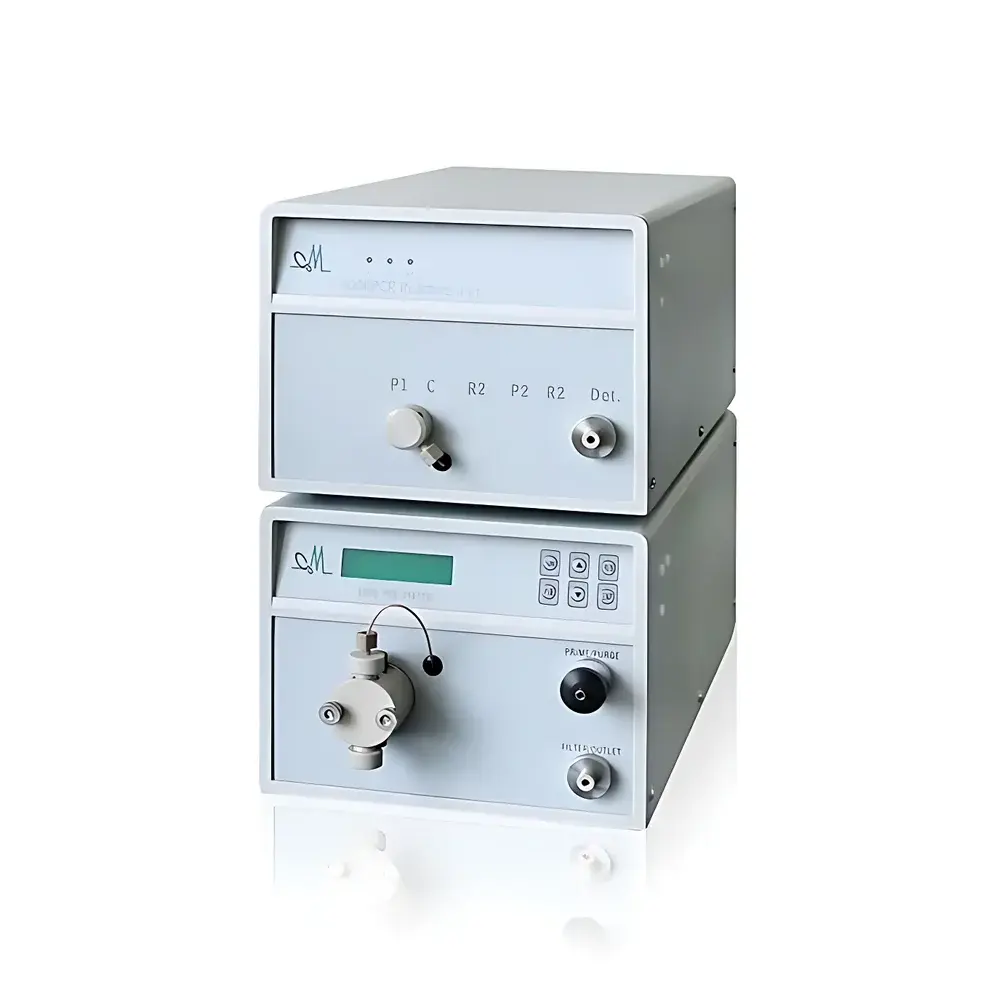
CoMetro COM6000 Post-Column Derivatization System for Free Formaldehyde Detection in Cosmetics
| Brand | CoMetro |
|---|---|
| Origin | Imported |
| Manufacturer Type | Authorized Distributor |
| Model | COM6000 for Free Formaldehyde Analysis |
| Temperature Range | Up to 150 °C |
| Derivatization Reagent Flow Rate | 0.001–10 mL/min (standard operating range: 10 mL/min) |
| Reaction Coil | Full PEEK construction |
| Reaction Volume Options | 0.15 / 0.5 / 1.5 mL |
| Temperature Accuracy | ±1 °C |
| Temperature Reproducibility | ±0.4 °C |
| Pressure Range | 0–4000 psi |
| Flow Accuracy | ±1% |
| Flow Precision | 0.2% RSD |
Overview
The CoMetro COM6000 Post-Column Derivatization System is a precision-engineered, modular platform designed to support sensitive and selective quantification of low-abundance analytes—particularly free formaldehyde—in complex cosmetic matrices via high-performance liquid chromatography (HPLC). It operates on the principle of post-column chemical derivatization: after separation on an HPLC column (e.g., CoMetro Comatex PR1545 C18, 250 × 4.6 mm, 5 µm), target analytes elute into a precisely controlled reaction environment where they undergo rapid, stoichiometric reaction with a derivatizing reagent (e.g., acetylacetone under acidic heating). This converts non-UV-active or weakly detectable formaldehyde into a stable, chromophoric derivative (e.g., 3,5-diacetyl-1,4-dihydrolutidine, DDL), enabling robust UV-Vis detection at 412 nm with enhanced sensitivity (LOD < 0.1 ppm) and improved chromatographic resolution. The system complies with the methodology stipulated in China’s National Medical Products Administration (NMPA) Notice No. 12 (2019), which mandates this derivatization-HPLC approach for regulatory compliance testing of free formaldehyde in cosmetics per the Cosmetic Safety Technical Specification (2015 Edition), effective January 1, 2020.
Key Features
- Modular reactor architecture supporting single- or dual-core configurations—enabling sequential heated and ambient-temperature reactions (e.g., hydrolysis followed by derivatization) within one integrated platform.
- Front-panel digital interface with real-time display of setpoint/actual temperature per reaction coil, derivatization pump flow rate, system pressure, and pressure limits—no external software required for basic operation.
- Full-Peek fluidic path from inlet to detector outlet ensures exceptional chemical resistance to aggressive reagents (e.g., strong acids, organic solvents) and eliminates metal-induced catalytic degradation or adsorption of labile analytes such as formaldehyde.
- Rapid reactor exchange: only two fittings required to replace reaction coils; available volumes (0.15 mL, 0.5 mL, 1.5 mL) optimized for kinetic efficiency and minimal band broadening (Δσ < 0.8 s).
- Derivatization pumps feature PEEK-built internal purge valves, stepper-motor-driven precision metering, and automatic online seal-washing cycles—extending seal lifetime >3000 h under continuous 10 mL/min operation.
- Temperature control range: ambient +10 °C to 150 °C (±1 °C accuracy, ±0.4 °C reproducibility); safety cutoff at 160 °C; thermal stabilization at 150 °C achieved within ≤30 min.
- RS232 serial interface enables full remote control and monitoring—including synchronized pump flow ramping, temperature profiling, and event-triggered data logging—compatible with LIMS and 21 CFR Part 11-compliant acquisition systems.
Sample Compatibility & Compliance
The COM6000 supports validated workflows for free formaldehyde quantification across diverse cosmetic formulations (creams, lotions, shampoos, nail polishes) following NMPA Method 1.1.17 (2019). Its design meets critical regulatory expectations for method robustness: consistent derivatization kinetics across matrix loads (0–100% aqueous/organic), negligible carryover (<0.05%), and inter-day RSD < 2.1% (n = 12, 1 ppm standard). The system is routinely deployed in GLP-compliant contract laboratories performing NMPA registration submissions, EU CPNP dossiers, and ASEAN Cosmetic Directive Annex III assessments. All wetted materials comply with USP , ISO 10993-1 (biocompatibility), and FDA extractables/leachables guidance for contact with aqueous biological samples.
Software & Data Management
While fully functional via front-panel controls, the COM6000 integrates seamlessly with third-party chromatography data systems (CDS) including Thermo Chromeleon, Waters Empower, and Agilent OpenLab via ASCII-based RS232 protocol. Audit trails capture all parameter changes (time-stamped, operator-ID tagged), including temperature setpoints, flow rate adjustments, and pressure excursions—supporting ALCOA+ data integrity principles. Pump firmware logs >10,000 events with cyclic redundancy check (CRC) verification. Optional Ethernet-to-RS232 gateway enables integration into enterprise-level instrument management platforms for centralized calibration tracking, preventive maintenance scheduling, and electronic signature workflows aligned with 21 CFR Part 11 Subpart B.
Applications
Beyond formaldehyde in cosmetics, the COM6000 serves as a universal derivatization engine for analytes requiring chemical enhancement prior to detection. Validated applications include: amino acid profiling (o-phthalaldehyde/fluorescamine), carbamate pesticide residues (naphthol derivatization), glyphosate and AMPA (FMOC-Cl), aflatoxins (bromination + post-column photochemical activation), gentamicin and other aminoglycosides (ortho-phthalaldehyde), voglibose (4-dimethylaminobenzaldehyde), and biogenic amines (dansyl chloride). It is widely adopted in food safety labs (EU Regulation 2023/915), environmental monitoring (EPA Method 549.2), clinical toxicology (ACLP-accredited newborn screening), and pharmaceutical QC (ICH Q2(R2)-aligned validation packages).
FAQ
Is the COM6000 compatible with UHPLC systems operating above 1000 bar?
Yes—its full-PEEK flow path and reinforced fittings are rated to 4000 psi (275 bar); for UHPLC integration, a pressure-matched restrictor and low-dead-volume connectors are recommended.
Can the system perform two independent derivatization reactions in series?
Yes—the dual-core module allows physically separated, thermally isolated reaction zones, enabling multi-step chemistries such as enzymatic cleavage followed by amine derivatization.
Does CoMetro provide method transfer support for NMPA formaldehyde testing?
Yes—application notes, system suitability protocols, and IQ/OQ documentation packages are provided; on-site installation qualification and method verification services are available globally.
What maintenance intervals are recommended for derivatization pumps?
Primary seals require replacement every 18 months under continuous operation; pump calibration verification is advised quarterly using gravimetric flow checks traceable to NIST SRM 2822.
Is the reaction coil volume user-adjustable without tools?
No—coil volume selection (0.15/0.5/1.5 mL) is hardware-defined; however, coil swapping requires only two wrench-tightened PEEK unions and takes <90 seconds.
Related Products






