
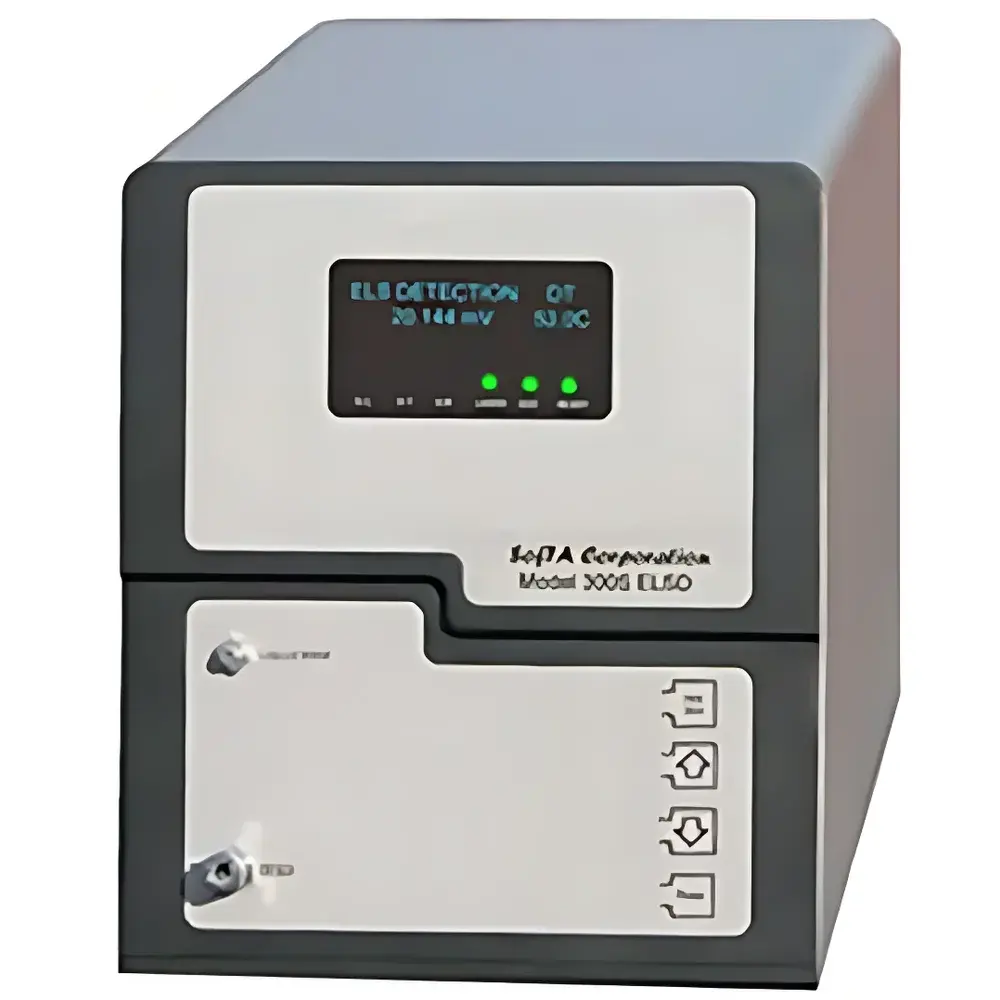
SofTA Model 300s ELSD Evaporative Light Scattering Detector
| Brand | SofTA |
|---|---|
| Origin | Imported |
| Manufacturer Type | Authorized Distributor |
| Model | 300s ELSD |
| Detection Principle | Evaporative Light Scattering Detection (ELSD) |
| Wavelength Range | 200 nm (UV cutoff, not emission wavelength) |
| Optical Configuration | Dual-beam |
| Light Source | Deuterium Lamp (for baseline stability reference), NIR Laser (650 nm, <5 mW) as primary scattering source |
| Nebulizer Material | PTFE (Teflon®) |
| Drift Tube Temperature Range | Ambient to 120 °C |
| Nebulization Zone Temperature Range | 10–70 °C |
| Sensitivity | 100 pg glucopyranoside (micro-HPLC, 2 µL direct injection, peak width at 10% height = 3 s) |
| Dynamic Range | 3 orders of magnitude (standard gain), extendable to 4–4.5 orders with gain optimization |
| Flow Rate Compatibility | Up to 5 mL/min (HPLC & preparative LC) |
| Gas Requirement | N₂ or inert gas, 50 psi supply, ≤2.5 L/min consumption |
| Integrated Pressure Regulation | Yes, with automatic shutoff delay and overpressure protection |
| Signal Output | Fixed 10 mV or 5 V |
| Interface | RS-232 (rear panel), digital status I/O (zero control, valve control, error reporting) |
| Power | 120/240 V AC, 50/60 Hz, 600 W |
| Dimensions | 25 W × 45 D × 29 H cm |
| Weight | 15 kg |
Overview
The SofTA Model 300s ELSD is a high-stability evaporative light scattering detector engineered for universal, non-destructive detection in liquid chromatography systems—including analytical HPLC, UHPLC, and preparative LC. Unlike UV-Vis absorbance detectors, the 300s ELSD operates on the principle of nebulization, solvent evaporation, and light scattering from non-volatile analyte particles—making it inherently mass-sensitive and independent of chromophore presence. Its dual-beam optical architecture, incorporating a deuterium lamp for real-time baseline correction and a Class 1 FCC-compliant 650 nm near-infrared laser for particle scattering, ensures exceptional signal stability across gradient elution and variable mobile-phase compositions. Designed for regulatory-compliant laboratories, the instrument meets mechanical and electrical safety requirements per IEC 61010-1 and supports audit-ready operation when integrated into GLP/GMP workflows.
Key Features
- PTFE-coated nebulizer nozzle: Resistant to clogging, chemical corrosion, and mechanical wear—ideal for high-salt, viscous, or surfactant-laden mobile phases.
- Thermally controlled nebulization zone (10–70 °C): Enables precise aerosol分流 (split ratio modulation) without mechanical valves, delivering consistent response across volatile and non-volatile solvents—including acetonitrile, methanol, THF, and aqueous buffers.
- Cooling-capable drift tube (ambient to 120 °C): Supports low-temperature operation for thermally labile compounds and enhances sensitivity for semi-volatile analytes by minimizing thermal degradation during solvent removal.
- Vacuum fluorescent display (VFD) with intuitive 4-button interface: Provides real-time monitoring of temperature, pressure, filter constant, self-test diagnostics, and alarm status—including audible feedback for critical faults.
- Onboard method storage: Up to 10 user-defined detection protocols—including gain settings, temperature profiles, and filtering parameters—enabling rapid method recall and system reproducibility.
- Fully integrated gas management: Built-in pressure regulator, automatic delayed shut-off valve, and overpressure protection eliminate manual gas-flow tuning and prevent inadvertent cylinder depletion.
Sample Compatibility & Compliance
The 300s ELSD detects any non-volatile or semi-volatile compound that forms stable particles upon mobile-phase evaporation—including carbohydrates, lipids, polymers, saponins, glycosides, and synthetic small molecules lacking UV chromophores. Its PTFE/stainless steel/alumina/glass fluidic path complies with USP extractables testing requirements and resists leaching in aggressive organic-aqueous gradients. The instrument supports FDA 21 CFR Part 11–ready data acquisition when paired with validated third-party chromatography data systems (CDS). All thermal and pneumatic subsystems undergo factory calibration traceable to NIST standards, and operational logs—including temperature ramp history, gas pressure events, and zero-point deviations—are retained in non-volatile memory for audit trail reconstruction.
Software & Data Management
While the 300s ELSD operates as a standalone detector with analog and digital I/O, its RS-232 serial interface enables bidirectional communication with major CDS platforms (e.g., Waters Empower, Thermo Chromeleon, Agilent OpenLab). Instrument status—drift tube temperature, nebulizer zone setpoint, gas pressure, and detector gain—is readable in real time. The zero-control and valve-control lines support automated sequence synchronization (e.g., zeroing before each injection). All parameter changes are timestamped and logged locally; no proprietary software installation is required for basic operation, reducing validation burden in regulated environments. Firmware updates are delivered via ASCII command protocol, ensuring compatibility with locked-down IT infrastructures.
Applications
- Pharmaceutical QC/QA: Quantification of excipients (e.g., lactose, mannitol), polysaccharide APIs, and lipid-based nanocarriers where UV detection fails due to lack of absorbance.
- Natural product analysis: Detection of terpenoids, flavonoid glycosides, and triterpene saponins in herbal extracts without derivatization.
- Polymer characterization: Molecular weight distribution profiling of PEG, PLGA, and dendrimers using SEC–ELSD.
- Food & beverage: Sucrose, fructose, and starch hydrolysate analysis in complex matrices with minimal sample cleanup.
- Preparative LC fraction tracking: Real-time detection of target fractions independent of UV response—critical for isolating novel metabolites from bioassay-guided fractionation.
FAQ
Does the 300s ELSD require column heating or post-column derivatization?
No. It is a label-free, post-column detection technique requiring only nebulization, evaporation, and light scattering—no chemical modification or thermal activation of analytes is needed.
Can it be used with gradient elution containing high water content?
Yes. The thermally regulated nebulization zone and optimized drift tube temperature profile ensure stable aerosol formation and efficient solvent removal—even under steep gradients from 95% water to 100% organic solvent.
Is nitrogen the only acceptable carrier gas?
No. While nitrogen is most commonly used, argon or other inert gases meeting purity Grade 5 (99.999%) may be substituted without performance loss.
How is sensitivity affected by flow rate?
At flow rates up to 5 mL/min, sensitivity remains stable due to the robust PTFE nebulizer design and active aerosol splitting; micro-HPLC sensitivity (100 pg) is achieved at ≤100 µL/min, while preparative-scale detection maintains linearity across full-range flow conditions.
Does the instrument support remote monitoring or integration into LIMS?
Yes—via RS-232 serial output and discrete digital I/O signals (status, error, zero trigger), enabling integration with laboratory automation systems and LIMS middleware through standard Modbus RTU or custom ASCII parsing protocols.






